
Multi-System Access
Dual-Frequency Key Fobs
One Credential, LF + HF

Quick answer
A dual-frequency key fob packs a 125 kHz LF transponder and a 13.56 MHz HF chip into one 40 × 32 × 6 mm ABS housing. Antenna isolation is verified per unit at < 1 dB cross-coupling. LF options span EM4100, T5577 and HID Prox emulation; HF spans MIFARE Classic, DESFire EV3 and NTAG. One fob carries users through a 12-24 month LF-to-HF migration in a single issuance event.
- One fob, two independent antenna systems — 125 kHz LF (ISO/IEC 18000-2) and 13.56 MHz HF (ISO/IEC 14443-3/-4) — electromagnetically isolated to < 1 dB cross-coupling, verified per unit at production acceptance.
- Compact 40 × 32 × 6 mm ABS housing (ultrasonic-welded, IP65 per IEC 60529), only ~1 mm thicker than a single-frequency fob — dual antennas fit without any user-noticeable size penalty.
- Migration-bridge credential: users carry the same fob through a 12-24 month LF-to-HF reader rollout with zero second-issuance event and zero mid-migration access interruption.
Used in these industries
Deployments where this product is referenced on our industry landing pages.
At a glance
Use these short answers to decide whether this page matches the project before moving into the detail.
LF chip (125 kHz)
EM4100 (read-only 64-bit factory ID) T5577 (rewritable, multi-format — EM / HID Prox / Indala / AWID / Kantech)
HF chip (13.56 MHz)
MIFARE Classic 1K / 4K (legacy pairing only — CRYPTO-1 documented) MIFARE DESFire EV3 (AES-128, NIST FIPS 197) — recommended HF-side default
Next step
Ready to move forward? Start your inquiry to get specific answers for this project.
Request dual-frequency fob quote- Typical pricing
-
USD 0.80–2.00 /pc @ 5k+ (typical FOB Shenzhen range) — firm quote in one business day.
Commercial terms
- MOQ
- Varies by SKU — stock items from 100 pcs; custom production typically 200-1,000 pcs
- Lead time
- Production 2-3 weeks after artwork and encoding sign-off; reorders on a 3-4 week cycle
- Samples
- Free samples and RF test report with every order; courier at customer cost
- Payment
- 50% T/T deposit, 50% before shipment; Net 30/60 for established accounts; LC for large orders
- Shipping
- FOB Shenzhen / Yantian; DHL, FedEx or EMS air freight; sea LCL / FCL for volume
- Response
- Itemized quote within one business day, Mon-Fri (UTC+8)
One credential, two frequencies
One fob, two frequencies — and no re-badging the building. A 125 kHz LF transponder and a 13.56 MHz HF chip share a single 40 × 32 × 6 mm ABS housing, so one credential carries a site from its Wiegand past into its OSDP future and staff get issued once instead of twice.
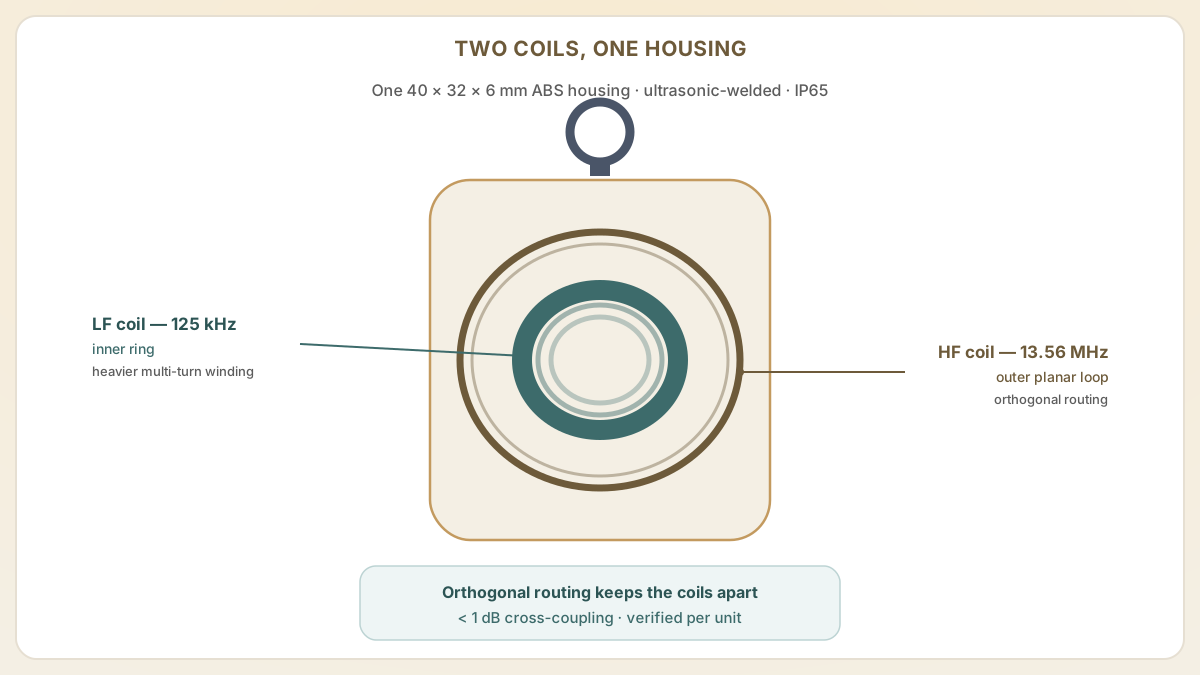
- Two independent antenna systems, electromagnetically isolated to < 1 dB cross-coupling and verified per unit at production acceptance.
- LF options span EM4100, T5577 and HID Prox emulation; HF spans MIFARE Classic, DESFire EV3 and NTAG.
- A single issuance event spans the full 12-24 month LF-to-HF migration — no second re-badging and no mid-migration access interruption.
Dual-frequency keyfob at a glance
Why the two chips don't fight
Two orders of magnitude apart in frequency, the two chips never notice each other. A planar HF coil forms the outer loop and a heavier-wound LF coil sits on the inner ring, routed orthogonally, so the two antennas are electromagnetically isolated with no mutual interference — the LF reader energises only the LF coil, the HF reader only the HF coil. Cross-coupling sensitivity degradation stays under < 1 dB, verified per unit on a both-frequency test rig.
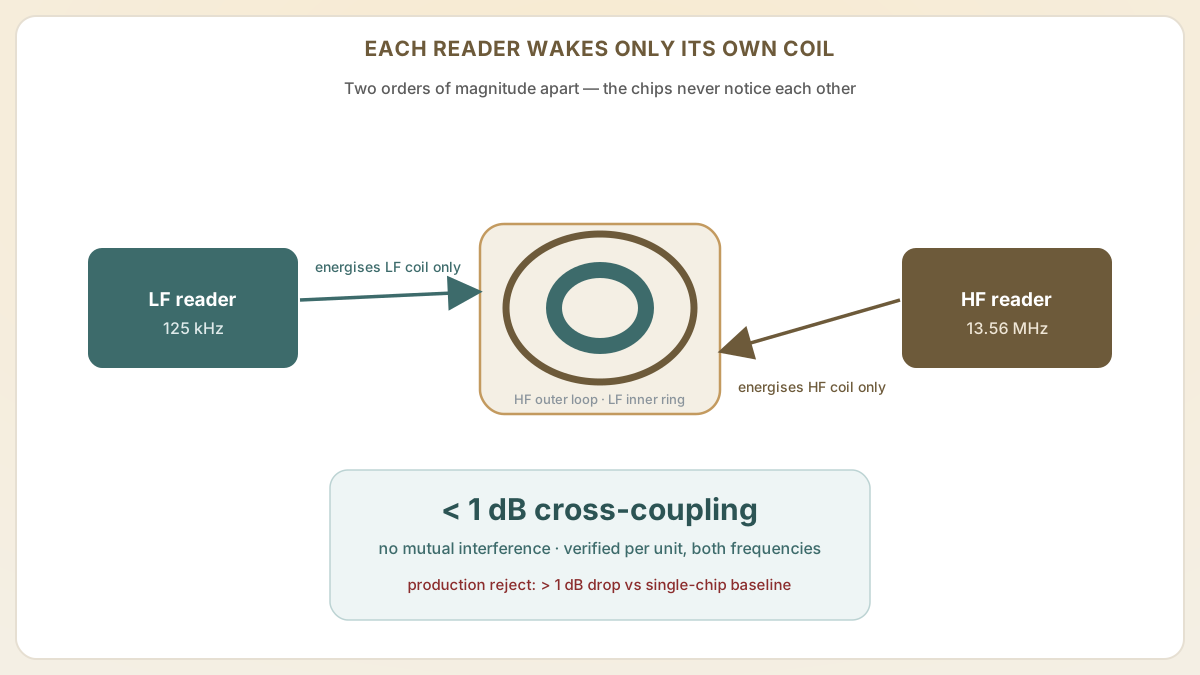
- LF coil: heavier multi-turn copper winding on the inner ring for the ISO/IEC 18000-2 inductive envelope.
- HF coil: planar coil forming the outer loop for the ISO/IEC 14443-3 / NFC Forum Type 2-4 envelope; orthogonal routing avoids mutual-inductance crosstalk.
- When presented to a 125 kHz reader, only the LF chip energises and responds. When presented to a 13.56 MHz reader, only the HF chip energises and responds.
- Production acceptance rejects any unit where cross-coupling affects sensitivity by more than 1 dB against a single-chip baseline — per-unit test, both frequencies.
Spans both reader eras
The credential outlives the wiring debate. A dual-frequency fob answers to whatever the panel behind the reader speaks — the incumbent Wiegand fleet today, the modernised OSDP link tomorrow — so the reader-to-panel retrofit can proceed on its own schedule, independent of the credential already in the user's pocket.
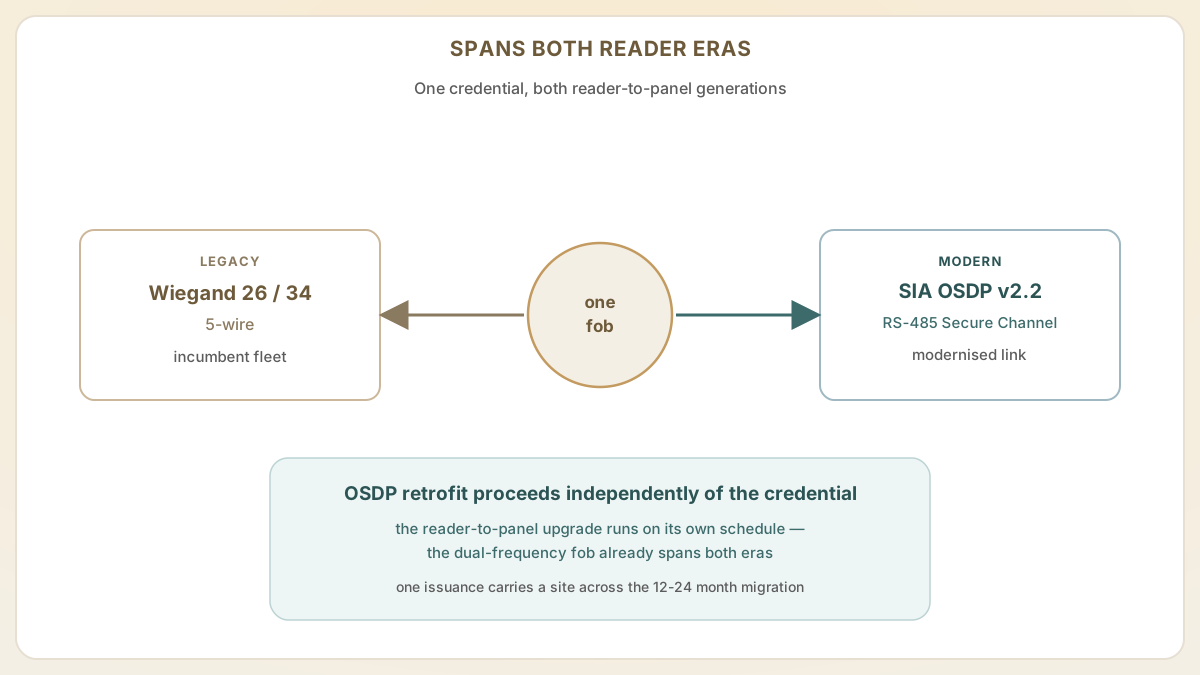
- Wiegand 26 / 34 legacy 5-wire (incumbent fleet)
- SIA OSDP v2.2 RS-485 Secure Channel Protocol (modernised reader-to-panel link)
- OSDP retrofit proceeds independently of the credential — dual-frequency fob spans both eras
Single-frequency vs dual-frequency — the migration question
The decision hinges on whether the site will carry two reader generations in parallel for an extended period. If the fleet is LF-only or HF-only on day one and will remain so for the life of the fob, single-frequency is cheaper. If the fleet will be mixed for 12+ months, dual-frequency pays back before the migration closes because it removes the second re-issuance event.
Two single-frequency fobs (one LF + one HF)
- Two separate credentials per user — doubled badge-management overhead
- Help-desk tickets every time a user forgets which fob opens which door
- Two procurement SKUs, two inventory lines, two reissuance workflows
- Mid-migration re-issuance event: LF fobs replaced / supplemented with HF fobs — 40+ staff-hours for a 500-employee site
- UID correlation between a user's LF fob and HF fob maintained manually in ACS
- Lost-fob replacement requires issuing BOTH a new LF fob and a new HF fob
One dual-frequency fob
- Single credential per user — the LF and HF chips live in the same housing, on the same keyring
- Zero 'which fob' confusion at the reader — user taps once, the right chip responds
- One SKU, one inventory line, one reissuance workflow — procurement collapses 2 → 1
- No mid-migration re-issuance event — the same fob spans the entire 12-24 month rollout
- Signed LF↔HF UID correlation CSV ships with every order — ACS auto-links both IDs to one user
- Lost-fob replacement is a single-fob replacement — operational simplicity at the service desk
Quantified case for dual-frequency during migration windows
Dual-frequency migration timeline — standard 12-24 month enterprise pattern
The single-re-issuance-event enterprise migration runs through three operational phases. Proud Tek's chip-pair preset (T5577 LF + DESFire EV3 HF) covers the full envelope; faster or slower rollouts simply scale the phase-2 duration.
- Month 0 · Single re-issuance event — dual-frequency fob distribution
All staff / tenants receive a dual-frequency fob in one issuance event. Both chips are pre-encoded (LF with existing facility code + card number, HF with new AES-128 application keys per NXP AN10922 diversification). Access continues uninterrupted because the LF half still opens every reader; the HF half is dormant until HF readers go live.
- Month 1-3 · Pilot building HF reader install + OSDP v2.2 reader-to-panel retrofit
One building or one floor receives new HF readers. Reader-to-panel wiring is simultaneously upgraded from legacy Wiegand 5-wire to SIA OSDP v2.2 RS-485 Secure Channel. Dual-frequency fobs authenticate via HF AES-128 against the new readers while the rest of the campus continues on LF — no credential change.
- Month 3-18 · Rolling HF reader rollout building by building
HF readers are deployed one building or one zone at a time. Because every user already carries a dual-frequency fob, the rollout never blocks on credential availability — the integrator schedules purely around electrician / network capacity. This is the bulk of the migration window and has zero user-facing disruption.
- Month 18-24 · HF coverage reaches 100 % — LF readers retired
The last LF reader comes offline. The LF half of the dual-frequency fob is no longer authoritative — only the HF AES-128 authentication grants access. The LF chip remains physically present in the fob but inactive; no credential reissue is required and the signed UID-correlation file remains the reconciliation record in the ACS.
- Month 24+ · Steady-state HF-only operation
Programme experience across system-migration, multi-building-campus, parking-plus-office, mixed-tenant-portfolio and LF-to-HF-bridge dual-frequency-keyfob contributes the audit, refresh and onboarding patterns that inform this solution's operating playbook. the site operates on HF AES-128 only, the dual-frequency fobs in circulation act as single-frequency HF fobs for the remainder of their service life, and the next natural re-issuance happens organically at fob end-of-life (5-10 years) rather than as a migration event.
The reference facts, at a glance
Everything a procurement or integration reviewer cross-checks against the datasheet — air-interface standards, housing, chip pairings, correlation evidence, migration posture, QA and logistics — kept in one scannable block.
Air-interface standards
ISO/IEC 18000-2:2009 Type A — LF 125-134.2 kHz; ISO/IEC 14443-3:2018 + ISO/IEC 14443-4:2018 — HF 13.56 MHz Type A; ISO/IEC 15693:2018 — HF alternative for Vicinity-class readers (optional HF variant).
Housing
40 × 32 × 6 mm ABS, ultrasonic-welded (no adhesive seam); IP65 per IEC 60529 — dust-tight + low-pressure water jet; Black / blue / red / green standard or custom pantone; metal split ring or lobster clasp.
Chip-pair presets
EM4100 + MIFARE Classic 1K (budget LF→HF upgrade); T5577 + MIFARE DESFire EV3 (flexible LF + AES-128 HF — recommended); HID Prox + HID iCLASS (HID-ecosystem migration within a single brand).
UID correlation evidence
Every order ships with a signed CSV mapping LF UID ↔ HF UID per physical fob; Customer access-control system links both IDs to one employee / tenant record; No manual reconciliation required during issuance or re-enrollment.
Migration posture
Single re-issuance event replaces two — staff receive dual-frequency fob once, keep it through rollout; LF half continues to serve legacy Wiegand panels until HF reader coverage reaches 100 %; HF half authenticates with AES-128 per NXP AN10922 diversification once the HF reader is live.
Quality assurance
Per-unit dual-frequency test — LF and HF read on different antennas before packaging; Coupling-degradation reject threshold: > 1 dB drop vs single-chip baseline; Signed production-lot evidence pack retained for access-control-audit closure.
Logistics
MOQ 500 pcs / 12-18 business days lead time; Pre-encoded on both chips with customer facility code + HF application keys; UID correlation CSV + per-lot QA certificate shipped with every order.
Useful next pages
Use these linked product, guide and comparison pages to keep the next click specific and practical.
Related credentials & migration paths
Adjacent form factors and the LF/HF decision reference.
FAQ
Is the fob bigger than a standard single-frequency fob?
Only slightly. Our dual-frequency fob is 40×32×6 mm — about 1 mm thicker than a standard single-frequency fob. The size difference is imperceptible on a keychain. The dual antenna design fits within the standard fob form factor through careful coil positioning.
Can you match our existing fobs?
Yes. Send us samples of both your LF and HF fobs (or tell us the reader models) and we produce a single dual-frequency fob that matches both. We provide a UID correlation table linking the LF and HF chip IDs for each fob.
How do I program both chips?
Each chip is programmed independently using its respective frequency reader/writer. We can pre-encode both chips at our factory. Provide your LF credentials (facility code, card number) and HF credentials (sector keys, access data) and we program everything before shipment. A UID mapping file is included with each order.
Does the LF chip interfere with the HF chip during a dual-frequency scan?
No. The two antennas are tuned to very different frequencies (125 kHz and 13.56 MHz — two orders of magnitude apart) and the coil geometries are designed for electromagnetic isolation. Each chip only responds to its own band; a 125 kHz reader energises only the LF coil and a 13.56 MHz reader energises only the HF coil. Proud Tek verifies isolation per unit during production by running both chips against a test reader of each frequency and rejecting any unit where cross-coupling affects sensitivity by more than 1 dB.
What's the typical migration timeline with dual-frequency fobs?
A typical enterprise LF-to-HF migration runs 12-18 months. Phase 1: issue dual-frequency fobs to all users in a single re-issuance event (zero access disruption because both chips work). Phase 2: roll out new HF readers building by building over 6-12 months. Phase 3: firmware-cut-over to disable LF mode on the dual-frequency credential (or simply retire the LF reader fleet) and operate HF-only. Because users carry the same fob throughout, there is no second issuance event and no mid-migration access interruption — this is the pattern Proud Tek's logistics-operator and corporate-campus references ran through.
Sources & references
Primary standards, OEM datasheets and regulatory documents cited by this article. All URLs were verified on the access date shown below.
- ISO/IEC 18000-2:2009 — Parameters for air interface communications below 135 kHz
LF 125 kHz physical-layer standard applicable to the EM4100/T5577 side of the dual-frequency stack.
- ISO/IEC 14443-3:2018 — Identification cards — Contactless integrated circuit cards — Proximity cards — Part 3: Initialization and anticollision
HF 13.56 MHz standard governing the MIFARE Classic / DESFire / NTAG side of the dual-frequency stack.
- ISO/IEC 14443-4:2018 — Identification cards — Contactless integrated circuit cards — Proximity cards — Part 4: Transmission protocol
T=CL block-framing used by MIFARE DESFire and MIFARE Plus on the HF side.
- ISO/IEC 15693:2018 — Identification cards — Contactless integrated circuit cards — Vicinity cards
HF alternative for Vicinity-class readers (HID iCLASS, ICODE) supported as optional HF variant.
- SIA OSDP v2.2 — Open Supervised Device Protocol specification
RS-485 Secure Channel Protocol replacing legacy Wiegand 5-wire in the reader-to-panel migration that runs alongside the credential-side LF→HF bridge.
- NXP MIFARE Classic security bulletin — CRYPTO-1 vulnerability
Vendor guidance referenced when advising customers to pair LF with DESFire EV3 rather than Classic 1K on the HF side.
- HID Global 125 kHz Prox Card Format Reference (H10301 26-bit Prox)
Reference for the HID Prox H10301 format emulated on the LF chip in HID-ecosystem migrations.
- IEC 60529:2013 — Degrees of protection provided by enclosures (IP Code)
IP65 rating claim on ultrasonic-welded ABS dual-frequency housing.
- NXP AN10922 — Symmetric key diversifications
AES-128 diversification reference for DESFire / Plus key issuance on the HF side of the dual-frequency credential.
- Directive (EU) 2015/863 amending Annex II to Directive 2011/65/EU (RoHS 3)
EU RoHS 3 compliance applicable to ABS housing and welding adhesives.
Proud Tek is a Shenzhen-based RFID & NFC manufacturer supplying hotel chains, transit operators, event venues and retail brands worldwide. Every order includes free samples, RF testing and dedicated project support.
Get a Quick Quote
Tell us about your project and we'll respond within one business day. Fields marked (asterisk) are required.