
Rewritable Fobs
EM4305 Keyfob
125 kHz Rewritable Access Fob

Quick answer
EM4305 keyfobs contain a rewritable 125 kHz LF RFID chip (ISO/IEC 18000-2 air-interface, 512-bit EEPROM, 100,000 write-cycle endurance, 32-bit password lock) that can be programmed and reprogrammed with new ID data. Unlike the read-only EM4100 / EM4200, EM4305 supports EM4100, HID Prox H10301, Indala and AWID emulation from a single chip — the specification anchor for tenant-turnover reuse, multi-protocol integrator inventory, SIA OSDP v2.2 retrofit of Wiegand-26 legacy readers, and the LF leg of any LF → HF AES-128 migration.
- Rewritable 512-bit EEPROM with 100,000 write-cycle endurance and optional 32-bit password lock (EM Microelectronic EM4305 datasheet) — reuse a fob across many tenant cycles without replacing hardware.
- Multi-protocol emulation: EM4305 is configurable to emulate EM4100, HID Prox H10301 26-bit, Indala and AWID — a single SKU replaces a library of format-specific fobs held by integrators for on-site commissioning.
- LF security posture is stated explicitly: the 125 kHz air interface has no cryptography — EM4305 is correct for tenant-reuse, OSDP retrofit and legacy-reader envelopes, NOT for enterprise access where AES-128 HF (DESFire EV3 / Plus SE / iCLASS SE) is the required control.
Used in these industries
Deployments where this product is referenced on our industry landing pages.
At a glance
Use these short answers to decide whether this page matches the project before moving into the detail.
Chip
EM Microelectronic EM4305 rewritable LF transponder 512-bit EEPROM user memory with 32-bit password-lock cell
Air interface
ISO/IEC 18000-2:2009 Type A — 125-134.2 kHz LF air-interface Manchester, Biphase, PSK1 / PSK2 / PSK3 and FSK modulation configurable
Next step
Ready to move forward? Start your inquiry to get specific answers for this project.
Request quote and samples- Typical pricing
-
USD 0.20–0.45 /pc @ 5k+ (typical FOB Shenzhen range) — firm quote in one business day.
Commercial terms
- MOQ
- Varies by SKU — stock items from 100 pcs; custom production typically 200-1,000 pcs
- Lead time
- Production 2-3 weeks after artwork and encoding sign-off; reorders on a 3-4 week cycle
- Samples
- Free samples and RF test report with every order; courier at customer cost
- Payment
- 50% T/T deposit, 50% before shipment; Net 30/60 for established accounts; LC for large orders
- Shipping
- FOB Shenzhen / Yantian; DHL, FedEx or EMS air freight; sea LCL / FCL for volume
- Response
- Itemized quote within one business day, Mon-Fri (UTC+8)
EM4305 keyfob at a glance
EM4100 vs EM4305 vs T5577 — which LF chip to specify
All three are 125 kHz LF chips sharing ISO/IEC 18000-2 physical-layer behaviour, but their memory, emulation breadth and ops profiles differ. The choice is usually driven by tenant-turnover cadence and how many legacy protocols the integrator's inventory has to cover.
EM4100 (read-only baseline)
- 64-bit factory-written ID — one chip, one identity, permanently
- Read-only — cannot be reprogrammed; each tenant turnover mandates a new fob
- Emulates only native EM4100 — no HID Prox, no Indala, no AWID
- Lowest unit cost but highest lifetime cost in high-turnover environments (40-60 % higher once reissue is counted)
- No password cell, no write-lock — no protection because there is nothing writable to protect
- Best fit: single-issuance, low-turnover, LF-only legacy reader where the fob is expected to be disposable
EM4305 (rewritable, multi-tenant default)
- 512-bit EEPROM, field-rewritable by any 125 kHz writer that knows the 32-bit password
- 100,000 write-cycle rating — outlasts the ABS housing by 2-3 orders of magnitude
- Emulates EM4100, HID Prox H10301 26-bit, Indala, AWID, ISO 11784/11785 FDX-B
- Optional 32-bit password prevents casual overwrites; write-lock bit seals the config permanently after personalisation
- Integrator inventory collapses from 4-6 chip SKUs to one — programmed on-site to match the client's reader
- Best fit: multi-tenant residential, storage, co-working, OSDP retrofit, integrator test inventory
Quantified cost case for rewritable over read-only in high-turnover sites
Read-only fobs win the invoice and lose the ledger. Over a high-turnover lease the cheaper sticker price quietly becomes the more expensive programme — here is where the money actually goes, and why the rewritable chip is the one procurement signs off on. The baseline it beats is the read-only EM4100 card.
| Cost driver | Read-only EM4100 / EM4200 | Rewritable EM4305 |
|---|---|---|
| Unit sticker price | Lowest — one fixed identity per chip | Small premium; one SKU covers every format |
| Tenant turnover (1-2 per year) | A new fob is issued at every turnover cycle | Reprogrammed on a 125 kHz writer in seconds; the housing is reused |
| Integrator shelf stock | 4-6 format-specific SKUs held for on-site commissioning | One SKU, programmed on site to the client's reader |
| Write endurance | Not applicable — read-only | 100,000 write cycles — outlasts the ABS housing |
| Lifetime cost, high-turnover site | 40-60 % higher once reissue is counted | Baseline |
Deployment roadmap — LF EM4305 within a multi-year reader fleet
EM4305 sits inside a life-cycle that typically begins with a legacy HID Prox / Wiegand-26 panel already in the building, ends with an HF AES-128 reader, and runs through a 12-24 month dual-technology bridge. Proud Tek staging follows the pattern below.
- Year 0 · Incumbent LF-only panel — Wiegand-26 / HID Prox
Site has HID ProxPoint / AWID / Indala readers already installed. EM4305 is programmed to emulate the existing HID Prox H10301 format with the correct facility code and card-number range; issuance is drop-in compatible with zero panel change.
- Year 0-1 · OSDP v2.2 retrofit of the 5-wire Wiegand interface
Reader-to-panel wiring is upgraded from Wiegand 5-wire to SIA OSDP v2.2 (RS-485, Secure Channel Protocol). The keyfob chemistry does not change — EM4305 still presents the HID Prox number — but the reader-to-panel link gets authenticated and encrypted. This closes the easiest credential-line attack without touching the fob fleet.
- Year 1-2 · Dual-technology issuance — LF EM4305 + HF DESFire EV3
New hires / tenants receive dual-frequency fobs carrying both an EM4305 LF chip and a DESFire EV3 HF chip. Old LF-only readers continue to accept the fob on 125 kHz while new HF readers start rolling out for high-security zones (main entrance, server rooms, cash office).
- Year 2-3 · HF rollout completion and LF retirement
HF readers cover 100 % of controlled openings. The LF half of the dual-frequency fob is no longer authoritative — only the DESFire EV3 authentication grants access. EM4305-only fobs are phased out for primary access and retained for low-risk carriers: guest parking, tenant-reuse amenities, storage lockers.
- Year 3+ · Operational steady state with documented residual risk
Reference clients across multi-tenant-residential, storage-facility, co-working, SIA-OSDP retrofit, HID-Prox-emulation, integrator test-inventory and LF-to-HF migration EM4305-keyfob programmes operate on per-vertical cadences for audit, hardware refresh, key rotation and supplier review. the LF residual (tenant amenities, storage unit access) is explicitly scoped in the site's access-control policy as a low-value envelope where Proxmark / Flipper clone risk is accepted, and the HF AES-128 envelope carries the high-value openings.
One EM4305, every legacy format your readers already speak
The reason integrators standardise on EM4305 is boring and decisive: one rewritable chip impersonates the whole 125 kHz zoo. Program it on a bench writer and the same fob answers to an EM4100 panel, an HID Prox reader, an Indala head or an AWID head — no per-format SKU, no guessing which legacy system the building runs. It is still LF, so walk the 125 kHz vs 13.56 MHz line before you bet a high-security door on it.
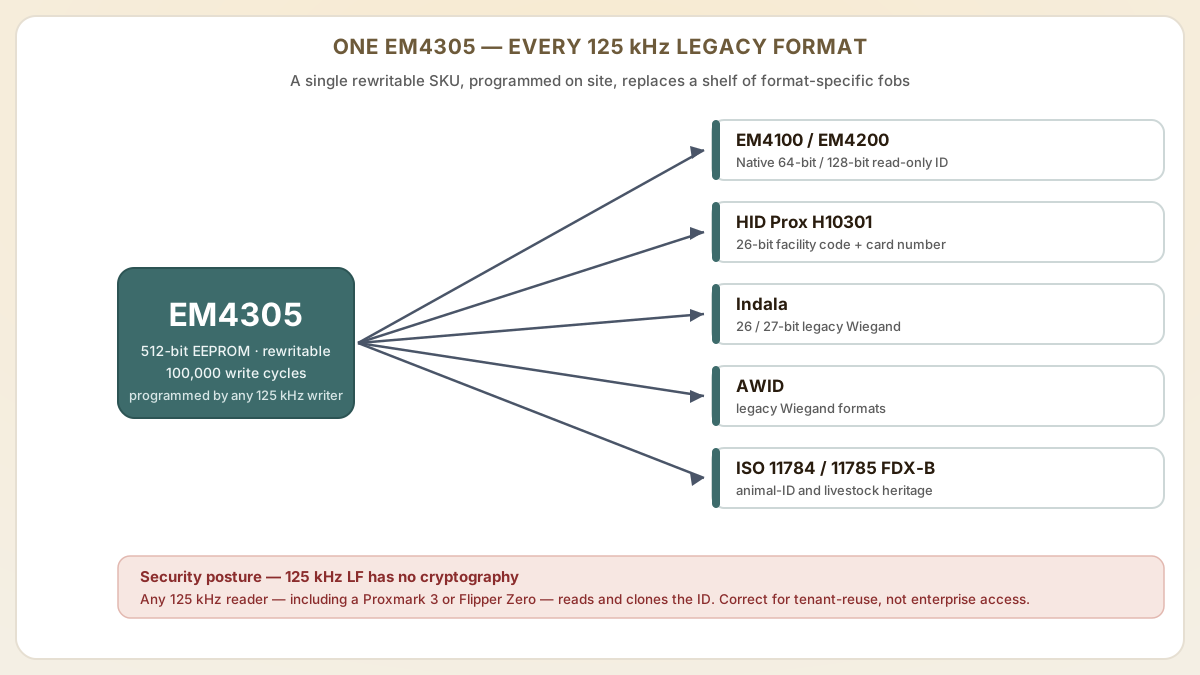
- Native EM4100 / EM4200: the 64-bit or 128-bit read-only ID every legacy LF panel already accepts.
- HID Prox H10301: program the 26-bit facility code and card number and the fob answers HID ProxPoint readers directly.
- Indala and AWID: the other two legacy Wiegand dialects, covered from the same chip.
- ISO 11784 / 11785 FDX-B: the animal-ID heritage that also gives the silicon its wide -25 to +85 °C temperature spec.
Anatomy of the fob — coil, chip, and the shell that survives a keyring
Electrically a 125 kHz fob is almost nothing: a many-turn copper coil, the EM4305 die, and potting. The engineering decision that actually reaches the buyer is the housing — ABS for cheap-and-colourful, platinum-cured silicone for IP68 wash-down, epoxy for a seamless outdoor drop — all finished on a 304 / 316 stainless split ring. Want the same chip in a card instead of a fob? The EM4100 RFID card shares the silicon.
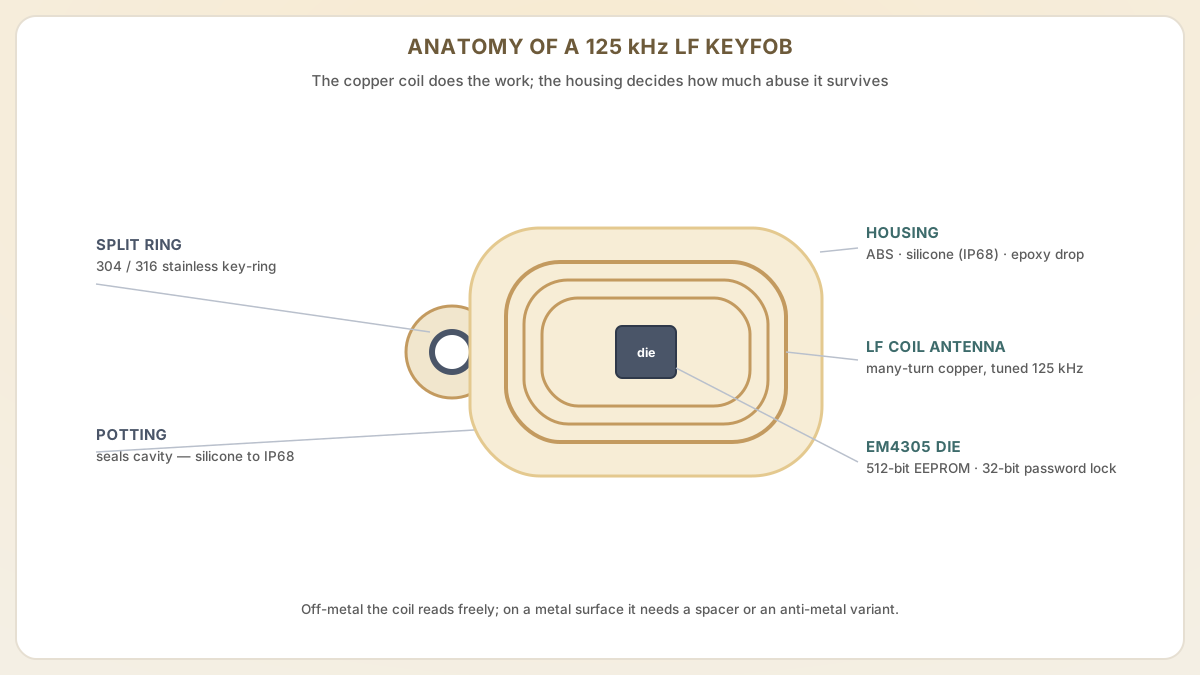
- Housing options: ABS in 10+ pantone colours, platinum-cured silicone rated IP68 (IEC 60529, Shore A 60), or a seamless epoxy drop for outdoor duty.
- LF coil antenna: a many-turn copper coil tuned to 125 kHz does all the energy harvesting — there is no battery.
- EM4305 die: 512-bit EEPROM with a 32-bit password-lock cell, bonded to the coil and sealed in potting.
- Split ring: 304 or 316 stainless steel — the part that actually fails first on a busy keyring.
The reference facts, at a glance
Protocol emulation
Native EM4100 / EM4200 64-bit / 128-bit ID HID Prox H10301 26-bit format (facility code + card number) per HID Global reference Indala 26 / 27-bit and AWID legacy Wiegand formats
Password / write protection
32-bit password cell restricts write-access; password defaults are customer-controlled Write-lock bit seals configuration after personalisation (one-way) Password protects against accidental overwrite — NOT against RF eavesdropping
Legacy-panel compatibility
Wiegand-26 / Wiegand-34 panel compatibility via HID Prox emulation SIA OSDP v2.2 retrofit of Wiegand 5-wire interface when the reader is upgraded Works with HID ProxPoint / ProxPro II, AWID 6100, Indala ASR-500 and legacy EM-only panels
Animal / automotive heritage
Chip family evolved from animal-ID (ISO 11784 / ISO 11785 FDX-B) silicon — same NMOS process ISO 11784 / ISO 11785 emulation available for FDX-B readers (animal-ID and livestock scenarios) Automotive immobiliser-adjacent chip lineage gives the chip a wide -25 to +85 °C spec
Housing
ABS (standard, 10+ pantone colours) — keyring-moulded Platinum-cured silicone (IP68 per IEC 60529, Shore A 60) Epoxy drop (seamless, outdoor duty) — all with 304 / 316 stainless split ring
Security posture
LF air interface has no cryptography — any 125 kHz reader or Proxmark / Flipper Zero reads the ID Password-lock protects EEPROM write access only; it does NOT authenticate the RF session Correct for tenant-reuse, OSDP retrofit, integrator test inventory — NOT for enterprise-access-control primary credential
Migration ceiling
When cloning must be prevented, migrate to HF AES-128 (DESFire EV3, Plus SE, iCLASS SE / Seos) Dual-frequency fob (LF EM4305 + HF DESFire EV3) bridges a 12-24 month reader-migration window Site access-control policy must document the LF-clone-risk residual when keeping EM4305
Personalisation service
Pre-programmed EM4100 emulation with sequential IDs Pre-programmed HID Prox with customer-supplied facility code + card-number range Database-matched individual encoding, delivered in labelled bags sorted by tenant / floor / building
Logistics
MOQ 100 stock ABS / 200 custom-colour or silicone Lead time 3-5 business days stock / 10-12 business days custom Pre-programmed personalisation adds 1-2 business days
Useful next pages
Use these linked product, guide and comparison pages to keep the next click specific and practical.
Related 125 kHz & LF-to-HF upgrade paths
Matching LF cards/keyfobs plus the recommended HF AES-128 upgrade when the deployment outgrows LF's security envelope.
FAQ
Can EM4305 keyfobs emulate HID proximity cards?
Yes. EM4305 supports configurable data encoding and modulation that can emulate HID 26-bit (H10301) and other HID Prox formats. You program the facility code and card number into the EM4305 chip using a 125 kHz RFID writer, and the keyfob responds to HID ProxPoint readers as if it were a genuine HID card. Note: this emulation works for basic HID Prox protocols; HID iCLASS (13.56 MHz) requires a different chip.
How many times can the EM4305 be reprogrammed?
The EM4305 EEPROM is rated for 100,000 write cycles. In a typical access control deployment where a keyfob is reprogrammed once per tenant turnover (1-2 times per year), the chip will outlast the physical keyfob housing by orders of magnitude. There is no practical rewrite limit for access control applications.
What is the MOQ and lead time?
EM4305 keyfobs in standard ABS housing: MOQ 100, lead time 3-5 business days from stock. Custom-colored or silicone housing: MOQ 200, lead time 10-12 business days. Pre-programmed with your facility code or protocol emulation: add 1-2 business days to standard lead time. Volume pricing available at 500, 1,000 and 5,000+ quantities.
Should I be worried about EM4305 keyfob cloning?
It depends on the threat model. 125 kHz LF chips — EM4100, EM4305, T5577 and HID Prox II — have no cryptographic authentication at the air interface. A consumer Proxmark 3 or Flipper Zero can read the ID in seconds. This is a property of LF Prox as a whole, not EM4305 specifically. For low-stakes applications (apartment common areas, storage unit access, gym lockers, tenant turnover reuse) this is the accepted trade-off for low cost and universal legacy compatibility. For enterprise access, hotel rooms, controlled substances or transit fare, migrate the deployment to HF 13.56 MHz with AES-128 (MIFARE Plus SE, DESFire EV3) or HID iCLASS SE / Seos.
Can EM4305 coexist with my HF 13.56 MHz reader on a dual-frequency migration?
Yes. A dual-frequency keyfob carries both an EM4305 (or T5577) LF chip and a HF chip (typically MIFARE DESFire EV3 or an NTAG) in the same housing. The LF chip is read by existing 125 kHz proximity readers; the HF chip is read by new 13.56 MHz readers. Users keep the same fob through a multi-year reader-migration programme. See the [dual-frequency keyfob](/products/rfid-keyfobs/dual-frequency-key-fob/) SKU for specification details.
Can EM4305 keyfobs be pre-programmed and branded with our logo and colours?
Yes. EM4305 keyfobs ship in ABS with 10+ pantone colour options and can be pad-printed or laser-marked with a logo and a sequential human-readable serial. Pre-programming is available: EM4100 emulation with sequential IDs, or HID Prox with your facility code and card-number range, delivered in labelled bags sorted by tenant, floor or building. Standard ABS is MOQ 100 (lead time 3-5 business days); custom-colour or silicone housing is MOQ 200 (10-12 business days); pre-programming adds 1-2 business days.
Sources & references
Primary standards, OEM datasheets and regulatory documents cited by this article. All URLs were verified on the access date shown below.
- ISO/IEC 18000-2:2009 — Parameters for air interface communications below 135 kHz
Physical-layer specification for LF 125-134.2 kHz chips including EM4100/EM4200/EM4305/T5577.
- EM Microelectronic EM4305 / EM4205 chip datasheet
Vendor datasheet for the EM4305 512-bit EEPROM, 100,000 write-cycle rating and 32-bit password-lock feature set.
- EM Microelectronic EM4100 chip datasheet
Reference datasheet for the read-only EM4100 chip compared against EM4305 in this SKU.
- Atmel / Microchip T5577 125 kHz Read/Write Passive RFID Chip — product page
- HID Global 125 kHz Prox Card Format Reference (H10301 26-bit Prox)
Reference for the HID Prox H10301 26-bit format that EM4305 is configured to emulate in the retrofit scenarios described.
- ISO 11784:1996 + ISO 11785:1996 — Radio frequency identification of animals — Code structure + Technical concept
- SIA OSDP v2.2 — Open Supervised Device Protocol specification
Replacement for the legacy Wiegand 5-wire reader-to-panel interface used in LF retrofit scenarios.
Proud Tek is a Shenzhen-based RFID & NFC manufacturer supplying hotel chains, transit operators, event venues and retail brands worldwide. Every order includes free samples, RF testing and dedicated project support.
Get a Quick Quote
Tell us about your project and we'll respond within one business day. Fields marked (asterisk) are required.