
Epoxy-Encapsulated Keyfob
Epoxy RFID Keyfob
IP68 Outdoor-Rated Credential

Quick answer
Epoxy RFID keyfobs seal a 125 kHz LF or 13.56 MHz HF inlay in a seamless resin dome — IP68 by construction, -40 °C to +85 °C, from 500 pieces in 12-18 business days. The 30-50 mm teardrop, rectangle or custom die-cut body carries CMYK artwork under a 3-5 mm crystal dome on a PVC / PET / aluminium substrate, and clears IEC 60068-2-78 damp-heat, IEC 60068-2-52 salt-mist, 1.5 m drop, ATEX Zone 2 passive-equipment use and NEMA 4X wash-down for industrial, outdoor and food-plant access control.
- Seamless epoxy encapsulation — IP68 by construction, not by seal; fob cleared against IEC 60068-2-78 damp-heat, IEC 60068-2-52 salt-mist cycling, IEC 60068-2-14 thermal cycling -40 °C to +85 °C, 1.5 m drop and 5-500 Hz vibration.
- ATEX Zone 2 / 22 passive-equipment compatible when paired with an ATEX reader — zero stored energy on the fob qualifies it under the passive-equipment clause for chemical / fuel / flour-mill sites.
- NEMA 4X wash-down clearance for food-plant and pharma-plant access control — survives CIP / SIP spray with typical quat, peracetic and caustic chemistry.
Used in these industries
Deployments where this product is referenced on our industry landing pages.
At a glance
Use these short answers to decide whether this page matches the project before moving into the detail.
Form factor
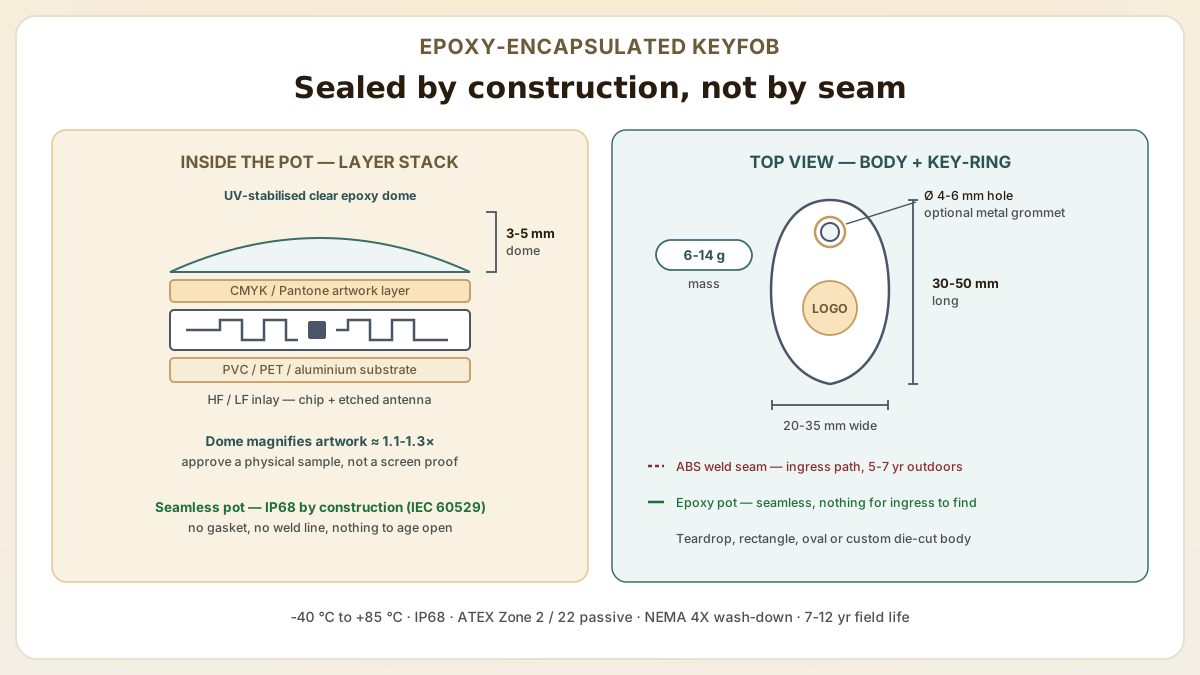
Teardrop / rectangle / oval / custom die-cut 30-50 mm × 20-35 mm with 3-5 mm epoxy dome height; 6-14 g mass; Ø 4-6 mm key-ring hole. Optional metal keyring grommet inser...
Air-interface envelope
13.56 MHz HF — ISO 14443 Type A/B (MIFARE Classic 1K, MIFARE Plus SE, MIFARE DESFire EV3, NTAG 213/215/216, NTAG 424 DNA). 125 kHz LF — EM4200 / EM4305 / T5577 / HID Pro...
Next step
Ready to move forward? Start your inquiry to get specific answers for this project.
Quote epoxy RFID keyfobs- Encapsulation chemistry
-
- Two-component epoxy — bisphenol-A-epichlorohydrin (CAS 25068-38-6) with aliphatic-amine or cycloaliphatic-amine hardener; UV-stabilised and HALS-extended for outdoor.
- Pot-life 20-40 min; gel-time 1-2 h at 25 °C; full cure 24 h; Shore D hardness 75-85.
- Ingress + durability
-
- IP68 per IEC 60529 by construction (fully encapsulated resin — no seam for ingress).
- IEC 60068-2-32 Ea drop 1.5 m; IEC 60068-2-6 vibration 5-500 Hz 2 h / axis; IEC 60068-2-64 random vibration for transport.
- Climate envelope
-
- IEC 60068-2-78 damp-heat steady 40 °C / 93 % RH for 4 days; IEC 60068-2-14 thermal cycling -40 °C to +85 °C × 10 cycles.
- IEC 60068-2-52 salt-mist cycling for coastal / outdoor service; 500-hour QUV for UV-stabilised resin variants.
- Chemical resistance
-
- Fully cured epoxy is resistant to typical facility cleaners, IPA wipe-down, dilute acids / bases, hydrocarbons, quat ammonia and NEMA 4X wash-down chemistry.
- Continuous immersion in aggressive solvents (MEK, toluene, concentrated acids) is out of envelope — move to PTFE / silicone housing for those cases.
- Hazardous-area posture
-
- ATEX 2014/34/EU passive-equipment compatible in Zone 2 (gas) / Zone 22 (dust) when paired with an ATEX-certified reader; the fob itself is passive with zero stored energy.
- IECEx / AS/NZS 60079 parallel conformity; NFPA 70 Class I Div 2 acceptable under the passive-equipment clause.
- Decoration + branding
-
- 4-colour CMYK or Pantone-matched artwork printed on the substrate before epoxy pot; crystal dome magnifies the artwork ≈ 1.1-1.3×.
- Laser-engraved serial number on the reverse aluminium / PVC base; custom die-cut brand silhouette on special-order SKUs.
- Chemistry + disclosure
-
- RoHS 3 + REACH SVHC cleared on the cured-resin + hardener + pigment system; California Prop 65 disclosure on consumer-facing SKUs.
- Halogen-free substrate and ink options; bio-based epoxy variants (bisphenol-F / bio-glycidyl ether) available for sustainability programmes.
- Integration
-
- Same Wiegand 26 / 34 / 37 + OSDP v2.2 Secure Channel + MIFARE DESFire EV3 + NTAG 424 DNA stack as the ABS variant; PACS sees an identical credential.
- Factory TID read-only (ISO 14443 / ISO 18000-63 as applicable); EPC / NDEF permalocked at issuance.
- Operating envelope summary
-
- -40 °C to +85 °C service; IP68 by construction; ATEX Zone 2 / 22 passive clearance; NEMA 4X wash-down.
- Typical field life 7-12 years under outdoor / industrial carry (longer than ABS thanks to seamless encapsulation).
- Typical pricing
-
USD 0.35–0.80 /pc @ 5k+ (typical FOB Shenzhen range) — firm quote in one business day.
Commercial terms
- MOQ
- Varies by SKU — stock items from 100 pcs; custom production typically 200-1,000 pcs
- Lead time
- Production 2-3 weeks after artwork and encoding sign-off; reorders on a 3-4 week cycle
- Samples
- Free samples and RF test report with every order; courier at customer cost
- Payment
- 50% T/T deposit, 50% before shipment; Net 30/60 for established accounts; LC for large orders
- Shipping
- FOB Shenzhen / Yantian; DHL, FedEx or EMS air freight; sea LCL / FCL for volume
- Response
- Itemized quote within one business day, Mon-Fri (UTC+8)
Why outdoor and industrial access control outgrows an ultrasonically-welded ABS shell
An access-control fob has one job: keep reading after the site has done its worst. Offices are gentle, and the ABS keyfob owns that world — but on a salt-fog jetty or a peracetic-acid wash-down lane, the weld seam is usually the coroner's finding. Epoxy removes the seam from the autopsy.
- Ultrasonic-welded ABS carries a weld seam along the fob perimeter; after 5-7 years of outdoor UV + thermal cycling the weld relaxes and ingress becomes the dominant failure mode. Sealed-by-construction epoxy has no seam.
- NEMA 4X wash-down chemistry — quat ammonia, peracetic acid, caustic soda, chlorinated alkaline — attacks ABS at routine process-floor concentrations; fully cured epoxy tolerates the same CIP / SIP spray indefinitely.
- ATEX Zone 2 / 22 sites require passive-equipment clearance for anything clipped to a worker; the potted fob stores zero energy and has no spark-capable fault mode, so the clause applies when paired with an ATEX-certified reader.
- Outdoor-industrial estates pair 500-hour QUV and 720-hour salt-fog qualification with a decade of daily carry; UV-stabilised, HALS-extended resin holds dome clarity and surface hardness across that envelope.
Epoxy vs ABS vs metal — where the envelope boundary sits
Same inlay, same reader estate, three jackets — pick by the chemistry you plan to spill on it. The metal keyfob takes the mechanical-abuse crown, epoxy takes weather and wash-down, and the wider decision — fob, card or wristband — lives in the access-credential comparison.
Ultrasonically-welded ABS keyfob
- Weld seam along perimeter; UV + thermal cycling relaxes the weld at 5-7 years of outdoor carry.
- Standard grade ABS attacked by NEMA 4X wash-down chemistry at food-plant concentrations.
- Not cleared for ATEX Zone 2 / 22 unless specifically re-certified per site.
- Injection-mould tool cost makes per-silhouette branded die-cuts economically unviable under 20k MOQ.
Epoxy-encapsulated keyfob
- Seamless resin pot — no weld seam for ingress; IP68 holds for 7-12 years of outdoor / industrial carry.
- Cured epoxy resistant to quat ammonia, peracetic acid, caustic soda, hydrocarbons and IPA wipe-down.
- ATEX Zone 2 / 22 passive-equipment clause applies (zero stored energy); paired with ATEX reader.
- Custom die-cut silhouette from a one-time cutting die — no per-shape injection mould; crystal dome magnifies CMYK / Pantone artwork.
| Housing | Sweet spot | Envelope & ratings | Decoration & weight |
|---|---|---|---|
| ABS (ultrasonic-welded) | Office, campus and fleet estates — the default indoor credential | IP68 for 5-10 years under office conditions; not rated for ATEX, NEMA 4X or continuous UV / salt-fog | Pad / screen print; each custom silhouette needs its own injection mould |
| Epoxy (resin-potted) | Outdoor, industrial, food-plant and ATEX Zone 2 / 22 estates | IP68 by construction; NEMA 4X wash-down; UV-stabilised outdoor variants; 7-12 yr field life | CMYK / Pantone artwork under the crystal dome; die-cut silhouettes without injection tooling; 6-14 g |
| Metal (stainless / zinc / aluminium) | Mechanical-abuse-first estates and premium branded programmes | Highest crush and impact resistance; nickel-release and food-contact chemistry govern alloy choice | Laser engraving; 15-30 g |
Where epoxy keyfobs earn their place in the catalogue
Every deployment below shares one habit: it destroys credentials that were specified for a desk drawer. If your estate runs keyfob-based access control, this is where the epoxy variant earns its line item.
Chemical plants & refineries
ATEX Zone 2 gas sites issue the epoxy fob on every contractor and employee lanyard, paired with an ATEX-certified reader at each area entrance.
Food & beverage plants
NEMA 4X wash-down zones under FSMA 21 CFR 117 HACCP programmes need non-shedding, cleanable credentials that survive daily CIP spray.
Pharma & GMP production
21 CFR 211 Current Good Manufacturing Practice suites accept the cleanable, non-particulate fob in clean-room ancillary areas (grade D / C).
Marine & offshore
Salt-fog, UV and vibration in a single posting; potted epoxy outlasts any ABS weld through 720-hour salt-fog cycling.
Theme parks, stadiums & events
Custom die-cut brand silhouettes carry guest and staff credentials, with CMYK artwork preserved under the dome for the full event span.
- University / hospitality loyalty — promotional branded fob with NTAG 424 DNA SUN payload for tap-to-reveal content; fob becomes a brand touchpoint rather than a plain credential.
Epoxy RFID keyfob specifications
Every number a tender template asks for, in one table. Chip-level silicon detail lives in the LF chip encyclopedia, and the consumer-branding cousin of this fob — same resin, different mission — is the NFC epoxy key tag.
| Attribute | Value | Notes |
|---|---|---|
| Form factor | Teardrop, rectangle, oval or custom die-cut silhouette | Custom die-cuts need a cutting die, not an injection mould |
| Dimensions | 30-50 mm × 20-35 mm body; 3-5 mm dome height | Ø 4-6 mm key-ring hole; optional metal grommet insert |
| Weight | 6-14 g | Grommet carries the lanyard load on pierced-hole variants |
| Construction | CMYK-printed PVC / PET / aluminium substrate under a two-component epoxy pot | UV-stabilised, HALS-extended resin on outdoor variants |
| Frequency options | 125 kHz LF · 13.56 MHz HF | One housing serves both legacy and modern reader estates |
| HF chip options | MIFARE Classic 1K · MIFARE Plus SE · MIFARE DESFire EV3 · NTAG 213 / 215 / 216 · NTAG 424 DNA | DESFire EV3 runs AES on Common Criteria EAL5+ certified silicon (NXP) |
| LF chip options | EM4200 · EM4305 · T5577 | HID ProxCard II-compatible configurations for legacy estates |
| PACS integration | ISO 14443 Type A/B · Wiegand 26 / 34 / 37 · OSDP v2.2 Secure Channel | Identical credential stack to the ABS variant — PACS sees the same credential |
| Operating envelope | -40 °C to +85 °C · IP68 per IEC 60529 | Sealed by construction — no gasket or weld seam to age |
| Qualification tests | IEC 60068-2-78 damp-heat · IEC 60068-2-52 salt-mist · IEC 60068-2-14 thermal cycling · 1.5 m drop · 5-500 Hz vibration | Typical field life 7-12 years under outdoor / industrial carry |
| Hazardous-area / wash-down posture | ATEX Zone 2 / 22 + IECEx passive equipment · NFPA 70 Class I Div 2 · NEMA 4X | Zone clearance is carried by the ATEX-certified reader, not the fob |
| Decoration | CMYK or Pantone-matched print under the dome; laser-engraved serials on the base | Dome magnifies artwork ≈ 1.1-1.3× — approve a physical sample |
| Encoding services | UID lists, facility codes, sector / AES keys, DESFire application layouts, NDEF payloads | Adds no MOQ; UID list included with every order |
| MOQ | 500 pieces standard shapes · 1,000 pieces custom die-cut | Custom die carries a one-time tooling fee |
| Lead time | 12-18 business days | Includes pre-encoding when ordered |
| Compliance | RoHS 3 · REACH SVHC · California Prop 65 disclosure on consumer SKUs | Halogen-free substrate and ink options available |
From artwork lock to cured dome — how an epoxy fob is made
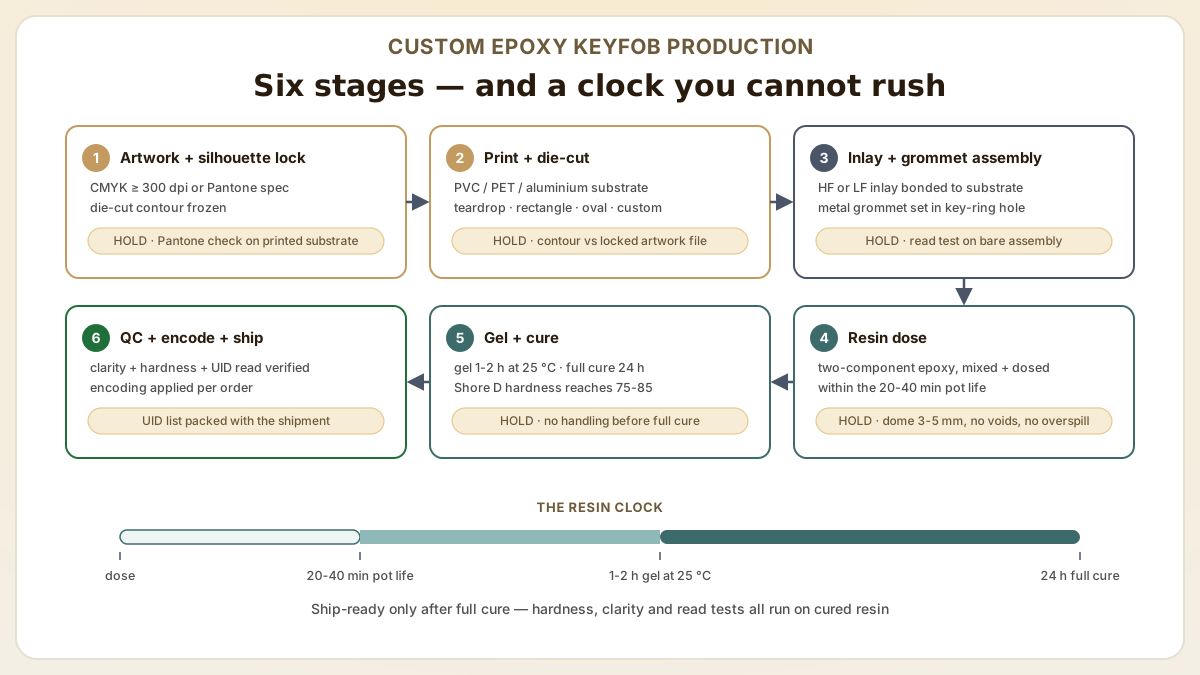
Resin keeps factory hours, not yours: the dome gels in 1-2 h at 25 °C and calls itself cured only at 24 h. Here is the path from artwork file to reader-ready fob, and where your approval gates sit. Running a custom-printed NFC card programme alongside? Lock both artwork palettes in the same review — the print rules are shared.
| Stage | What happens | Hold point |
|---|---|---|
| 1 — Artwork + silhouette lock | CMYK artwork at ≥ 300 dpi or Pantone spec approved on the printed substrate; die-cut contour frozen | Pantone verification on substrate before any resin is dosed |
| 2 — Print + die-cut | Substrate printed and cut to teardrop, rectangle, oval or custom outline | Contour check against the locked artwork file |
| 3 — Inlay + grommet assembly | HF or LF inlay bonded to the substrate; optional metal grommet set in the key-ring hole | Read test on the bare assembly |
| 4 — Resin dose | Two-component epoxy mixed and dosed within its 20-40 min pot life | Dome height 3-5 mm; no voids, no overspill |
| 5 — Gel + cure | Gels in 1-2 h at 25 °C; full cure at 24 h; Shore D hardness reaches 75-85 | No handling or packing before full cure |
| 6 — QC + encode + ship | Hardness, optical clarity and UID read verified; encoding applied per order | UID list packed with the shipment |
How to roll out an epoxy keyfob programme across an outdoor / industrial estate
A fob programme succeeds in this order: reader certifications first, resin chemistry second, artwork last. Run it backwards and you own 5,000 beautiful fobs that fail the zone audit.
- Week 1 — reader + zone audit
Map every zone entrance to ATEX / IECEx / NEMA 4X / Class I Div 2 posture; confirm reader certification; freeze the keyfob die-cut shape and chip choice per zone.
- Weeks 2-4 — resin + sample validation
Run 200-500 fobs through IEC 60068-2-78 damp-heat, IEC 60068-2-52 salt-mist, IEC 60068-2-14 thermal cycling, 500-hour QUV for outdoor variants; confirm optical clarity, surface hardness and no antenna drift.
- Weeks 5-6 — encode + issue workflow
Stand up the encode bench tied to HRIS / ITAM / visitor-management; revocation latency < 10 s; dry-run pilot batch against the PACS head-end at each reader.
- Weeks 7-10 — pilot deployment
Deploy 1,000-5,000 fobs across a pilot chemical-plant / food-plant / offshore / theme-park site; audit PACS logs, failed authentications, environmental failure events.
- Month 4+ — estate rollout and sustainability reporting
Scale to 50,000+ fobs; log each issue / revoke / retirement against ISO/IEC 27001 A.11.1 + SOC 2 CC6 + HIPAA 164.310 + PCI DSS v4.0 Req. 9 + FDA 21 CFR 117 / 211 and corporate CDP / Higg Index reporting.
- Start from the reader estate: confirm ATEX / IECEx / NEMA 4X reader certification at each zone entrance — the fob's passive-equipment clearance only exists alongside a certified reader.
- Choose the chip by security posture: EM4200 / T5577 for legacy HID-compatible estates, MIFARE DESFire EV3 for ISO/IEC 27001-aligned AES-128 estates, NTAG 424 DNA for consumer / guest / BYOD tap.
- For food and pharma plants, file the cured-epoxy material safety-data sheet against your 21 CFR 117 / 211 non-shedding, non-particulate posture — and keep un-cured resin out of finished-goods areas after QA.
- Specify UV-stabilised / HALS-extended resin for outdoor and offshore estates, with 500-hour QUV and 720-hour salt-fog as acceptance criteria on the incoming lot.
- Lock the artwork file and Pantone palette before pot — the crystal dome magnifies artwork 1.1-1.3×, so artwork tolerance is tighter than flat-printed ABS.
- Plan disposal up front: cured epoxy is not melt-recyclable — route retired fobs to a thermoset-composite recycling stream per WEEE Directive 2012/19/EU Art. 8(5), with chips rendered inoperative per NIST SP 800-88.
Useful next pages
Use these linked product, guide and comparison pages to keep the next click specific and practical.
Related keyfob housing and credential options
Alternative keyfob housings and adjacent RFID credentials for outdoor-industrial and hazardous-area deployments.
FAQ
Is the epoxy keyfob ATEX Zone 2 / 22 certified?
The fob qualifies under the passive-equipment clause of ATEX 2014/34/EU rather than carrying its own certificate. It is a passive transponder with zero stored energy and no mechanical fault mode capable of producing a spark, so the clause applies — alongside the parallel IECEx / AS/NZS 60079 / NFPA 70 Class I Div 2 rules — when the fob is paired with an ATEX-certified reader. Formal Zone 2 / 22 clearance is carried by the reader, not the fob; this is how virtually every passive-RFID hazardous-area credential is structured.
Can the epoxy keyfob survive food-plant CIP / SIP wash-down?
Yes — cured epoxy is chemically resistant to typical food-plant CIP / SIP chemistry (quat ammonia 200-400 ppm, peracetic acid 80-150 ppm, caustic soda 1-2 % at 60-80 °C) for the tens-of-minutes contact times normal in daily wash-down. Sustained high-concentration hot-caustic or aggressive solvent immersion (MEK, toluene) sits outside envelope; for those cases switch to a silicone or PTFE-overmoulded housing.
How does the crystal dome impact artwork tolerance?
The cured epoxy dome acts as a plano-convex lens with ≈ 1.1-1.3× optical magnification at the centre of the dome. This magnifies both the artwork and any print defect, so artwork production lane tolerance is tighter than for a flat-printed ABS fob: Pantone match verification on the printed substrate before pot is recommended, and CMYK raster artwork should be delivered at ≥ 300 dpi to avoid visible print pattern under the dome.
What is the minimum order quantity and lead time for epoxy RFID keyfobs?
Epoxy RFID keyfobs run at MOQ 500 pieces on the standard teardrop, rectangle and oval bodies, and 1,000 pieces on custom die-cut silhouettes, which also carry a one-time cutting-die fee. Standard lead time is 12-18 business days including pre-encoding. Physical samples precede the production batch so artwork colour and read performance are approved on real resin rather than a screen proof.
Can epoxy keyfobs ship pre-encoded for an existing access-control system?
Yes — epoxy keyfobs ship with UID lists, facility codes, sector-key or AES-key programming, DESFire application layouts and NTAG NDEF payloads applied at the factory, and encoding adds no MOQ. The credential stack is identical to the ABS variant (ISO 14443 Type A/B, Wiegand 26 / 34 / 37, OSDP v2.2 Secure Channel), so the PACS head-end sees the same credential regardless of housing.
Which chip should I choose for an epoxy RFID keyfob?
Match the chip to the reader estate. Legacy 125 kHz estates take EM4200, EM4305 or T5577 in HID ProxCard II-compatible configurations. New or upgraded 13.56 MHz estates should specify MIFARE DESFire EV3, which runs AES cryptography on Common Criteria EAL5+ certified silicon per NXP. Guest, loyalty and BYOD tap programmes use NTAG 213 / 215 / 216, or NTAG 424 DNA where AES-128 SUN message authentication is required.
Are epoxy RFID keyfobs RoHS and REACH compliant?
Yes — the cured-resin, hardener and pigment system is cleared against RoHS 3 and the REACH SVHC candidate list, with California Prop 65 disclosure on consumer-facing SKUs. Halogen-free substrate and ink options are available, and the cured-epoxy material safety-data sheet supports 21 CFR 117 / 211 non-shedding, non-particulate documentation for food-plant and pharma QA files.
Sources & references
Primary standards, OEM datasheets and regulatory documents cited by this article. All URLs were verified on the access date shown below.
- IEC 60529 — Degrees of protection provided by enclosures (IP Code)
IP68 rating definition used for the seamless epoxy keyfob.
- IEC 60068-2-78 — Environmental testing — Test Cab: Damp heat, steady state
Damp-heat qualification (40 °C / 93 % RH, 4 days) on the cured epoxy housing.
- IEC 60068-2-52 — Environmental testing — Test Kb: Salt mist, cyclic
Salt-mist cyclic qualification for outdoor / coastal service.
- Directive 2014/34/EU — ATEX Equipment Directive
Equipment for explosive atmospheres; passive-equipment clause covers the RFID fob when paired with an ATEX-certified reader.
- NFPA 70 — National Electrical Code, Article 500 Hazardous (Classified) Locations
US Class I Div 2 framework under which the passive epoxy keyfob qualifies as non-incendive when paired with a certified reader.
- NEMA 250 — Enclosures for Electrical Equipment (1000 Volts Maximum), Type 4X
Wash-down enclosure rating used for food / pharma-plant reader enclosures paired with the epoxy fob.
- NXP MIFARE DESFire family — AES cryptographic engines; MIFARE DESFire EV3 rated Common Criteria EAL5+
Manufacturer reference for the MIFARE DESFire EV3 chip option — AES cryptography on Common Criteria EAL5+ certified silicon over the ISO 14443 Type A air interface.
- NXP NTAG 424 DNA — AES-128 cryptography and SUN (Secure Unique NFC) message authentication
Manufacturer reference for the NTAG 424 DNA chip option and the SUN tap-authentication capability cited for branded / loyalty fobs.
- EM Microelectronic — EM4305 Read/Write Contactless Identification Device
Canonical EM product page for the EM4305 LF chip option (read/write 125 kHz transponder) listed in the specification table.
- Atmel / Microchip — ATA5577C (T5577) LF Multi-Standard Read/Write Transponder Datasheet
Datasheet for the T5577 LF chip option used for HID ProxCard II-compatible configurations.
Proud Tek is a Shenzhen-based RFID & NFC manufacturer supplying hotel chains, transit operators, event venues and retail brands worldwide. Every order includes free samples, RF testing and dedicated project support.
Get a Quick Quote
Tell us about your project and we'll respond within one business day. Fields marked (asterisk) are required.