
Metal-Housing Keyfob
Metal RFID Keyfob
Stainless & Zinc Premium Fob

Quick answer
Metal RFID keyfobs house a ferrite-backed HF or LF inlay in 316L stainless steel, die-cast zinc alloy, or anodised aluminium at 15-30 g. All three alloys pass EN 1811 nickel release (≤ 0.5 µg/cm²/week) and REACH Annex XVII; 316L stainless adds LGA / FDA 21 CFR 175 food-contact incidental clearance. Housing field life runs 15-25 years, so premium access, food-plant, lab, and vibration-heavy environments retire the chip before the shell. A 0.3-0.5 mm ferrite sheet decouples the antenna from the shell, holding tap range at 0-30 mm HF and 0-40 mm LF.
- 316L stainless, die-cast zinc alloy or anodised aluminium housing with ferrite-backed inlay — 15-30 g hand-feel, 15-25 year housing life, chip replacement is what drives retirement.
- EN 1811 nickel release ≤ 0.5 µg/cm²/week + REACH Annex XVII entries 27 / 63 cleared + LGA / FDA 21 CFR 175 food-contact incidental on stainless variants — full skin + food-plant compliance envelope covered.
- Anti-metal antenna design + 0.3-0.5 mm ferrite sheet deliver HF tap 0-30 mm and LF tap 0-40 mm through the metal shell — no compromise on PACS integration.
Used in these industries
Deployments where this product is referenced on our industry landing pages.
At a glance
Use these short answers to decide whether this page matches the project before moving into the detail.
Form factor
Teardrop / rectangle / rounded-rectangle 30-55 mm × 20-30 mm × 4-8 mm; 15-30 g mass; Ø 4-6 mm key-ring hole. Two-piece construction: metal upper shell + ferrite-backed H...
Alloy options
316L austenitic stainless steel per ASTM A276 — corrosion-resistant, non-magnetic, hygienic, easy to passivate per ASTM A967. Die-cast zinc alloy ZA-4 / ZA-8 — cost-effe...
Next step
Ready to move forward? Start your inquiry to get specific answers for this project.
Quote metal RFID keyfobs- Typical pricing
-
USD 0.80–2.00 /pc @ 5k+ (typical FOB Shenzhen range) — firm quote in one business day.
Commercial terms
- MOQ
- Varies by SKU — stock items from 100 pcs; custom production typically 200-1,000 pcs
- Lead time
- Production 2-3 weeks after artwork and encoding sign-off; reorders on a 3-4 week cycle
- Samples
- Free samples and RF test report with every order; courier at customer cost
- Payment
- 50% T/T deposit, 50% before shipment; Net 30/60 for established accounts; LC for large orders
- Shipping
- FOB Shenzhen / Yantian; DHL, FedEx or EMS air freight; sea LCL / FCL for volume
- Response
- Itemized quote within one business day, Mon-Fri (UTC+8)
Why some credentials specifically call for a metal housing
Most credentials are specified by the security team; metal keyfobs are also specified by whoever guards the brand book — and then still have to survive pockets, wash-downs and drop tests like everything else on the ring. Still deciding between fob, card and wristband? Start with the form-factor comparison. Decided on a fob that has to feel the way the lobby looks? Read on.
| Buying trigger | What the environment does | Why the metal shell clears it |
|---|---|---|
| Brand presence | Residents, members and VIP guests judge the building by the object on their key-ring | 15-30 g of brushed 316L stainless or PVD-gold zinc alloy reads as permanence; ABS reads as a giveaway |
| Wash-down chemistry | Commercial kitchens, food plants and labs run hot-water and caustic wash-down that degrades ABS welds within 1-2 years | 316L stainless tolerates hot-caustic, peracetic-acid and chlorinated-alkaline chemistry indefinitely |
| Mechanical stress | NEBS GR-63-CORE Level 3 data-centre / telco key carriers and MIL-STD-810G vibration programmes fatigue adhesive seals on plastic housings | The laser-welded metal seam is the mechanical-integrity answer |
| Skin compliance | Anything that lives on a key-ring in a pocket or handbag counts as prolonged skin contact | EN 1811 nickel release ≤ 0.5 µg/cm²/week and REACH Annex XVII entries 27 (Ni) and 63 (Pb) cleared on all three alloys |
| Replacement budget | Plastic housings retire every 5-10 years, and re-badging an estate is never in anyone's plan | 15-25 year housing life — the chip retires first, and the same shell can be re-encoded through multiple chip-family migrations |
Stainless vs zinc vs aluminium — picking the alloy
Safety chemistry will not pick your alloy — all three clear the same EN 1811 and REACH Annex XVII gates. What actually decides it: finish options, food-line exposure and hand-feel. And if the estate is outdoor chemical splash rather than marble lobby, the epoxy keyfob usually wins the argument before any alloy gets a vote.
Ultrasonically-welded ABS keyfob
- ABS weld seam relaxes under UV + hot-caustic + vibration within 1-7 years depending on environment.
- Cost-effective but does not pass food-grade incidental-contact rules; not acceptable in commercial kitchens / labs.
- Not cleared for NEBS GR-63-CORE Level 3 mechanical retention on its own.
- 5-10 year typical field life; chip usually outlives the housing.
Metal (316L / zinc / aluminium) keyfob
- Laser-welded or snap-fit metal shell with ferrite-backed inlay — 15-25 year housing life.
- 316L stainless is food-contact incidental per LGA / FDA 21 CFR 175; acceptable in commercial kitchens, labs, pharma ancillary areas.
- Stainless / zinc 2.0 m drop + 5-500 Hz vibration survival; NEBS + MIL-STD mechanical envelopes clear.
- Housing outlasts the chip; same shell can run MIFARE Classic → Plus → DESFire EV3 → NTAG 424 DNA generations.
| Alloy | Grade / standard | Finish library | Food-contact posture | Pick it for |
|---|---|---|---|---|
| 316L stainless steel | ASTM A276, passivated per ASTM A967 | Brushed · PVD gold / rose gold / black · laser engraving | Food-contact incidental per LGA / FDA 21 CFR 175 | Food plants, labs, premium access — the unquestioned option |
| Die-cast zinc alloy | ZA-4 / ZA-8 | Electroplated Ni-Cr + epoxy-filled enamel; excellent fine-detail casting | Not food-grade — plating chemistry is not cleared | High-detail branded fobs at mid price |
| Anodised aluminium | 6061 / 7075 | Anodised colour library + laser engraving | Food use only with NSF 51 food-grade anodising | Lightweight SKUs — 50-60 % of steel's weight — and colour-driven brands |
The on-metal problem — and the ferrite layer that solves it
A passive 13.56 MHz credential is powered like a transformer: reader coil and tag coil are mutually coupled inductances, and energy transfer lives or dies on the tag resonating at the carrier. Wrap that coil in a conductive shell and the shell joins the circuit uninvited — the tuning shifts, field power gets absorbed, and a bare inlay in a metal fob goes quiet on every reader in the building. The label-format version of this physics lives in our on-metal vs standard NFC comparison, and the card-format version drives the RFID metal business card; below is the fob-format answer.
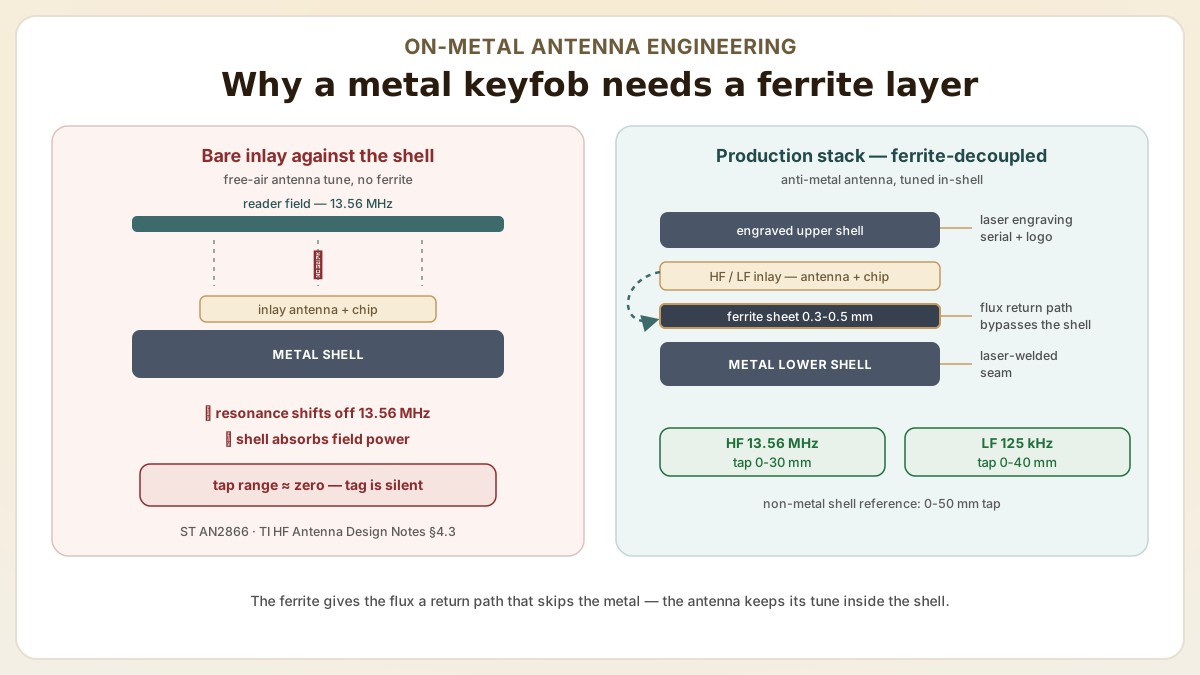
- Detuning kills first: power transfer and read distance peak when the tag resonates at the reader carrier, and a metal surface in the antenna environment shifts that tuning off 13.56 MHz (STMicroelectronics AN2866).
- Absorption finishes the job: metal close to the antenna soaks up field power, cutting read distance even where the tuning survives (Texas Instruments, HF Antenna Design Notes).
- The 0.3-0.5 mm ferrite sheet between inlay and lower shell gives the magnetic flux a high-permeability return path that bypasses the metal boundary.
- The anti-metal antenna is tuned in its final in-shell position, not in free air — which is why HF tap holds at 0-30 mm and LF at 0-40 mm through the shell, versus 0-50 mm in a non-metal fob.
Metal RFID keyfob specifications
Every number a PACS integrator or a procurement reviewer will want to check, in one pass. Chip choice is independent of alloy choice — the ferrite stack does the RF work under any of the three shells.
| Attribute | Value | Notes |
|---|---|---|
| Form factors | Teardrop / rectangle / rounded-rectangle | Ø 4-6 mm key-ring hole |
| Dimensions | 30-55 mm × 20-30 mm × 4-8 mm | Two-piece shell, laser-welded or snap-fit |
| Mass | 15-30 g | Varies by alloy and footprint; aluminium runs 50-60 % of steel |
| Housing alloys | 316L stainless (ASTM A276) · die-cast zinc ZA-4 / ZA-8 · anodised aluminium 6061 / 7075 | Stainless passivated per ASTM A967 |
| Antenna isolation | Ferrite sheet 0.3-0.5 mm between inlay and lower shell | Anti-metal antenna, tuned in its final in-shell position |
| HF chip options (13.56 MHz) | MIFARE Classic 1K · MIFARE DESFire EV3 · NTAG 213/215/216 · NTAG 424 DNA · I-CODE SLIX2 | Match chip and encoding format to the installed reader estate |
| LF chip options (125 kHz) | EM4200 · EM4305 · T5577 · HID-compatible | For legacy reader estates |
| Read range | HF tap 0-30 mm · LF tap 0-40 mm | Versus 0-50 mm for the same chip in a non-metal shell |
| Drop rating | 2.0 m stainless / zinc · 1.5 m aluminium | IEC 60068-2-32 Ea |
| Vibration / shock | IEC 60068-2-6 vibration 5-500 Hz 5 g RMS 2 h / axis · MIL-STD-810G shock 40 g, 11 ms | NEBS GR-63-CORE Level 3 for data-centre key carriers |
| Skin-contact compliance | EN 1811 nickel release ≤ 0.5 µg/cm²/week · REACH Annex XVII entries 27 / 63 | All three alloys |
| Food-contact posture | 316L stainless: LGA / FDA 21 CFR 175 incidental | Aluminium only with NSF 51 food-grade anodising; plated zinc is not food-grade |
| Chemistry disclosure | RoHS 3 (EU 2015/863) · REACH SVHC screen · CA Prop 65 | Screened on every plating-chemistry lot |
| Decoration | Laser engraving (30-50 W fibre) · epoxy-filled enamel (zinc) · PVD gold / rose gold / black | Engraved serial survives the housing's full service life |
| Housing field life | 15-25 years under daily carry | Chip-family migration is the usual retirement driver |
Where metal keyfobs earn their place in the catalogue
Metal-fob deployments split into two families: the ones that must outlive the cleaning schedule, and the ones that must look expensive doing nothing at all. Both usually arrive as part of a wider keyfob access-control programme — the shell changes, the PACS does not.
Commercial kitchens, food plants, labs
316L stainless credentials cleared for food-contact incidental under LGA / FDA 21 CFR 175; NSF 51 food-grade anodised aluminium is acceptable for ancillary use.
Pharma, biotech and cleanroom ancillary
316L stainless is the only non-shedding, caustic-resistant credential surface acceptable in grade D / C cleanroom support areas.
NEBS / MIL-STD hardware carriers
Data-centre hand-off fobs, military-GSE credentials and rolling-stock operator fobs — the mechanical-retention envelope that fatigues plastic housings.
Air-interface envelope
13.56 MHz HF — ISO 14443 Type A/B (MIFARE Classic 1K, MIFARE DESFire EV3, NTAG 213/215/216, NTAG 424 DNA, I-CODE SLIX2). 125 kHz LF — EM4200 / EM4305 / T5577 / HID-compatible for legacy reader estates.
Antenna design
Ferrite sheet 0.3-0.5 mm thick between inlay and metal lower shell decouples the antenna from the metal boundary. Read-range on HF 13.56 MHz tap 0-30 mm (versus 0-50 mm in a non-metal shell); LF 125 kHz tap 0-40 mm with tuned anti-metal inlay.
Nickel release + skin chemistry
EN 1811 nickel-release test: ≤ 0.5 µg/cm²/week for prolonged skin contact (fob on a key-ring in a pocket or handbag). 316L stainless passivated per ASTM A967; electroplated zinc alloy with thick Ni-Cr top coat; anodised aluminium with sealed oxide layer.
REACH + RoHS posture
REACH Annex XVII entries 27 (nickel release) and 63 (lead in consumer articles) cleared; SVHC candidate-list screen on every plating chemistry lot. RoHS 3 (EU 2015/863) cleared on plating + solder + inlay; CA Prop 65 disclosure for consumer markets.
Food-contact posture
316L stainless is food-grade per LGA / FDA 21 CFR 175 incidental contact; acceptable in food-plant and commercial-kitchen wash-down environments. Plated zinc alloy is not food-grade; aluminium not food-contact unless passivated with food-grade anodising per NSF 51 — pick stainless for food use.
Mechanical durability
IEC 60068-2-32 Ea drop 2.0 m (stainless / zinc); 1.5 m (aluminium); IEC 60068-2-6 vibration 5-500 Hz 5 g RMS 2 h / axis. MIL-STD-810G shock Method 516.6 (40 g, 11 ms); NEBS GR-63-CORE Level 3 for data-centre key carriers.
Finish + decoration
Laser engraving (30-50 W fibre) for permanent serial + logo on stainless / aluminium; epoxy-filled enamel on zinc alloy. PVD (physical vapour deposition) finishes — gold / rose gold / black — for premium hospitality + automotive SKUs.
Use-case envelope
Premium residential and automotive credentials; yacht-club / executive-parking / VIP-membership access. Commercial kitchen / food-plant stainless credentials; lab-bench access; NEBS / MIL-STD vibration environments.
Operational lifecycle
Typical field life 15-25 years under daily carry — the housing outlasts the inlay chip technology (chip-family migration is the usual driver for replacement). Retirement: laser-engraved serial is defaced, inlay pulled, chip rendered inoperative per NIST SP 800-88; stainless / zinc / aluminium to WEEE metal stream.
- Luxury residential / high-rise / private-club access — brushed 316L stainless or PVD-gold-plated zinc alloy with laser-engraved building mark. Paired with MIFARE DESFire EV3 for ISO/IEC 27001-aligned AES-128 PACS.
- Automotive / yacht / aviation executive access — dealership loaner fob, service-department credential, yacht-club card alternative. PVD finish matches brand identity; NTAG 424 DNA SUN tap for mobile-wallet integration.
- Brand membership / loyalty premium credentials — boutique hotel chain, sports club, premium-brand loyalty programme; PVD finish + NTAG 424 DNA SUN tap-to-reveal for branded content.
How to roll out a metal keyfob programme without breaking PACS or safety chemistry
The sequence mirrors any keyfob rollout, with two metal-specific gates bolted on: a tap-range acceptance test at every reader, and a chemistry evidence pack that follows the fob for its whole 15-25 year tour. Teams that skip a gate at week one traditionally rediscover it at week six.
- Week 1 — alloy + finish selection
Freeze alloy (316L / zinc / aluminium), finish (brushed / PVD / anodised / enamel) and chip per-site; model nickel-release + REACH Annex XVII + RoHS 3 evidence pack into the RFQ.
- Weeks 2-3 — antenna + reader validation
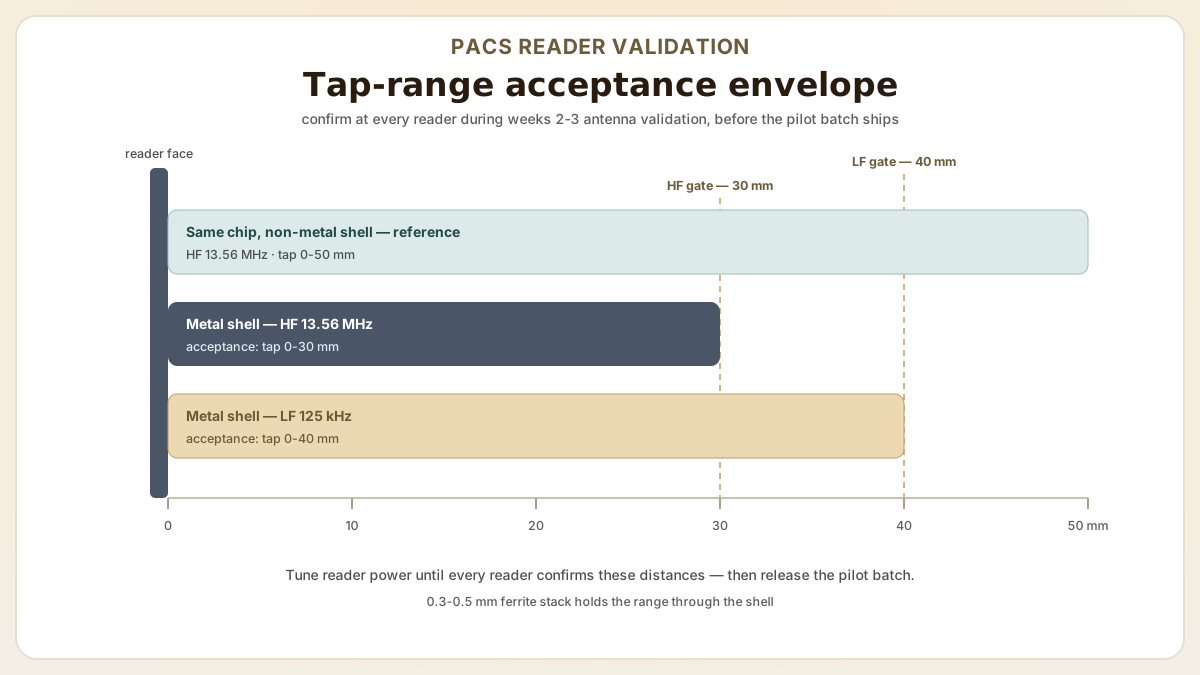
Sample 200-500 fobs with the selected chip; tune reader power so HF tap 0-30 mm and LF tap 0-40 mm are confirmed at every reader; confirm 2.0 m drop + 5-500 Hz vibration.
- Weeks 4-5 — encode + issue workflow
Stand up the encode bench tied to HRIS / ITAM / visitor-management; revocation latency < 10 s; pilot batch rolled to 500-2,000 credentials.
- Weeks 6-10 — premium + food / lab rollout
Deploy across residential / automotive / hospitality premium sites (PVD + laser engraving) and commercial kitchen / food-plant / lab sites (316L brushed + food-contact declaration); audit reads, failures, user hand-feel feedback.
- Month 4+ — estate audit + sustainability reporting
Wire credential issue / revoke / retirement events into ISO/IEC 27001 A.11.1, SOC 2 CC6, HIPAA 164.310 and PCI DSS v4.0 Req. 9 evidence trails; log WEEE Annex VII metal-stream disposal and feed Higg Index / CDP reporting. Schedule periodic compliance reviews and refresh-cycle planning per vertical.
- Alloy first: 316L stainless for food / lab / premium, zinc alloy for high-detail branded logos, aluminium for lightweight or colour-library SKUs.
- Specify the ferrite sheet (0.3-0.5 mm) and the anti-metal antenna tune per chip; HF tap 0-30 mm and LF tap 0-40 mm are the acceptance criteria at every reader.
- Close the chemistry audit: EN 1811, REACH Annex XVII entries 27 / 63, REACH SVHC screen, RoHS 3 DoC, CA Prop 65 — plus the LGA / FDA 21 CFR 175 declaration on food-plant SKUs.
- Lock the finish: laser engraving for stainless / aluminium serials, epoxy-enamel for zinc branding, PVD gold / rose gold / black for premium cosmetics.
- Keep lifecycle identical to plastic fobs: PACS revocation within 10 s of HRIS termination; retirement defaces the engraved serial and pulls the inlay before the shell enters the WEEE metal stream.
- Plan recycling up front: stainless and aluminium separate cleanly; plated zinc needs plating-strip and zinc-recovery processing under WEEE Annex VII.
Useful next pages
Use these linked product, guide and comparison pages to keep the next click specific and practical.
Related keyfob and premium-credential options
Alternative keyfob housings and premium-credential adjacents in the catalogue.
FAQ
Is the metal keyfob safe for prolonged skin contact?
Yes — all three alloys (316L stainless, die-cast zinc alloy ZA-4 / ZA-8 with Ni-Cr plating, anodised aluminium 6061 / 7075) pass EN 1811 nickel release at ≤ 0.5 µg/cm²/week and clear REACH Annex XVII entries 27 (nickel) and 63 (lead). 316L stainless and anodised aluminium are the strongest-posture options for nickel-sensitive users; the electroplated zinc variant uses a Ni-Cr top coat specifically sized to stay under the threshold.
Which alloy is suitable for food-plant and commercial-kitchen environments?
316L austenitic stainless steel per ASTM A276, passivated per ASTM A967, is the only food-contact-incidental option under LGA and FDA 21 CFR 175; it tolerates hot-caustic (1-2 % NaOH, 60-80 °C), peracetic-acid (80-150 ppm) and chlorinated-alkaline wash-down indefinitely. Plated zinc alloy is not food-grade because the plating chemistry is not cleared; anodised aluminium is acceptable only when NSF 51 food-grade anodising is specified. Pick 316L stainless for commercial kitchens, food plants, pharma-ancillary areas and labs.
Does the metal shell compromise read range on the reader?
No, provided the 0.3-0.5 mm ferrite sheet is specified between the inlay and the metal lower shell and the antenna is tuned for the anti-metal environment. HF 13.56 MHz tap range is 0-30 mm (vs 0-50 mm in a non-metal shell) and LF 125 kHz tap range is 0-40 mm — in both cases well inside the handshake envelope of every PACS reader we have validated against. The read range is the only spec that changes versus an ABS / epoxy fob; chip, PACS integration, Wiegand / OSDP behaviour are identical.
Why does a bare RFID inlay stop reading inside a metal shell?
A 13.56 MHz credential is powered by inductive coupling and transfers energy efficiently only while its antenna resonates at the reader's carrier frequency; metal in the antenna environment shifts that tuning and absorbs field power, so an unshielded inlay inside a metal housing loses most or all of its read range. Metal RFID keyfobs restore performance with a 0.3-0.5 mm ferrite sheet between the inlay and the lower shell plus an antenna tuned in its final in-shell position, holding tap range at 0-30 mm HF and 0-40 mm LF.
Can a metal keyfob run on an existing HID or MIFARE / DESFire reader estate?
Yes. Metal keyfobs take the same chip families as plastic fobs: 125 kHz EM4200 / EM4305 / T5577 / HID-compatible for legacy LF estates, and 13.56 MHz MIFARE Classic 1K, MIFARE DESFire EV3, NTAG 213/215/216, NTAG 424 DNA or I-CODE SLIX2 for HF estates. Specify the chip and encoding format to match the installed readers — the metal shell changes tap distance (0-30 mm HF), not protocol behaviour.
Can metal keyfobs carry logos and sequential serial numbers?
Yes. 316L stainless and anodised aluminium fobs are laser-engraved (30-50 W fibre) with permanent logos and per-fob serials; die-cast zinc alloy carries epoxy-filled enamel branding, and PVD gold / rose gold / black finishes cover premium programmes. The engraved serial supports per-credential issue and audit logging, and is defaced when the fob is retired.
Is pre-encoding available on metal keyfobs?
Yes — pre-encoding (UID lock, sector-key programming, AES-128 diversified keys, HID Corporate 1000 format, DESFire application layout) adds no MOQ and is recommended for any order of 500+ fobs, so credentials arrive ready for the PACS enrolment bench rather than a site-side encoding session.
Sources & references
Primary standards, OEM datasheets and regulatory documents cited by this article. All URLs were verified on the access date shown below.
- ASTM A276/A276M — Standard Specification for Stainless Steel Bars and Shapes
Material specification for 316L austenitic stainless used on the stainless keyfob housing.
- ASTM A967/A967M — Standard Specification for Chemical Passivation Treatments for Stainless Steel Parts
Passivation regime applied to the 316L stainless fob to close the corrosion / nickel-release chemistry.
- EN 1811 — Reference test method for release of nickel from items intended to come into direct and prolonged contact with the skin
Consumer-skin nickel release test — ≤ 0.5 µg/cm²/week threshold used for key-ring items.
- Regulation (EC) 1907/2006 (REACH) — Annex XVII entries 27 (Nickel) and 63 (Lead)
Heavy-metal restriction framework applied to metal keyfob plating and alloy chemistry.
- 21 CFR Part 175 — Indirect food additives: Adhesives and components of coatings
Food-contact-incidental regime governing stainless and food-grade-anodised aluminium keyfob surfaces.
- NSF/ANSI 51 — Food Equipment Materials
Food-equipment-materials standard that food-grade-anodised aluminium variants reference for commercial-kitchen acceptability.
- AN2866 — How to design a 13.56 MHz customized antenna for ST25 NFC/RFID tags (Rev 6)
Tag-reader mutual-inductance coupling model; metal surfaces and ferromagnetic material shift the tag's tuning frequency; resonance at the carrier maximises power transfer and communication distance.
- HF Antenna Design Notes — Technical Application Report (11-08-26-003)
§4.3: metal close to a 13.56 MHz antenna detunes it and absorbs power, reducing read distance; antennas should always be tuned in their final positions.
Proud Tek is a Shenzhen-based RFID & NFC manufacturer supplying hotel chains, transit operators, event venues and retail brands worldwide. Every order includes free samples, RF testing and dedicated project support.
Get a Quick Quote
Tell us about your project and we'll respond within one business day. Fields marked (asterisk) are required.