
Battery Passport NFC
NFC Battery Passport Tags
EU 2023/1542 Ready

Quick answer
NFC battery passport tags are the NXP NTAG 424 DNA data carrier for the EU Battery Passport that Regulation 2023/1542 mandates from 18 February 2027. The deadline covers every EV battery, industrial battery > 2 kWh and LMT (e-bike / e-scooter) battery placed on the EU market. The tag pairs AES-128 5-key role-based access with chemical-resistant, anti-metal construction rated -40 °C to +85 °C per ISO 16750. Data models align with GBA and CIRPASS.
- EU Battery Regulation (EU) 2023/1542 hard deadline 18 February 2027 — applies to every EV battery, industrial battery > 2 kWh, and Light Means of Transport (LMT) battery placed on EU market. Set in primary regulation rather than delegated act; will not slip with broader ESPR (2024/1781) timing.
- NTAG 424 DNA with 5-key role-based access architecture — public consumer key (chemistry / carbon footprint / recycling) + authenticated owner key (SoH / warranty) + authorized service provider key (repair / diagnostic) + authorized recycler key (disassembly / hazardous handling). Direct implementation of Article 77 + Annex XIII access-level requirements.
- Automotive-grade ruggedization — chemical-resistant lamination + -40 °C to +85 °C operating temperature + ISO 16750 vibration qualification + anti-metal ferrite antenna for aluminium / steel battery pack housings + UV resistance. Aligned with Global Battery Alliance (GBA) Battery Passport data model + CIRPASS DPP interoperability architecture (GS1 Digital Link + JSON-LD + W3C DIDs).
Used in these industries
Deployments where this product is referenced on our industry landing pages.

At a glance
Use these short answers to decide whether this page matches the project before moving into the detail.
EU Battery Regulation 2023/1542 framework
EU Regulation (EU) 2023/1542 concerning batteries and waste batteries — entered into force 17 August 2023; battery-passport-relevant provisions effective 18 August 2024....
Required data elements per Annex XIII
Identification: manufacturer ID, model, serial, production date. Composition: battery chemistry (Li-ion variants — NMC / NCA / LFP / LMFP / sodium-ion etc.), critical ra...
Next step
Ready to move forward? Start your inquiry to get specific answers for this project.
Request battery passport tag quote- Chip silicon — NTAG 424 DNA AES-128 with 5-key architecture
-
- NXP NTAG 424 DNA (NT4H2421Gx): AES-128 + Secure Dynamic Messaging + 5 application keys + master key.
- Key 0: master / production only.
- Key 1: public-tap URL — consumer-facing chemistry / carbon footprint / recycling data.
- Key 2: authenticated-owner — SoH and warranty data, distributed via OEM app.
- Key 3: authorized-service-provider — repair and diagnostic data, distributed via dealer portal.
- Key 4: authorized-recycler — detailed disassembly instructions, material percentages, hazardous-substance handling, distributed to EU-approved battery recyclers.
- SDM/SUN URL PICC data field identifies which key authenticated the tap; backend selects appropriate data layer.
- Ruggedized construction for battery environments
-
- Chemical-resistant lamination — protects against LiPF₆ electrolyte exposure (lithium-ion battery electrolyte).
- High-temperature rated -40 °C to +85 °C — automotive battery pack operating range; survives Arctic logistics + automotive underbody.
- ISO 16750 vibration profile qualification — automotive vibration + shock resistance.
- UV-resistant for outdoor exposure (EV underbody, solar storage, e-mobility outdoor parking).
- Constant-vibration tolerance for LMT (e-bike / e-scooter / e-cargo) applications.
- Anti-metal antenna design for battery housings
-
- Battery pack housings typically aluminium or steel — standard NFC labels detune severely.
- Ferrite spacer + anti-metal antenna design recovers read range to 3-5 cm on metal substrate.
- Mounting positions: pack housing exterior, BMS area, charge-port vicinity — wherever consumer / inspector / recycler smartphone tap is operationally accessible.
- Embedded-inlay variant for batteries where exterior mounting is impractical (sealed industrial cells).
- Global Battery Alliance (GBA) Battery Passport alignment
-
- GBA Battery Passport framework harmonised with EU Regulation 2023/1542 at data-element level.
- GBA proof-of-concept pilots (2023-2024) with Audi, Tesla, CATL, LG Energy Solution, BASF shaped final EU delegated acts.
- Both cover battery identity, composition, carbon footprint, responsible sourcing, recycled content, performance / durability indicators.
- Re|Source consortium (cobalt chain-of-custody) + Aura Blockchain Consortium reference deployments for responsible-sourcing on-chain provenance — SDM URL can include pointer to ledger entry for cobalt-mine-to-pack traceability.
- CIRPASS DPP interoperability architecture
-
- CIRPASS EU Horizon Europe coordination project — establishes DPP transport-layer reference architecture.
- GS1 Digital Link URI + JSON-LD payload + W3C Decentralized Identifiers (DID) for issuer authentication.
- Battery Passport (2027) and broader ESPR DPP (2027-2030) share this transport layer — forward-compatible architecture.
- Proud Tek tags encode GS1 Digital Link URI compliant with CIRPASS reference architecture; programme deployed in 2026 forward-compatible with textile (2027-2028), electronics (2028-2029), construction (2029+) DPP rollout.
- Cloud registry + over-life data updates
-
- NFC tag stores unique identifier; SoH and degradation data updated in cloud registry by Battery Management System (BMS) via connected-vehicle / IoT platform.
- Tap-to-access serves latest data from registry — tag is persistent physical link, not stored-state device.
- Registry survives manufacturer business changes; multiple-stakeholder access continues even if OEM goes out of business.
- Recycler-tier data critical at end-of-life when vehicle has changed hands multiple times — tag-to-registry link persists across ownership transfers.
- Stakeholder use cases
-
- EV battery pack OEMs: Battery Regulation compliance for EU sales — primary procurement driver.
- Industrial stationary storage providers: > 2 kWh threshold captures grid-scale battery installations.
- LMT battery manufacturers: e-bike / e-scooter / e-cargo bike — passport requirement extends beyond automotive.
- Second-life battery repurposers: SoH data + chemistry + materials guide repurposing decisions (EV → stationary storage).
- Battery recyclers: disassembly + material composition data optimises recycling stream and recovery rates.
- Customs and market-surveillance integration
-
- Port inspectors and customs authorities tap-to-verify Battery Passport at import — faster clearance vs paper documentation.
- Notified-Body audits + Article 77 conformity assessment require functional Battery Passport on every unit.
- Pre-populating registry before EU shipment reduces customs clearance from 3-5 days to same-day.
- Market-surveillance authorities access regulator-tier data via authorized key for post-market surveillance + recall coordination.
- Procurement and lead times
-
- MOQ 5,000 pieces; lead time 15-20 business days for stock antenna designs.
- AES-128 5-key provisioning at NXP secure facility — coordinated through Proud Tek as part of first production batch.
- Programme lead time: 12-18 months from start to first production batch — covers procurement + data-registry integration + production-line validation + Notified-Body pre-audit.
- Decision window for 2027 deadline: Q3 2025 for most programmes.
- Compliance posture
-
- EU Regulation 2023/1542 Battery Passport Article 77 + Annex XIII alignment.
- EU Regulation 2024/1781 ESPR DPP umbrella framework forward-compatibility.
- ISO 16750 automotive vibration / chemical / temperature qualification.
- GS1 Digital Link 1.3 URI Syntax + ISO/IEC 15459 unique identifier.
- GBA Battery Passport reference data model + CIRPASS interoperability architecture.
- Typical pricing
-
USD 0.30–1.20 /pc @ 5k+ (typical FOB Shenzhen range) — firm quote in one business day.
Commercial terms
- MOQ
- Varies by SKU — stock items from 100 pcs; custom production typically 200-1,000 pcs
- Lead time
- Production 2-3 weeks after artwork and encoding sign-off; reorders on a 3-4 week cycle
- Samples
- Free samples and RF test report with every order; courier at customer cost
- Payment
- 50% T/T deposit, 50% before shipment; Net 30/60 for established accounts; LC for large orders
- Shipping
- FOB Shenzhen / Yantian; DHL, FedEx or EMS air freight; sea LCL / FCL for volume
- Response
- Itemized quote within one business day, Mon-Fri (UTC+8)
Why Battery Passport — hard 2027 deadline + lead-time arithmetic
- Hard deadline at 18 February 2027 set in primary regulation — the lead-time arithmetic is unforgiving. 12-18 months for tag procurement + data-registry integration + production-line validation + Notified-Body pre-audit places decision window at Q3 2025 for most programmes.
- Ruggedization is not optional — battery pack environments (chemical electrolyte exposure + -40 to +85 °C + automotive vibration + UV outdoor) destroy generic NFC labels in months.
- Role-based access via NTAG 424 DNA SDM is the structural answer to Annex XIII access tiers — single physical tag serves consumer / owner / service / recycler / regulator from one chip.
Generic NFC vs NTAG 424 DNA Battery Passport tag
Generic NTAG213 / 216 NFC label
- Single public URL — no role-based access tiers
- Standard adhesive — fails in battery electrolyte / temperature environments
- No anti-metal antenna — detunes severely on aluminium / steel pack housing
- Detuning + delamination results in unreadable tag within months
- Insufficient for Battery Regulation Article 77 + Annex XIII compliance
NTAG 424 DNA Battery Passport tag (this page)
- 5-key SDM role-based architecture: public + owner + service + recycler + regulator
- Chemical-resistant lamination + -40 to +85 °C + ISO 16750 vibration
- Ferrite spacer + anti-metal antenna for aluminium / steel pack housings
- 10+ year retention covers EV battery 10-15 year service life
- Article 77 + Annex XIII compliant + GBA + CIRPASS interoperability
What 5-key role-based access actually unlocks
- Public consumer tier: chemistry, carbon footprint, recycling info.
- Authenticated owner tier: state-of-health, warranty (OEM app key).
- Authorized service provider tier: repair, diagnostic (dealer portal key).
- Authorized recycler tier: disassembly, material percentages, hazardous handling.
- Regulator / market-surveillance tier: full compliance record (Notified-Body access).
From paper battery label 2010s to NFC + GBA + EU Reg 2023/1542 default
- 2010s
EV battery labelling relies on paper labels + serial numbers + paper documentation. State-of-health data accessible only via OEM diagnostic tools; recycling stream lacks composition data.
- 2017-2019
NXP NTAG 424 DNA launches with AES-128 SUN + 5-application-key architecture. Early adopters in automotive + industrial battery space begin pilot programmes.
- 2020
Global Battery Alliance (GBA) launches Battery Passport initiative — industry alignment on data model and stakeholder access tiers.
- 2023
EU Regulation 2023/1542 publishes (entry into force 17 August 2023). Article 77 + Annex XIII establish Battery Passport hard deadline of 18 February 2027.
- 2023-2024
GBA Battery Passport pilots with Audi, Tesla, CATL, LG Energy Solution, BASF — proof-of-concept demonstrates feasibility at consumer scale + shapes final EU delegated acts.
- 2024
EU Regulation 2024/1781 ESPR publishes — broader DPP framework. CIRPASS publishes interoperability reference architecture (GS1 Digital Link + JSON-LD + W3C DIDs). Battery-passport-specific provisions effective 18 August 2024.
- 2026 Today
Field-reference patterns drawn from EV-battery-pack, industrial-stationary-storage, light-mobility-ebike-scooter, second-life-repurpose, and recycler-end-of-life programmes converge on NTAG 424 DNA + 5-key SDM + chemical-resistant ISO 16750 ruggedized lamination + anti-metal ferrite antenna + GS1 Digital Link CIRPASS-compliant URI + cloud registry with BMS-fed SoH updates + Re|Source / Aura Blockchain pointer for responsible-sourcing as the operator-side template.
One tap, five keys — how the battery passport opens
A battery passport is a legal document that has to survive a decade bolted to a moving vehicle, and a printed sticker is not that document. The NTAG 424 DNA chip signs a fresh URL on every tap with an AES-128 key that never leaves the silicon, so the phone resolving the GS1 Digital Link identifier is reading a passport that authenticated itself first — before it shows a customs officer, a recycler or an owner a single field. The full authentication mechanics live in the NTAG 424 DNA SUN + CMAC encyclopedia; the general-purpose ESPR sibling is the NFC Digital Product Passport tag.
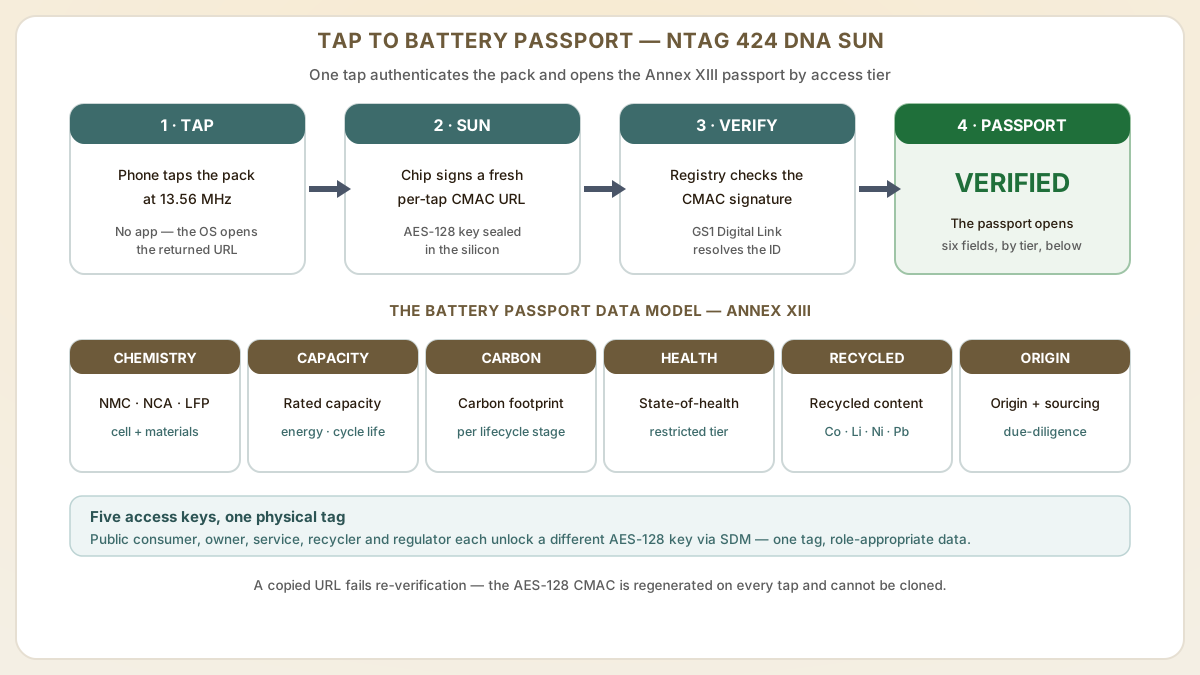
- Secure Dynamic Messaging signs a fresh CMAC URL on every tap; the AES-128 key is provisioned at NXP's secure facility and never leaves the silicon, so copying the label artwork or its URL does not reproduce the key.
- The SDM/SUN URL carries a PICC data field that tells the backend which of the five keys authenticated the tap, and the passport returns only the data layer that key is cleared for.
- Five keys, one chip: public consumer (chemistry, carbon footprint, recycling), authenticated owner (state-of-health, warranty), authorized service, authorized recycler (disassembly, hazardous handling), and regulator / market-surveillance.
- State-of-health is never stored on the tag — the chip is a persistent identifier into a cloud registry the BMS updates over the battery's life, so a tap always serves the latest reading and the link survives ownership transfers.
Built for the battery pack — anti-metal construction and mounting
The tag has to outlive everything the pack goes through: electrolyte, an Arctic supply chain, an automotive underbody, and a service life longer than most warranties. That rules out ink, and it rules out a generic label, which detunes to uselessness the moment it meets an aluminium or steel housing. The anti-metal build slips a ferrite spacer between the antenna and the metal to win the read back, then wraps the die in a chemical-resistant, high-temperature lamination. The bare-metal cousin for non-passport assets is the anti-metal RFID tag; the full label range sits on the RFID label hub.
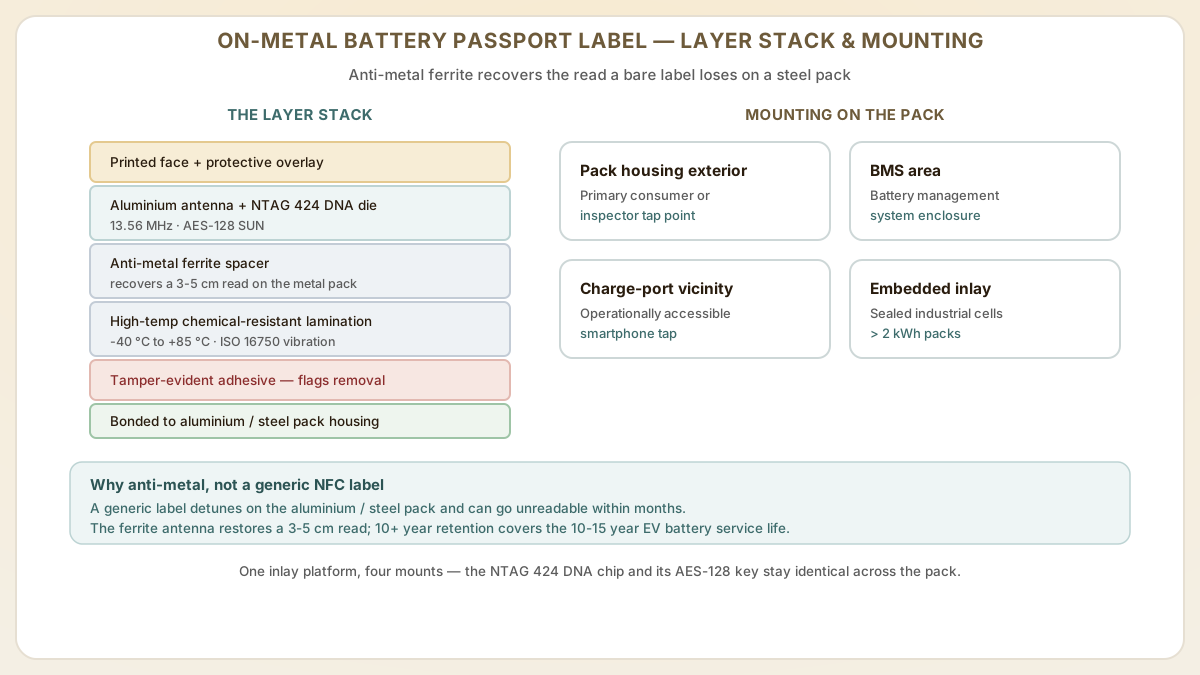
- Battery pack housings are aluminium or steel, and a standard NFC label detunes severely against them; a ferrite spacer plus a tuned anti-metal antenna recovers the read to 3-5 cm on the metal substrate.
- The lamination is chemical-resistant against lithium-ion electrolyte exposure and rated -40 °C to +85 °C — the automotive pack operating range — qualified to the ISO 16750 vibration and shock profile with UV resistance for outdoor exposure.
- Mounting follows the tap point: pack housing exterior, BMS area, or charge-port vicinity wherever a consumer, inspector or recycler smartphone can reach, with an embedded-inlay variant for sealed industrial cells.
- The tamper-evident adhesive ties the passport to the physical pack, and the chip's 10+ year retention covers the 10-15 year service life of an EV battery — long after a generic label would detune, delaminate and go unreadable within months.
NFC battery passport tag — the spec sheet
One place to scope the programme before a production line is committed: the chip, the on-metal build, the passport data model, and the commercial terms. The deadline arithmetic and the phased category rollout live on the EU compliance — ESPR, DPP, Battery Passport page; the end-to-end walk-through is the Digital Product Passport solution guide.
| Attribute | Value | Notes |
|---|---|---|
| Recommended chip | NTAG 424 DNA — AES-128 SUN / SDM, 5 keys | Public consumer / owner / service / recycler / regulator from one tag |
| Frequency / air interface | 13.56 MHz NFC — NTAG 424 DNA | Universal smartphone tap — no app install |
| Unique identifier | GS1 Digital Link 1.3 URI + ISO/IEC 15459 | Aligned with the GBA + CIRPASS reference data model |
| On-metal read | Ferrite spacer + anti-metal antenna — 3-5 cm on aluminium / steel | Recovers the range a bare label loses on a metal pack |
| Environmental rating | -40 °C to +85 °C · ISO 16750 vibration · UV-resistant | Chemical-resistant lamination for lithium-ion electrolyte exposure |
| Passport data fields | Chemistry · capacity · carbon footprint · state-of-health · recycled content · origin / due-diligence | Annex XIII elements, served per access tier |
| Access architecture | 5 AES-128 application keys via SDM / SUN | PICC data field selects the data layer on each tap |
| Regulatory anchor | EU Regulation 2023/1542 — Article 77 + Annex XIII | Battery Passport hard deadline 18 February 2027 |
| Applies to | EV · industrial > 2 kWh · LMT (e-bike / e-scooter) batteries | On the EU market, wherever the battery is manufactured |
| Registry model | Tag = persistent identifier; SoH updated in cloud by the BMS | Data survives ownership transfer and OEM business change |
| MOQ / lead time | 5,000 pieces · 15-20 business days | Stock antenna designs; AES-128 5-key provisioning at NXP secure facility |
| Programme lead time | 12-18 months to first production batch | Decision window Q3 2025 for the 18 February 2027 deadline |
| Compliance | EU 2023/1542 · ISO 16750 · GS1 Digital Link 1.3 · ISO/IEC 15459 · GBA + CIRPASS | Forward-compatible with ESPR 2024/1781 DPP |
Useful next pages
Use these linked product, guide and comparison pages to keep the next click specific and practical.
Related products
Other DPP and industrial NFC solutions in the cryptographic-authentication tier.
Industry & solution context
EU compliance, DPP framework, and battery industry deep-dives.
Chip-level technical reference
Deep-dive specifications for NTAG 424 DNA Battery Passport applications.
FAQ
When exactly does the Battery Passport become mandatory?
18 February 2027 for every EV battery, industrial battery > 2 kWh, and Light Means of Transport (LMT) battery placed on the EU market. Hard deadline set in primary regulation (Reg 2023/1542 Article 77) rather than a delegated act — will not slip with broader ESPR (2024/1781) timing. Applies regardless of where the battery is manufactured. Recommend starting implementation in Q3 2025 to allow 12-18 months for testing and integration.
Does the tag survive inside a battery pack enclosure?
Yes — battery passport tags designed for mounting on the exterior of the battery pack housing, BMS area, or charge-port vicinity. Anti-metal construction (ferrite spacer + tuned antenna) provides reliable NFC reading on aluminium / steel enclosure with 3-5 cm read range. Tag rated for full automotive temperature (-40 to +85 °C) and ISO 16750 vibration / shock profile. For batteries where exterior mounting is impractical (sealed industrial cells), embedded-inlay variant available.
Can the state-of-health data be updated over the battery's life?
Yes — NFC tag stores unique identifier linking to cloud-based data registry. State-of-health data is updated in the registry by the Battery Management System (BMS) via connected-vehicle / IoT platforms, NOT on the tag itself. When someone taps the tag, registry serves the latest SoH data. Tag is persistent physical link to digital record — not stored-state device. Registry survives manufacturer business changes; ownership-transfer + multi-stakeholder access continues across battery lifecycle.
How does the Battery Passport tag align with Global Battery Alliance (GBA) and CIRPASS?
EU Battery Regulation Battery Passport implementing acts harmonised with GBA Battery Passport framework at data-element level — both cover battery identity, composition, carbon footprint, responsible sourcing, recycled content, performance / durability indicators. GBA proof-of-concept pilots (Audi, Tesla, CATL, LG Energy Solution, BASF in 2023-2024) shaped final delegated acts. CIRPASS EU Horizon Europe project established DPP interoperability reference architecture (GS1 Digital Link URI + JSON-LD payload + W3C Decentralized Identifiers for issuer authentication) that Battery Passport + subsequent ESPR-driven DPPs share. Proud Tek tags encode CIRPASS-compliant GS1 Digital Link URI — programme deployed in 2026 forward-compatible with broader ESPR DPP rollout (textiles 2027-2028, electronics 2028-2029, construction 2029+).
What are the role-based access-control patterns NTAG 424 DNA SDM / SUN implements?
NTAG 424 DNA supports up to 5 application keys + master key. Typical Battery Passport deployment provisioning: (key 0) master / production only; (key 1) public-tap URL for consumer-facing carbon footprint / chemistry / recycling data; (key 2) authenticated-owner key for SoH and warranty data (distributed via OEM app); (key 3) authorised-service-provider key for repair / diagnostic data (distributed via dealer portal); (key 4) authorised-recycler key for detailed disassembly / material percentages / hazardous-substance handling (distributed to EU-approved battery recyclers). SDM/SUN URL message includes PICC data field identifying which key authenticated the tap — passport backend uses field to select data layer to return. Direct implementation of Article 77 + Annex XIII access-level requirements. SDM URL can additionally include pointer to Aura Blockchain Consortium or Re|Source battery-specific ledger entry for cobalt chain-of-custody mine-to-pack provenance.
What are the cobalt / lithium / nickel / lead recycled-content reporting requirements?
EU Regulation 2023/1542 Annex XII establishes mandatory minimum recycled-content thresholds: cobalt 16% by 2031, 26% by 2036; lithium 6% by 2031, 12% by 2036; nickel 6% by 2031, 15% by 2036; lead 85% by 2031, 95% by 2036. Battery Passport data must include actual recycled-content percentages for each. Producers must demonstrate compliance via supply-chain due-diligence documentation (Annex XV). NFC SDM URL pointer to Re|Source consortium ledger or Aura Blockchain Consortium entry enables cryptographic proof of recycled-content claims — increasingly procurement requirement on EV battery contracts.
What is the MOQ, lead time and programme timeline for battery passport tags?
MOQ is 5,000 pieces and lead time is 15-20 business days for stock antenna designs; AES-128 5-key provisioning happens at NXP's secure facility, coordinated through the first production batch, so budget a sampling round first. Across the full programme — tag procurement, data-registry integration, production-line validation and Notified-Body pre-audit — plan 12-18 months from decision to first production batch, which places the decision window at Q3 2025 for programmes facing the 18 February 2027 deadline.
Sources & references
Primary standards, OEM datasheets and regulatory documents cited by this article. All URLs were verified on the access date shown below.
- Regulation (EU) 2023/1542 — concerning batteries and waste batteries (EU Battery Regulation) — Article 77 + Annex XIII Battery Passport framework
Standalone Battery Passport regulation with hard 2027 deadline and 5-tier access architecture.
- Regulation (EU) 2024/1781 — Ecodesign for Sustainable Products Regulation (ESPR) — umbrella DPP framework
Broader ESPR framework — Battery Passport implementation extends compatibility forward.
- Global Battery Alliance Battery Passport — reference data model, pilot results, industry alignment framework
Industry-wide reference data model that EU Battery Regulation harmonised with at element level.
- CIRPASS — EU Horizon Europe coordination project establishing DPP interoperability reference architecture
GS1 Digital Link URI + JSON-LD + W3C DIDs reference architecture for cross-DPP interoperability.
- GS1 Digital Link URI Syntax standard — DPP transport layer
Web-addressable GS1 identifier encoding used as the Battery Passport URI transport layer.
- NXP NTAG 424 DNA product page and data sheet (NT4H2421Gx) — AES-128 SDM/SUN + 5-key role-based access architecture
Recommended chip silicon for EU Battery Passport — 5-application-key architecture maps directly to Annex XIII access tiers.
- NXP AN12196 — NTAG 424 DNA + TagTamper features and hints (SDM / SUN URL generation, PICC data role-identification field)
Application note covering 5-key SDM access-controlled file authentication for role-based Battery Passport access.
- NFC Forum Type 4 Tag Operation Specification
Defines the 13.56 MHz NFC carrier and Type 4 tag command set behind the tap-to-passport flow on the NTAG 424 DNA chip.
Proud Tek is a Shenzhen-based RFID & NFC manufacturer supplying hotel chains, transit operators, event venues and retail brands worldwide. Every order includes free samples, RF testing and dedicated project support.
Get a Quick Quote
Tell us about your project and we'll respond within one business day. Fields marked (asterisk) are required.