
Industrial RFID
Is RFID Too Expensive for Small Business?
Quick answer
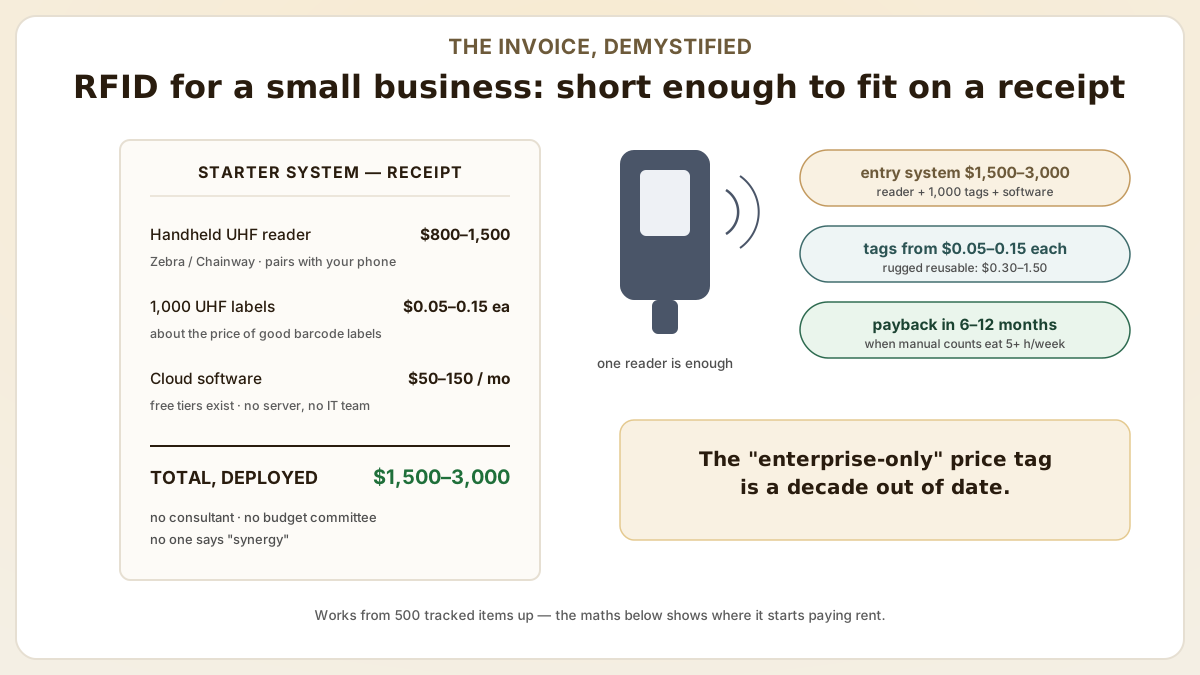
A working small-business RFID system costs $1,500-$3,000 — one handheld reader, 1,000 tags, cloud software — and pays back in 6-12 months if manual counts eat 5+ hours a week. The 'enterprise-only' price tag is a decade out of date; here is the invoice, line by line.
- Entry-level UHF RFID systems (handheld reader + software + initial tag supply) can be deployed for $1,500-$3,000, making RFID accessible to businesses with as few as 500 tracked items.
- RFID tag costs have dropped to $0.05-0.15 per tag for standard UHF labels, and $0.30-1.50 for rugged reusable tags. Far lower than most small business owners expect.
- Small businesses with manual counting processes spending 5+ hours per week on inventory management typically achieve positive ROI from RFID within 6-12 months through labor savings and error reduction alone.
At a glance
Use these short answers to decide whether this page matches the project before moving into the detail.
Key takeaway
Entry-level UHF RFID systems (handheld reader + software + initial tag supply) can be deployed for $1,500-$3,000, making RFID accessible to businesses with as few as 500 tracked items.
How do you handle breaking down RFID costs for small businesses?
Ask a small-business owner why they haven't looked at RFID and the answer is usually some version of 'that's for the big chains, not for me.' The technology has a reputa...
Next step
Ready to move forward? Start your inquiry to get specific answers for this project.
Get RFID tag pricing for your businessHow do you handle breaking down RFID costs for small businesses?
Ask a small-business owner why they haven't looked at RFID and the answer is usually some version of 'that's for the big chains, not for me.' The technology has a reputation for arriving with a dedicated IT team, a budget meeting, and a consultant who says 'synergy' a lot. The actual invoice is far less dramatic — and short enough to fit on a receipt. Here is what each piece really costs, in plain line items: reader, tags, software, and the manual labor it quietly replaces.
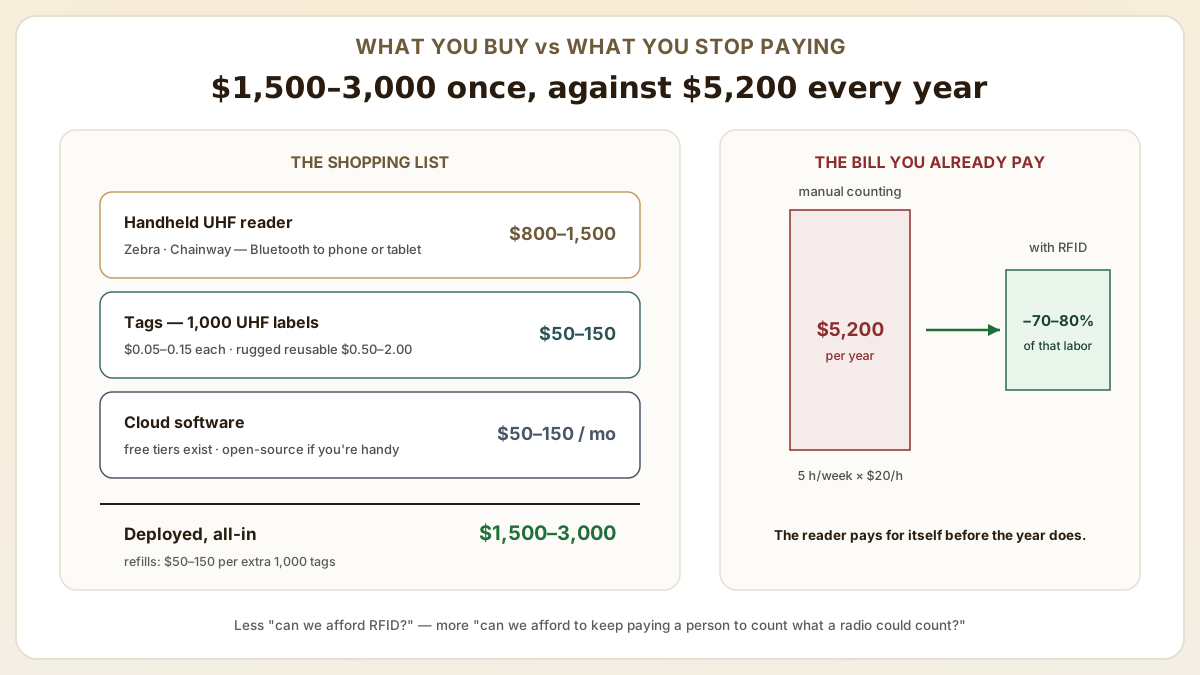
Put those two numbers next to each other and the question quietly reverses: it's less 'can we afford RFID?' and more 'can we afford to keep paying a person to count things a radio could count?'
- Handheld UHF RFID reader. Entry-level models from Zebra, Chainway, and other vendors start at $800-1,500 and connect to a smartphone or tablet via Bluetooth. These are sufficient for inventory counting, asset tracking, and shipping verification in small facilities.
- RFID tags and labels. Standard UHF RFID labels cost $0.05-0.15 per tag in quantities of 1,000+, comparable to the cost of high-quality barcode labels. Reusable hard tags for equipment and tools range from $0.50-2.00 each depending on form factor and durability.
- Software: several cloud-based RFID inventory platforms offer free tiers or plans starting at $50-150 per month for small businesses. Open-source options are also available for technically capable users.
- Total entry cost: a small business can deploy a functional RFID system (1 handheld reader, 1,000 tags, basic software) for approximately $1,500-3,000, with ongoing tag costs of $50-150 per 1,000 additional tags.
- Compare this to the cost of manual counting labor: if one employee spends 5 hours per week on inventory tasks at $20/hour, that is $5,200 per year in direct labor cost that RFID can reduce by 70-80%.
Which small business RFID use cases have the fastest ROI?
Not every use case pays back at the same speed. The ones below win because they attack a cost you are already paying — in lost time, lost tools, or lost stock — rather than adding a shiny capability you didn't have before. Match RFID to your most expensive recurring headache first.
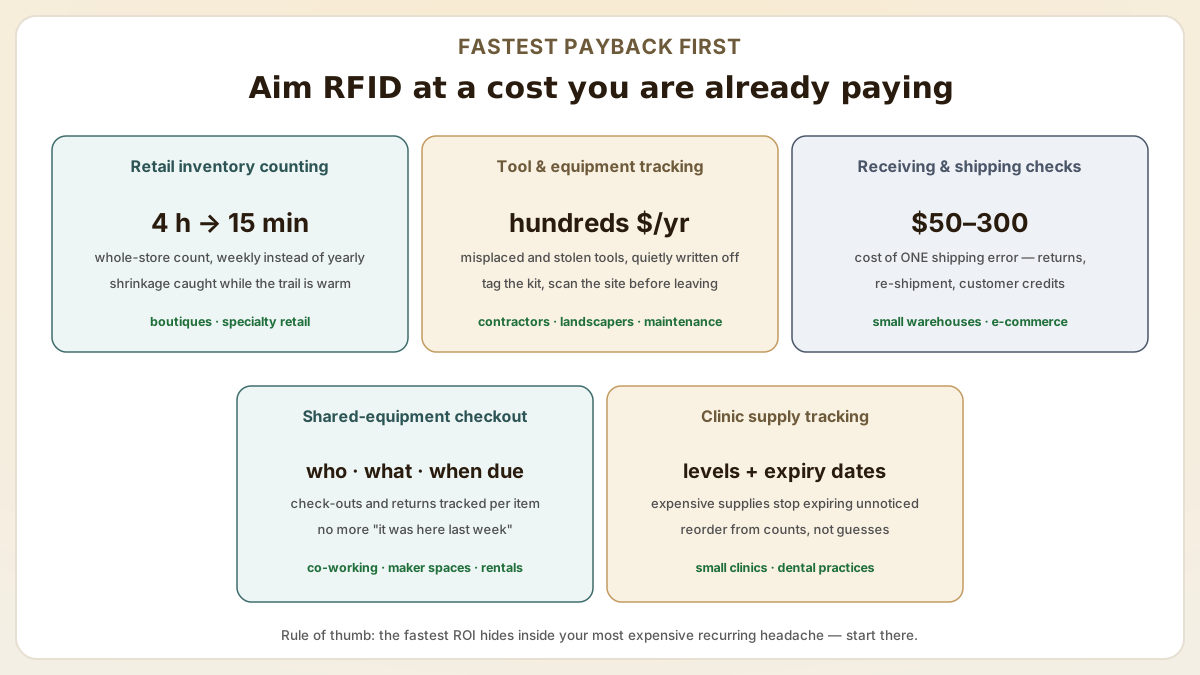
- Retail inventory counting: a clothing boutique or specialty retailer using RFID can count their entire store inventory in 15 minutes instead of 4 hours, enabling weekly counts that catch shrinkage and misplacement immediately.
- Tool and equipment tracking. Contractors, landscapers, and maintenance companies lose hundreds of dollars annually in misplaced or stolen tools. RFID-tagging equipment and scanning job sites eliminates this loss.
- Small warehouse receiving and shipping. Verifying inbound and outbound orders with RFID reduces shipping errors that cost $50-300 per incident in returns processing, re-shipment, and customer credits.
- Asset management for shared equipment. Co-working spaces, maker spaces, and rental businesses use RFID to track which items are checked out, by whom, and when they are due back.
- Medical and dental supply tracking. Small clinics and practices use RFID to monitor supply levels, track expiration dates, and prevent expensive supply waste.
How to start with RFID on a small business budget
The fastest way to overspend on RFID is to buy like an enterprise on day one — fixed readers bolted to the ceiling, a software suite with modules you'll never open, a tag on every item you own. The cheaper and smarter path is almost the opposite: start with the smallest setup that proves the point, then let the results sign off on the next purchase.
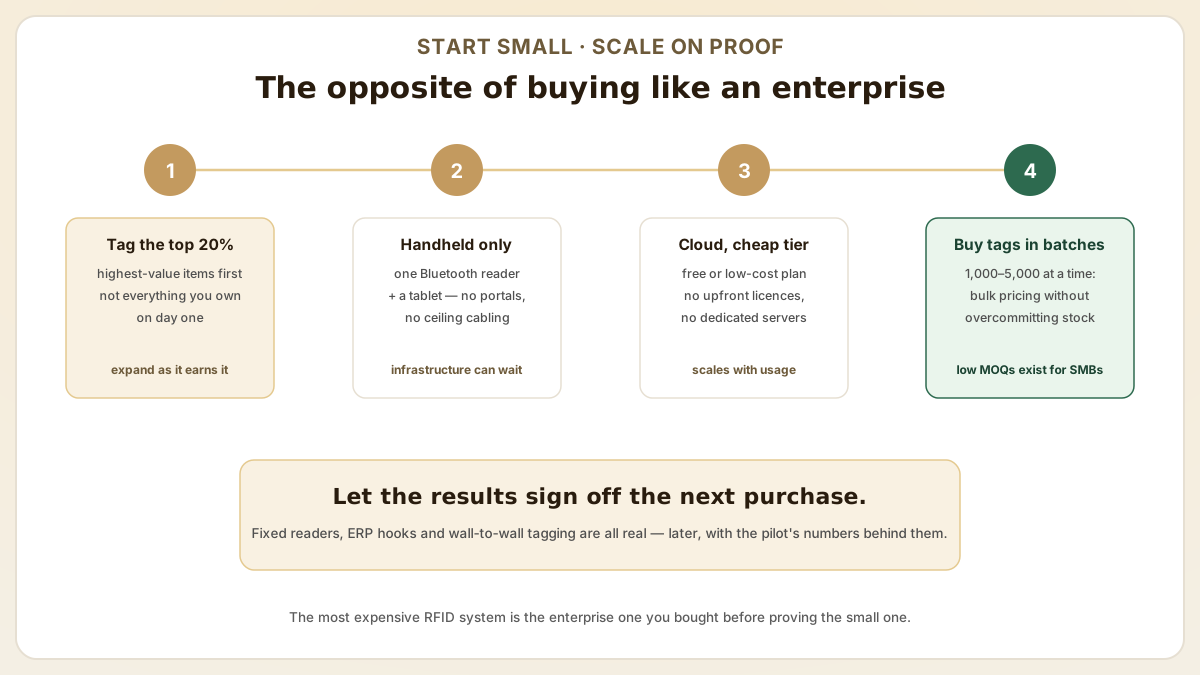
- Start small: tag your top 20% highest-value items first. You do not need to RFID-tag everything on day one. Expand as the system proves its value.
- Choose a handheld-only setup initially. Avoid the cost of fixed portal readers and infrastructure cabling. A single Bluetooth handheld reader connected to a tablet handles most small business needs.
- Use cloud-based software with a free or low-cost plan. Avoid large upfront software licensing fees. Cloud platforms scale with your usage and do not require dedicated servers.
- Order RFID tags from Proud Tek in quantities of 1,000-5,000 to access bulk pricing without overcommitting inventory. We offer low MOQs specifically designed for small business customers entering the RFID market.
Three real small-business RFID deployments — what they actually cost
Generic 'RFID for small business' cost ranges hide huge variance. The three case-study profiles below — drawn from actual SMB deployment patterns documented in vendor case studies and AssetPulse, RFIDLinked and SimpleRFID forums — show what real money buys at real scale, with actual hardware, software and lifetime cost line items.
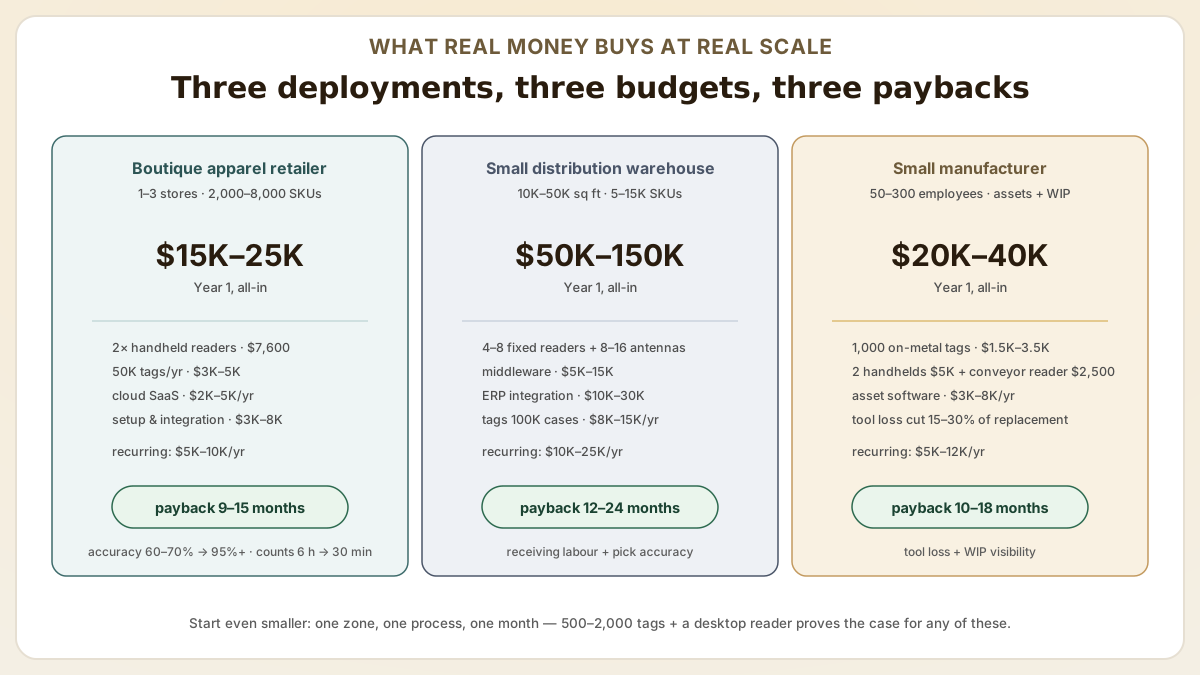
- Boutique apparel retailer (1-3 stores, 2,000-8,000 SKUs) — UHF inlay $0.06-$0.10/tag x 50K tags = $3K-$5K annual tag spend. Two Zebra MC3300x handheld readers $3,800 each = $7,600 hardware. Cloud SaaS (SimpleRFID, RFIDLinked) $59-$120/month per user = $2K-$5K/year. Initial setup labour and integration $3K-$8K. Total Year 1: $15K-$25K. Annual recurring: $5K-$10K. Payback typically 9-15 months from inventory accuracy gain (95%+ from 60-70% manual baseline) and labour reduction (cycle count from 6 hours to 30 min).
- Small distribution warehouse (10K-50K sq ft, 5-15K SKUs) — Per AssetPulse and CPCON benchmarks, $50K-$150K Year 1 covers 4-8 fixed UHF readers (Impinj R420 / R700 at $1,500-$3,000 each) plus 8-16 antennas at $150-$300 each, RFID middleware (Impinj ItemSense, TagMatiks Lite) $5K-$15K, integration with QuickBooks/NetSuite/Sage $10K-$30K, training $3K-$8K. Tag spend $0.08-$0.15/case-level x 100K cases = $8K-$15K/year. Recurring $10K-$25K. Payback 12-24 months from receiving labour reduction and pick accuracy.
- Small manufacturer (50-300 employees, asset and WIP tracking) — Mixed UHF + LF deployment. Asset tags (tools, fixtures, returnable totes) UHF on-metal $1.50-$3.50/tag x 1,000 = $1.5K-$3.5K. Two handheld readers $5K. WIP tracking with conveyor-mounted UHF reader $2,500. Asset management software (Asset Panda, GreyTrunk RFID, FactorySense) $3K-$8K/year. Year 1 total $20K-$40K. Recurring $5K-$12K. Payback 10-18 months from tool loss reduction (typically 15-30% of replacement cost) and WIP throughput visibility.
- Common avoid-this-trap pitfalls — Over-buying enterprise software (Manhattan Associates, Oracle WMS) when SimpleRFID, RFIDLinked or Asset Panda do the job; over-spec'd readers (Impinj R720 enterprise gateway when an R420 works); buying tags before validating tag selection on actual surfaces; skipping the 50-200 unit pilot and going straight to 10K production; under-investing in training so the system gets bypassed within 6 months.
- Where SMBs should actually start — One zone, one process, one month. Pick the highest-pain inventory category (typically high-shrink or high-cycle-count items), buy 500-2,000 tags + one $1,200-$1,800 USB desktop UHF reader (TSL 1166, Zebra DS9908-R, Atlas Standard Desk Reader), connect to a $30-$60/month cloud SaaS, and run cycle counts for 30 days. The data justifies the larger investment — or shows that barcode + better process discipline is enough.
SMB RFID software shortlist — what actually fits a sub-$50K budget
Enterprise RFID software (Manhattan Active Inventory, SAP RFID, Oracle WMS Cloud) starts at $50K-$200K/year licensing and presumes an IT team. SMB-grade RFID software hits the sweet spot of usable, integrated, and affordable — these are the platforms that actually ship in <$50K total budgets.
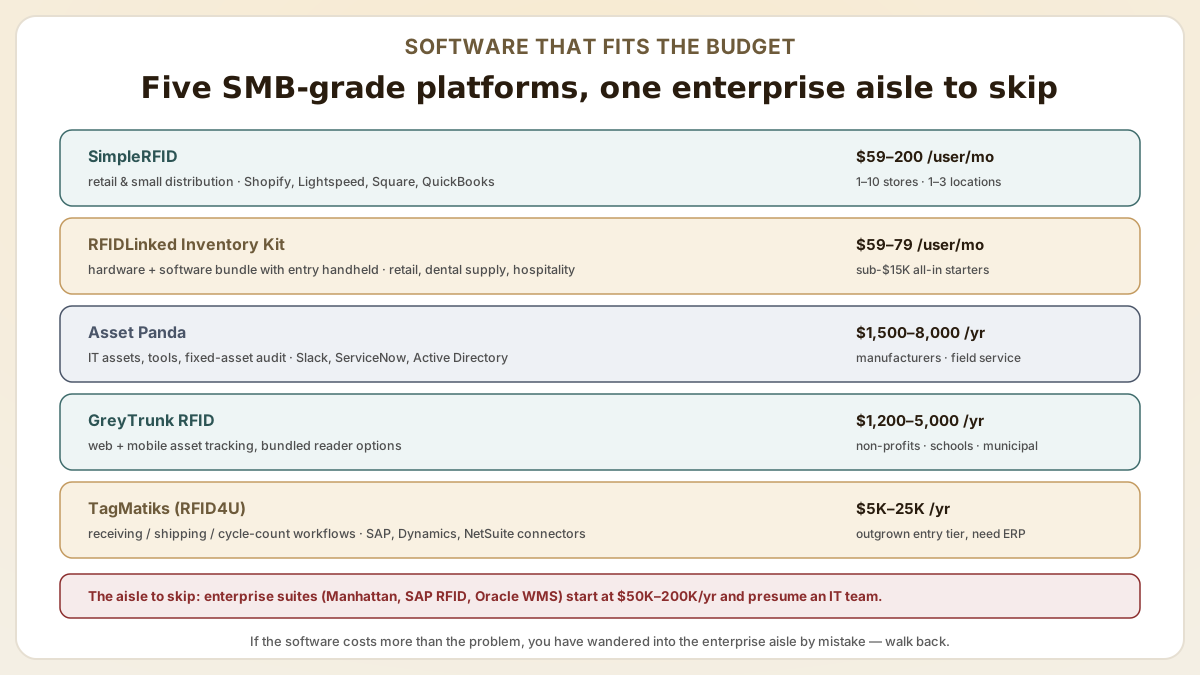
The honest budget test, in one line: if the software costs more than the problem, you have wandered into the enterprise aisle by mistake — walk back.
- SimpleRFID (simplyrfid.com, simplerfid.com) — Cloud SaaS purpose-built for retail and small distribution. $59-$200/user/month. Native iOS/Android apps work with TSL, Zebra, CipherLab handhelds. Direct integrations with Shopify, Lightspeed, Square, QuickBooks. Best for 1-10 store retail and 1-3 location distribution.
- RFIDLinked Inventory Kit — All-in-one hardware + software bundle starting $59-$79/user/month. Comes with iOS app and entry handheld reader. Targets retail, dental supply, hospitality. Strong for sub-$15K all-in starter programs.
- Asset Panda — Asset tracking SaaS with RFID and barcode support. $1,500-$8,000/year for SMB tiers. Integrations with Slack, ServiceNow, Active Directory. Best for IT asset management, tool tracking, fixed-asset audit at small manufacturers and field-service businesses.
- GreyTrunk RFID — Low-cost asset tracking platform $1,200-$5,000/year. Web + mobile apps. Bundled handheld reader options. Good fit for non-profits, schools, municipal asset tracking.
- TagMatiks (RFID4U) — Slightly larger SMB scale, $5K-$25K/year licensing. Workflow templates for receiving, shipping, cycle count, audit. SAP, Microsoft Dynamics and NetSuite connectors. Right pick when you've outgrown the entry-tier and need ERP integration but don't want to hire an enterprise integrator.
Useful next pages
Use these linked product, guide and comparison pages to keep the next click specific and practical.
Affordable RFID products for small businesses
Explore cost-effective RFID tags and labels with low minimum orders.
SMB RFID resources and software comparisons
Public references and pricing benchmarks for small-business-friendly RFID platforms.
FAQ
What is the minimum number of items that makes RFID worthwhile for a small business?
There is no hard minimum, but RFID typically becomes cost-effective when you are tracking 300+ items and spending more than 3-5 hours per week on manual inventory counting or asset management. Below that threshold, the time savings may not justify the initial hardware investment, though the accuracy improvement may still be valuable for high-value items.
Can I use RFID without a dedicated IT person?
Yes. Modern cloud-based RFID platforms are designed for non-technical users. Handheld readers connect via Bluetooth to a smartphone app with minimal configuration. Proud Tek supplies pre-encoded tags ready to use out of the box. Most small business owners can be operational within a day of receiving their equipment.
How long do RFID tags last?
Adhesive RFID labels last 1-5 years depending on environmental conditions. Rugged reusable tags (ABS, silicone, ceramic) last 5-10+ years. The RFID chip itself has unlimited read cycles and no battery to replace. For most small business applications, tags outlast the items they are attached to.
Can a single-location small business actually justify RFID, or should we stick with barcode?
It depends on three factors. First, SKU count above 1,500-2,000 distinct items — below this, barcode discipline plus a $300 wireless scanner usually wins. Second, cycle-count frequency above monthly — if you only count quarterly or annually, RFID's labour savings don't compound enough to pay back. Third, shrinkage above 1.5% of revenue — high-shrink categories (cosmetics, electronics, accessories, apparel) get fast RFID payback from accuracy alone, low-shrink categories (groceries, hardware) usually don't. A boutique apparel store with 5,000 SKUs counting weekly with 2-3% shrink hits payback in 9-15 months. A small hardware store with 800 SKUs counting quarterly with 0.5% shrink probably never does — and should optimise barcode workflow instead.
What's the smallest pilot we should run before committing to a full RFID rollout?
$2,500-$4,500 covers a credible 30-day pilot. Buy: 500-2,000 UHF tags ($30-$200), one USB desktop reader (Zebra DS9908-R or Atlas Standard Reader, $1,200-$1,800), one handheld (TSL 1128 or RFD8500 used $400-$900), one month SimpleRFID or RFIDLinked entry SaaS ($59-$120), and 4-8 hours of vendor onboarding ($300-$800). Tag your single highest-pain category (e.g. high-shrink premium items, frequently mislocated stock, or audit-critical fixed assets), run daily cycle counts for 30 days, and measure: count time, accuracy delta vs. manual baseline, and number of items found that were 'lost' in the WMS. Three of those four measurements at significant improvement justify the larger spend; if only one or two move, refine the use case before scaling.
Proud Tek is a Shenzhen-based RFID & NFC manufacturer supplying hotel chains, transit operators, event venues and retail brands worldwide. Every order includes free samples, RF testing and dedicated project support.
Get a Quick Quote
Tell us about your project and we'll respond within one business day. Fields marked (asterisk) are required.