
Case study · Retail & apparel
UHF Source-Tagging at 11M Tags/Year
Apparel

Quick answer
A North American mid-tier apparel retailer source-tagged its full-price women's, men's and children's apparel SKUs with Impinj Monza R6-P UHF inlays on hang-tag-format paper labels. Annual programme volume: 11 million units. Store inventory accuracy moved from 67% (visual cycle counts) to 98% (handheld UHF scans every 7 days). Out-of-stock at the size level fell 26%.
- Customer profile — North American mid-tier apparel retailer, 340 stores, 11 M units / year tagged.
- Chip selected — Impinj Monza R6-P, UHF RAIN, 96-bit EPC + 32-bit TID, Autotune-enabled for variable apparel substrate.
- Inventory accuracy lift — 67% (pre-RFID visual counts) → 98% (handheld weekly scans). Size-level OOS down 26%.
At a glance
Use these short answers to decide whether this page matches the project before moving into the detail.
Customer profile
North American mid-tier apparel retailer, 340 stores, 11 M tagged units / year across women's, men's and children's apparel.
Chip & form factor
Impinj Monza R6-P, UHF RAIN, 96-bit EPC, 32-bit TID, Autotune-enabled. Paper hang-tag substrate, 80 × 50 mm, CMYK two-sided print + thermal-transfer EPC barcode + size/c...
Next step
Ready to move forward? Start your inquiry to get specific answers for this project.
Request an apparel inlay sample pack- Measured results (year 1 vs baseline)
-
- Store inventory accuracy: 67% → 98% (handheld scan every 7 days at every store).
- Size-level out-of-stock rate: -26%.
- Markdowns due to mis-priced inventory: -18%.
- Shrink (theft + admin error): -22% YoY at the chain level.
- Endless-aisle / store fulfilment of online orders: +14% units fulfilled from store.
Why source-tagging at the factory (not the DC)
Tagging in the retailer's DC (distribution centre) was the option this customer used during pilot. It worked but added a $0.04 / unit DC labour cost and a 4-day DC dwell time. Source-tagging — encoding at the apparel supplier's factory in Vietnam / Bangladesh / Indonesia — eliminated both costs and shifted the responsibility for chip presence to the goods receipt audit.
- DC tagging — $0.04 / unit DC labour + 4-day DC dwell. Convenient for pilot, not scalable to 11 M units / year.
- Source tagging at supplier factory — $0.00 incremental DC labour, 0-day DC dwell. Tag is part of the hang-tag artwork SKU.
- Trade-off — retailer needs an EPC encoding standard the suppliers can follow. Customer adopted GS1 SGTIN-96 with the retailer's GS1 prefix.
- Receipt audit — retailer's DC reads a 5% sample of every inbound carton through a portal reader to verify chip presence and EPC correctness.
Why Monza R6-P (and not UCODE 9 / Higgs 9)
Monza R6-P, UCODE 9 and Alien Higgs-9 are all viable for apparel source-tagging. The customer chose Monza R6-P for three reasons:
- Autotune — Monza R6-P automatically detunes the antenna based on the underlying substrate. Apparel substrate varies (jeans denim is wet-looking dielectric, lingerie is air-coupled, jackets have metal zipper interference). Autotune normalises read rate across these substrates without per-SKU antenna design.
- Read-rate consistency — the customer's existing reader fleet (Zebra FX9600 portals + MC9300 handhelds) was already tuned for Monza chips from a prior pilot. Switching chip family would have required re-tuning across 340 stores.
- GS1 compatibility — Monza R6-P supports the GS1 EPC Tag Data Standard 2.0 SGTIN-96 encoding natively, which is the customer's mandated standard.
- Cost — at the customer's annual volume the chip-cost delta vs UCODE 9 was less than $0.002 / unit, immaterial vs the Autotune benefit.
GS1 SGTIN-96 encoding at the supplier factory
Each tag carries a unique GS1 SGTIN-96 EPC = retailer's GS1 company prefix + item reference (SKU) + serial number. The retailer provides each supplier with a serial-number block, the supplier's encoder writes the EPC at the printing-and-attaching step, and a per-carton EPC manifest is uploaded to the retailer's WMS before the carton ships.
- EPC field — GS1 SGTIN-96 = 8-bit header (00110000) + 3-bit filter + 3-bit partition + 24-bit GS1 prefix + 20-bit item reference + 38-bit serial.
- Per-supplier serial-number block — retailer pre-allocates serial-number ranges to each supplier to guarantee uniqueness without supplier-to-supplier coordination.
- Carton manifest — supplier's encoder generates an EPCIS-compatible XML manifest per carton, uploaded to retailer's WMS before despatch.
- DC verification — retailer's DC reads each carton's EPCs at receipt and reconciles against the manifest. Mismatch triggers a chargeback to the supplier.
In-store handheld scans drive the inventory accuracy lift
Each store performs a full-floor RFID scan once every 7 days using a Zebra MC9300 handheld. A 100,000-unit store completes the scan in 35–45 minutes, vs the 8 hours a visual cycle count used to take. The inventory delta from the scan is reconciled into the WMS overnight and feeds the size-level replenishment recommendation. The 26% out-of-stock reduction is the operations team's primary KPI for the programme — replenishment recommendations only work if the underlying inventory data is trustworthy.
How the programme was built — inlay, source tagging, rollout
The architecture comes down to three decisions and one discipline: an inlay that reads through denim, lingerie and zipper metal without a per-SKU antenna; an EPC written at the supplier's factory so the tag arrives as part of the hang-tag artwork; and a goods-receipt audit that turns “is the chip actually there” into the supplier's problem to prove. The GS1 EPC encoding guide covers the identifier; the supply-chain solution covers the factory-to-DC leg.
- Chip and tag — a Monza R6-P UHF RAIN inlay (96-bit EPC + 32-bit TID, Autotune-enabled) laminated into an 80 × 50 mm paper hang-tag with CMYK two-sided print, a thermal-transfer EPC barcode and the size/colour SKU.
- Source tagging — the EPC is written at the apparel supplier's factory in Vietnam / Bangladesh / Indonesia, so goods arrive pre-encoded: $0.00 incremental DC labour and a 0-day DC dwell, versus $0.04 / unit and a 4-day dwell when the pilot tagged at the DC.
- Encoding standard — GS1 SGTIN-96 built from the retailer's GS1 company prefix, item reference and serial, with a per-supplier serial-number block so suppliers never coordinate to stay unique.
- Receipt audit — the DC reads a 5% carton sample through a portal reader and reconciles it to the supplier's per-carton EPC manifest; a mismatch triggers a chargeback to the supplier.
- Reader estate — the existing Zebra FX9600 portals and MC9300 handhelds, already tuned for Monza from the pilot, carried the rollout to all 340 stores without a chip-family re-tune.
- Scale — 11 M units / year across women's, men's and children's apparel.
The item-level lifecycle — factory encode to store floor
One tag, five checkpoints. The SGTIN-96 written at the factory is the same identifier the store-floor scan, the endless-aisle order and the returns desk all read — no re-encode, no re-key, no second barcode to reconcile. The inventory-tracking solution documents the store-floor half of this flow.
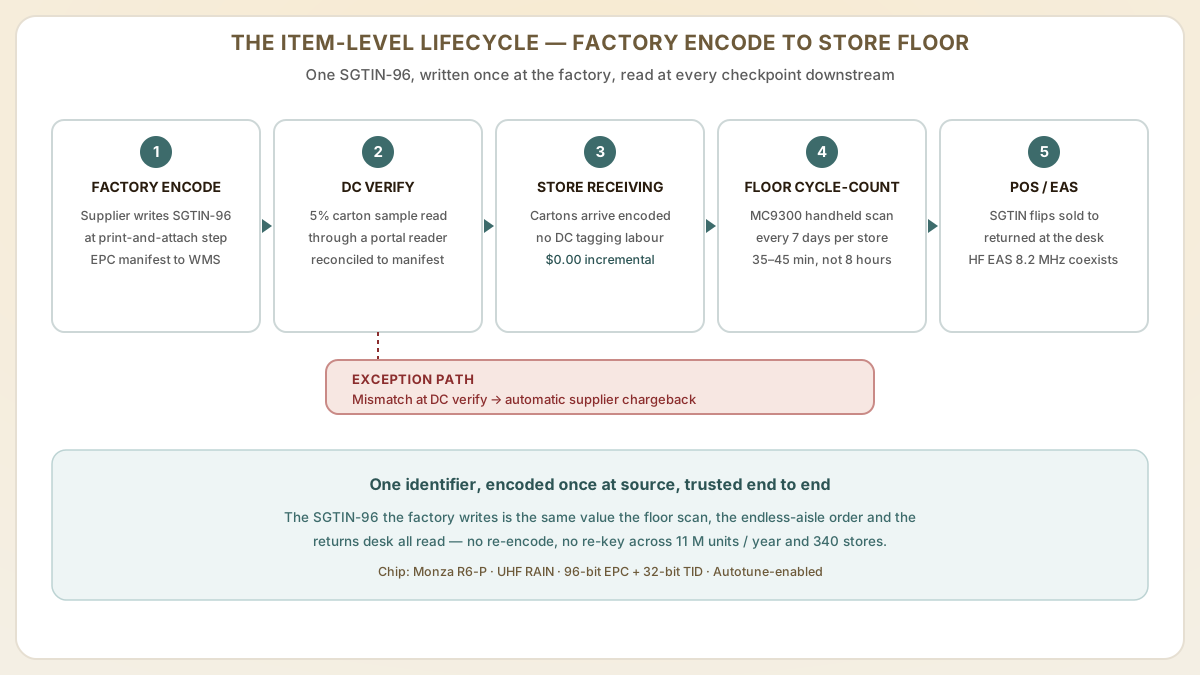
- Factory encode — the supplier writes the GS1 SGTIN-96 at the print-and-attach step and uploads a per-carton EPC manifest to the retailer's WMS before the carton ships.
- DC verify — the distribution centre reads a 5% carton sample through a portal reader and reconciles it to the manifest; the tag is already on the goods, so DC dwell stays at zero.
- Store receiving — cartons arrive pre-encoded, with no DC tagging step and no $0.04 / unit tagging labour to absorb.
- Floor cycle-count — every store re-scans its full floor every 7 days with an MC9300 handheld: 35–45 minutes for a 100,000-unit store, against the 8 hours a visual count used to take.
- POS and EAS — a returned item's SGTIN flips from ‘sold’ to ‘returned’ at the desk, and the store's HF EAS gates at 8.2 MHz coexist with the UHF RAIN inlays without cross-triggering.
Year-one results — measured against the pre-RFID baseline
The programme had one job: make the inventory number trustworthy. Everything downstream — replenishment, endless-aisle fulfilment, shrink control — is what a number you can trust unlocks, and year one put a figure against each. The wider pattern lives in the retail and apparel industry guide.
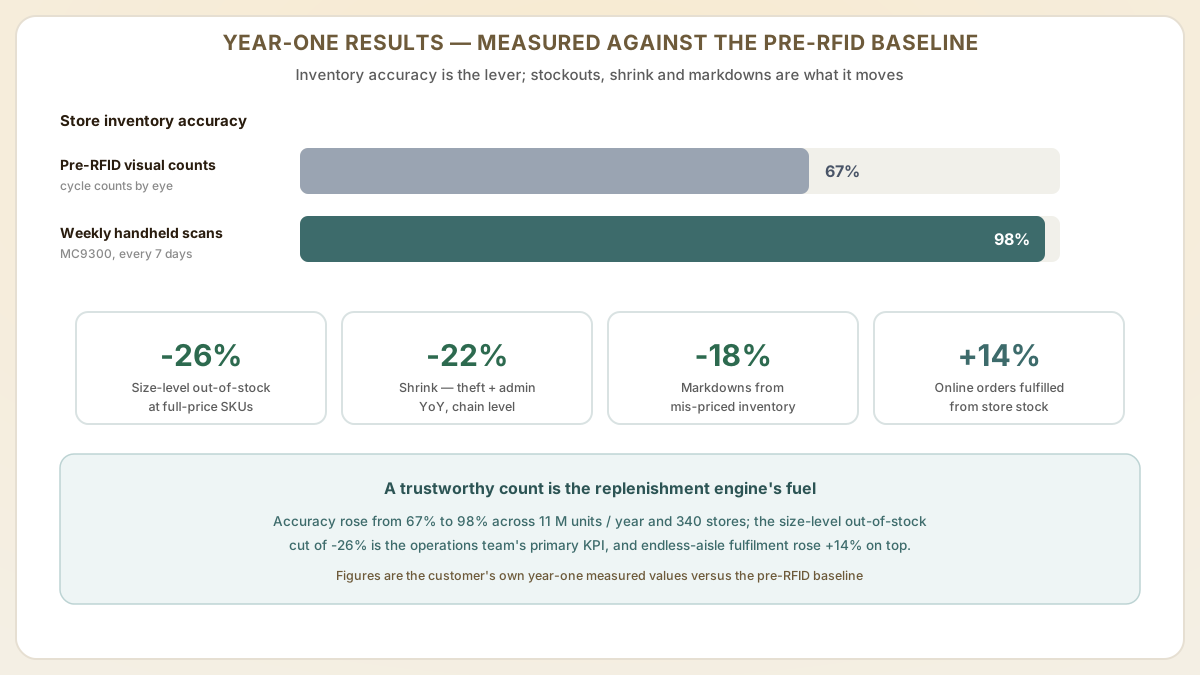
- Store inventory accuracy: 67% under pre-RFID visual cycle counts, 98% under weekly handheld scans.
- Size-level out-of-stock at full-price SKUs: -26% — the operations team's primary KPI for the programme.
- Shrink from theft and admin error: -22% year on year at the chain level.
- Markdowns from mis-priced inventory: -18%.
- Endless-aisle fulfilment of online orders from store stock: +14% units.
The deployment at a glance — inlay, tag and measured results
One table for the reviewer who wants the specification and the numbers in the same glance. Every figure is the customer's own reported value — nothing here is modelled or rounded up for the slide.
| Attribute | Value | Notes |
|---|---|---|
| Chip | Monza R6-P — UHF RAIN, ISO/IEC 18000-63 + EPC Gen2v2 | 96-bit EPC + 32-bit TID, Autotune-enabled |
| Tag format | Paper hang-tag, 80 × 50 mm | CMYK two-sided print + thermal-transfer EPC barcode + size/colour SKU |
| Encoding | GS1 SGTIN-96, written at the supplier factory | Per-supplier serial block; per-carton EPC manifest to the WMS |
| Tagging cost & dwell | $0.00 incremental DC labour, 0-day DC dwell | vs $0.04 / unit and a 4-day dwell tagging at the DC |
| Inventory accuracy | 67% → 98% | Weekly MC9300 handheld scan, every store |
| Out-of-stock & shrink | Size-level OOS -26%, shrink -22% YoY | Markdowns -18%, store fulfilment +14% |
| Scan time | 35–45 minutes per 100,000-unit store | vs 8 hours for a visual cycle count |
| Scale | 11 M units / year, 340 stores | Women's, men's and children's apparel |
What transfers — where item-level source tagging pays off
The deciding factors here — a size-and-colour SKU count that defeats visual counting, full-price stockouts that cost real margin, and a supply chain long enough to tag upstream — recur across soft-goods retail. The pattern ports cleanly; compare the chip families first on the UCODE vs Monza vs Higgs page, then map the workflow with the inventory-tracking solution.
- Footwear and accessories — the same size/colour SKU explosion that makes visual counts hopeless and item-level RFID decisive.
- Department and specialty apparel — high full-price out-of-stock sensitivity, where a trustworthy size-level count is the replenishment engine's fuel.
- Any retailer with an upstream supplier network — source tagging moves the encode to the factory and the audit to goods-receipt, exactly as it did here.
- Omnichannel programmes leaning on ship-from-store — endless-aisle fulfilment only works when store stock is accurate enough to promise online.
Useful next pages
Use these linked product, guide and comparison pages to keep the next click specific and practical.
Apparel SKUs deployed
The hang-tag substrates and inlays referenced.
Compare UHF chip families before committing
Monza R6-P vs UCODE 9 vs Higgs-9 trade-offs for source tagging.
FAQ
How many SKUs does a 340-store retailer typically scan in a single handheld scan?
A 100,000-unit store has roughly 8,000–10,000 unique SKUs (size + colour combinations). The full-floor scan completes in 35–45 minutes with a Zebra MC9300 reading at 25–35 tags / second sustained. Store-back-room scans (deeper stock) take an additional 10–15 minutes. Weekly cadence is the operations team's target; bi-weekly is the fallback when staffing is short.
What about RFID interference with the security gates at the store entrance?
The customer's security gates are HF-based EAS antennas (8.2 MHz), which do not interfere with UHF RAIN inlays. UHF reads do not trigger the HF gates, and the HF EAS strips on premium products do not interfere with UHF reads. The retailer is planning a future migration to dual-tech (UHF security + UHF inventory in one tag) once their EAS vendor ships a compatible reader.
How are returned items handled in the EPC system?
Returns are read at the customer-service desk on a desktop reader and the SGTIN is flipped from 'sold' to 'returned' in the WMS. The item is re-shelved with the original tag intact. The chip is read-only after the supplier factory encodes the EPC, so no chip re-write is required and no risk of EPC drift across returns.
What is the EPC re-use cycle for retired serial numbers?
GS1 SGTIN-96 serial numbers must be unique for the product's lifecycle. The retailer's policy is no EPC re-use within 24 months of the item's last sale, which is conservative — GS1 recommends 12 months. With a 38-bit serial-number field per supplier prefix the address space is large enough that re-use is rarely necessary.
Sources & references
Primary standards, OEM datasheets and regulatory documents cited by this article. All URLs were verified on the access date shown below.
- Impinj Monza R6 / R6-P UHF RAIN tag chip — product page
Vendor reference for the Monza R6-P inlay, its 96-bit EPC and 32-bit TID, and the Autotune feature the deployment relies on across mixed apparel substrates.
- GS1 EPC Tag Data Standard (TDS) — SGTIN encoding
Defines the SGTIN scheme the suppliers encode at the factory — GS1 company prefix, item reference and serial — written here as a GS1 SGTIN-96 EPC.
- GS1 EPC UHF Gen2 (Gen2v2) air-interface protocol
The EPC Gen2 air-interface protocol, developed for item-level retail rollouts, that the Monza R6-P inlays and the store reader fleet implement.
- ISO/IEC 18000-63:2015 — UHF RFID air interface (Type C)
The UHF RAIN air-interface standard underlying the Monza R6-P inlays read at the DC portal and on the store handhelds.
Proud Tek is a Shenzhen-based RFID & NFC manufacturer supplying hotel chains, transit operators, event venues and retail brands worldwide. Every order includes free samples, RF testing and dedicated project support.
Get a Quick Quote
Tell us about your project and we'll respond within one business day. Fields marked (asterisk) are required.