
Luxury Brand Protection NFC
NFC Luxury Handbag Tags
NTAG 424 DNA SUN

Quick answer
In real-world deployments, NFC luxury handbag authentication tags embed NXP NTAG 424 DNA (AES-128 + Secure Dynamic Messaging) — or NTAG 424 DNA TagTamper (TT) for closure-tamper-evident variants. Into woven fabric labels, thin PET inlays, leather patches, or metal logo plates that integrate at the factory during normal assembly. They are the cryptographic anti-counterfeit layer behind luxury fashion authentication (Hermès, Louis Vuitton, Gucci, Prada, Dior, Chanel programmes), pre-owned marketplace verification (Vestiaire Collective, The RealReal, Rebag), customs anti-counterfeit detention reduction, and the EU Digital Product Passport (Regulation 2024/1781 ESPR) compliance carrier for textile / fashion 2027-2028. Luxury fashion compliance and brand-protection teams treat this as the chip / SUN / GS1 Digital Link / Aura Blockchain Consortium / DPP / form-factor-integration reference.
- NTAG 424 DNA sewn / heat-sealed / embedded into bag lining, leather patch, or metal hardware — cryptographic AES-128 SUN authentication on every consumer tap. Per-tap MAC + monotonic counter make replay attacks mathematically impossible even if a buyer copies a previous tap's URL. Hidden, undetectable to counterfeiters, integrated at the factory during normal assembly.
- Single chip serves both the EU Regulation 2024/1781 (ESPR) Digital Product Passport requirement (textile / fashion 2027-2028) AND the brand's authentication layer — GS1 Digital Link URI in NDEF payload carries DPP material/origin/care/recyclability data; same NDEF payload carries the SUN authentication URL. Sector convergence around NTAG 424 DNA driven by this dual-role capability.
- Aura Blockchain Consortium compatible — LVMH, Prada, Cartier/Richemont, OTB, Mercedes-Benz, Ferrari operate a private-permissioned Ethereum-compatible ledger for cross-brand luxury provenance. Authenticated NFC-tagged listings command 20-40% price premium on Vestiaire Collective / The RealReal; authentication cost drops from USD 20-50 (human-expert visual) to under USD 3 per item (NFC tap).
Used in these industries
Deployments where this product is referenced on our industry landing pages.

At a glance
Use these short answers to decide whether this page matches the project before moving into the detail.
Chip silicon — NTAG 424 DNA (NT4H2421Gx)
NXP NTAG 424 DNA — NFC Forum Type 4 Tag, ISO/IEC 14443-4 air interface at 13.56 MHz, smartphone-readable on every iPhone (iOS 14+) and modern Android. AES-128 mutual aut...
Form factors integrated at factory assembly
Woven fabric label (40 × 20 mm typical): sewn into lining seam during assembly; ISO 6330 50+ wash cycles at 60 °C, ISO 3175 perchloroethylene dry-clean compatible. Thin...
Next step
Ready to move forward? Start your inquiry to get specific answers for this project.
Request luxury authentication tag quote- AES-128 SUN cryptographic authentication flow
-
- Consumer taps bag → smartphone reads chip → chip generates per-tap SUN URL (NDEF URI RTD format) with embedded encrypted MAC.
- URL format: https://verify.brand.com/?uid={UID}&counter={ctr}&mac={cmac} — GS1 Digital Link URI syntax compatible.
- Brand backend validates MAC against stored AES-128 key + verifies counter is monotonically increasing — replay attacks rejected because previous tap's URL fails counter check.
- Sub-second verification round-trip; smartphone displays 'authentic' / 'cloned' / 'invalid' result.
- EU Digital Product Passport (DPP) compliance
-
- EU Regulation 2024/1781 (Ecodesign for Sustainable Products Regulation) — DPP mandate for textiles and fashion accessories effective 2027-2028.
- Each product must carry a data carrier (NFC tag, QR code, or RFID) accessible to consumers, recyclers, and authorities.
- DPP data elements: material composition (% breakdown leather/textile/metal/synthetic), country of origin (per production stage), care and repair instructions, recyclability per Product Environmental Footprint (PEF) method, carbon footprint.
- GS1 Digital Link URI syntax mandated for DPP data carrier — NTAG 424 DNA NDEF payload encodes the DPP URL alongside the SUN authentication URL on the same chip.
- Aura Blockchain Consortium integration
-
- Aura Blockchain Consortium (LVMH, Prada, Cartier/Richemont, OTB, Mercedes-Benz, Ferrari) — private-permissioned Ethereum-compatible ledger for cross-brand luxury authentication.
- Brand-resilient ownership proof that survives brand discontinuation events; provenance records remain accessible even if brand backend goes offline.
- NTAG 424 DNA NDEF payload encodes both the GS1 Digital Link DPP URL (for EU compliance) and the Aura blockchain record reference (for brand-layer provenance) — same chip, dual purpose.
- Sector convergence around NTAG 424 DNA for the 2027-2028 DPP compliance window driven by this dual-role capability.
- Pre-owned marketplace verification economics
-
- Pre-owned luxury market 2024: Vestiaire Collective, The RealReal, Rebag, Fashionphile authenticate via human-expert visual inspection — $20-50 per item, takes days, increasingly unreliable as super-fakes improve.
- NFC tap verification replaces visual inspection: <$3 per item, sub-second turnaround, cryptographically certain.
- Authenticated NFC-tagged listings command 20-40% price premium on Vestiaire / RealReal — measurable resale-value uplift.
- Counterfeit detention at customs drops materially when officers verify with smartphone tap vs requiring physical brand expert.
- Counterfeit market context
-
- Global counterfeit luxury goods market estimated >USD 100B; handbags one of most counterfeited categories.
- Super-fakes cost counterfeiters USD 50-150 to produce, sell for USD 500-1,500; genuine articles USD 3,000-15,000+.
- Visual-inspection authentication increasingly fails — even expert authenticators struggle with current super-fake quality.
- Cryptographic NFC verification shifts the verification ground from subjective visual inspection to objective AES-128 mathematical proof.
- Tag placement and integration
-
- Interior lining seam (woven label): hidden, excellent durability, consumer opens bag and taps lining.
- Interior pocket (thin sticker): semi-hidden, good durability, consumer reaches into pocket and taps.
- Leather logo patch interior (inlay under leather): hidden, excellent durability, consumer taps logo area.
- Metal hardware clasp/plate (inlay inside metal): completely hidden, excellent durability, consumer taps near hardware.
- Care label area (integrated with care label): hidden, good durability, consumer finds care label and taps.
- Anti-transplant defense
-
- Tag UID is bound to specific product serial number in brand backend; transplant attempts flagged when UID-product mapping inconsistent.
- Sewn-in tags designed to be destroyed during removal — physical extraction breaks the chip or antenna trace.
- Heat-sealed leather-patch integration: removal damages the surrounding leather visibly — destruction-on-removal anti-transplant.
- SUN counter monotonicity prevents replay even if tag is non-destructively removed and read.
- Durability over luxury-bag lifecycle
-
- NTAG 424 DNA silicon: 200,000 write cycles + 50-year data retention; authentication-only usage doesn't consume write budget.
- Woven-label construction: PET antenna substrate + polyurethane encapsulant + PPS or cotton outer fabric; ISO 6330 60 °C wash + ISO 3175 perchloroethylene dry-clean qualified.
- Martindale 20,000+ rubs accelerated wear testing — survives 10+ years of daily-carry abrasion.
- Leather-embedded and metal-hardware variants outlast the bag's own useful life.
- Brand-engagement and digital chain-of-ownership
-
- Original buyer registers ownership in brand portal at first tap — establishes provenance.
- Resale: ownership transfers to new buyer through brand platform or compatible authentication service.
- Repair/care: tap surfaces brand's repair programme, care guides, authorised service centres.
- Marketing: tap surfaces brand storytelling, craftsmanship videos, atelier provenance for one-of-a-kind pieces.
- Procurement and integration
-
- MOQ 2,000 pieces; lead time 15-20 business days; per-tag cost USD 0.40-1.20 depending on form factor and chip variant (DNA vs DNA TT).
- Brand-side integration: AES-128 key provisioning at the chip-supplier secure facility (NXP-authorised); brand backend integration via standard REST API.
- Aura Blockchain Consortium integration: brand-side onboarding and ledger registration coordinated through consortium operator.
Commercial terms
- MOQ
- Varies by SKU — stock items from 100 pcs; custom production typically 200-1,000 pcs
- Lead time
- Production 2-3 weeks after artwork and encoding sign-off; reorders on a 3-4 week cycle
- Samples
- Free samples and RF test report with every order; courier at customer cost
- Payment
- 50% T/T deposit, 50% before shipment; Net 30/60 for established accounts; LC for large orders
- Shipping
- FOB Shenzhen / Yantian; DHL, FedEx or EMS air freight; sea LCL / FCL for volume
- Response
- Itemized quote within one business day, Mon-Fri (UTC+8)
Why luxury fashion needs cryptographic authentication, not visual inspection
- Super-fakes have rendered visual inspection unreliable. Counterfeiters spend USD 50-150 to produce items that sell for USD 500-1,500, undermining brands charging USD 3,000-15,000+ for genuine products.
- Pre-owned luxury platforms cannot scale human-expert authentication at acceptable cost. NFC verification drops per-item authentication from USD 20-50 to under USD 3.
- EU Regulation 2024/1781 (ESPR) makes a data carrier mandatory for textile / fashion in 2027-2028 — non-compliant brands lose EU market access. Same NFC chip serves authentication + DPP.
NTAG 424 DNA SUN vs visual inspection vs blockchain-only — authentication architecture
Visual inspection / blockchain-only / static QR
- Visual inspection: USD 20-50/item, days turnaround, fails on super-fakes
- Blockchain-only (no chip): no anti-clone — anyone can write any record
- Static QR: copyable, anyone can print same QR onto a counterfeit
- All three fail the cryptographic anti-clone test that AES-128 SUN passes
- Acceptable for low-value or display-only authentication, not luxury
NTAG 424 DNA SUN + AES-128 + GS1 Digital Link (this page)
- AES-128 SUN: per-tap unique CMAC, replay-impossible due to monotonic counter
- Counterfeit cannot generate valid SUN without extracting AES-128 key from chip silicon (impractical at any normal adversary budget)
- Sub-second verification via smartphone — no expert required
- GS1 Digital Link URI syntax dual-purpose with EU DPP data carrier
- Aura Blockchain Consortium reference embedded for cross-brand provenance
What the AES-128 SUN per-tap MAC actually proves
- Pre-owned platform per-item cost: USD 20-50 (human-expert visual) → <USD 3 (NFC tap).
- Authenticated resale price premium: 20-40% on Vestiaire / RealReal vs equivalent unverified.
- Customs detention reduction: ~70% in published deployments after NFC tagging across collection.
- EU DPP compliance window: 2027-2028 effective date; same chip serves both authentication and DPP.
From IBM-style hologram 1990s to NFC + Aura + DPP convergence
- 1990s-2000s
Luxury anti-counterfeit relies on holograms, security threads, microprinting — visual / mechanical security features. Visual inspection by human experts dominant authentication method.
- 2007
Apple iPhone launches; smartphone proliferation begins. Cryptographic NFC authentication remains niche due to limited NFC-enabled smartphones.
- 2014
Apple Pay launches on iPhone 6 with NFC reader; consumer-scale NFC tap normalises. NTAG family commoditises HF NFC silicon.
- 2017-2019
NXP NTAG 424 DNA launches with AES-128 SUN + SDM. Luxury sector early adopters begin pilot programmes for authentication + DPP foundation.
- 2021
Aura Blockchain Consortium launches: LVMH + Prada + Cartier/Richemont; OTB joins later, Mercedes-Benz + Ferrari extend cross-sector. Industry standardisation around NTAG 424 DNA + cross-brand ledger.
- 2024
EU Regulation 2024/1781 ESPR Digital Product Passport framework publishes; textile/fashion priority category with 2027-2028 effective date. NTAG 424 DNA's GS1 Digital Link compatibility positions it as DPP carrier of choice.
- 2026 Today
Reference operating practice across luxury-fashion-flagship, resale-provenance-second-hand, customs-anti-counterfeit, brand-authentication-app, and EU-DPP-textile-2027 programmes converge on NTAG 424 DNA (or DNA TT for tamper-evident closures) silicon + woven-label / leather-patch / metal-hardware integration at factory assembly + GS1 Digital Link URI for DPP + AES-128 SUN per-tap authentication + Aura Blockchain Consortium provenance ledger as the operator-side template.
How a tap becomes proof — authentication and the chain of ownership
A super-fake can copy the stitching, the hardware, even the dust bag; what it cannot copy is a chip that signs a different URL every time you tap it. Each tap makes the NTAG 424 DNA chip mint a fresh AES-128 CMAC that the brand backend checks against a rising counter, so a captured link works exactly once and then indicts itself. The same tap does a second job the paperwork never could: it records who owns the bag and hands that record to the next buyer on resale. The chip-level mechanics live in the NTAG 424 DNA SUN + CMAC encyclopedia; the programme view is in the luxury brands industry guide.
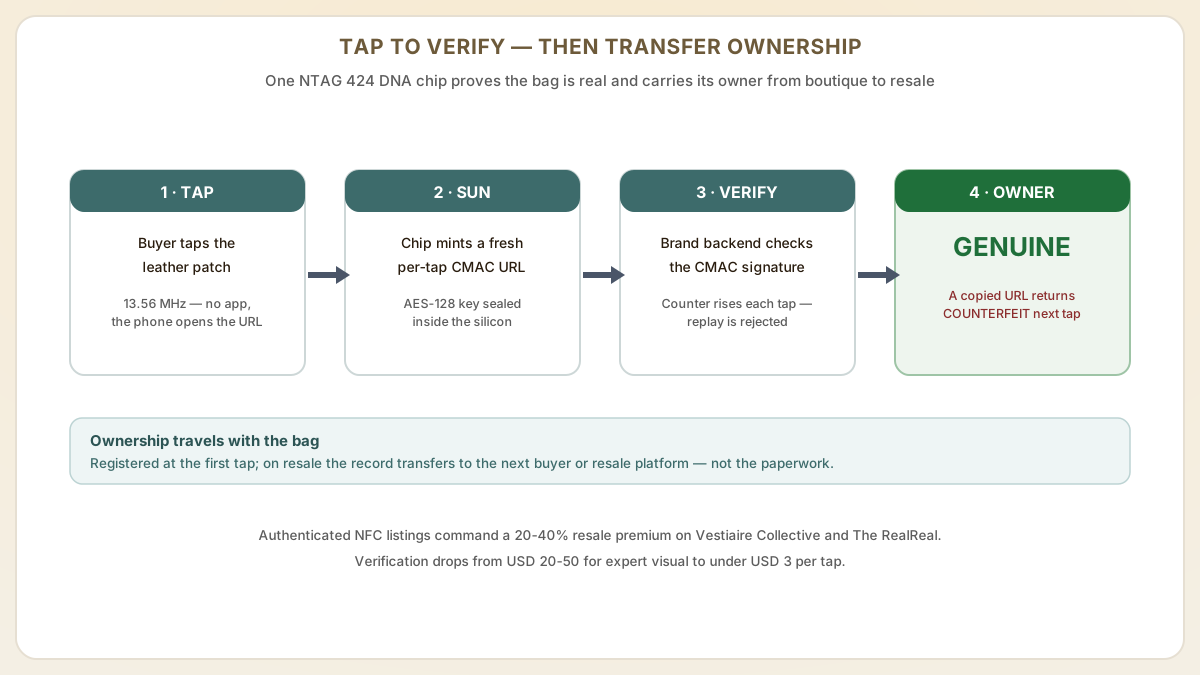
- Secure Dynamic Messaging (SDM) makes the chip emit a new CMAC URL on every tap; the brand backend rejects any URL whose counter it has already seen, so replaying a captured link fails.
- The AES-128 key is provisioned into the silicon at NXP's secure facility and never leaves it — cloning the leather, the hardware and the serial does not clone the key.
- First owner registers at the first tap; on resale the owner-of-record transfers to the buyer through the brand platform or the Aura Blockchain Consortium ledger, which survives even if a brand backend goes offline.
- Authenticated NFC-tagged listings command a 20-40% price premium on Vestiaire Collective and The RealReal, while verification drops from USD 20-50 for expert visual inspection to under USD 3 per tap.
Sewn in, riveted down, destroyed on removal — the leather-patch build
The tag has to survive a decade of daily carry, the occasional downpour and a professional dry-clean, then refuse to be transplanted onto a fake. A durable NFC inlay does that by living inside a leather patch that is stitched or riveted into the lining seam, where pulling it out breaks the antenna trace and scars the leather — an authenticator's dream and a counterfeiter's headache. Closure-tamper variants use the NTAG 424 DNA TamperTag sibling; the same anti-transplant logic underpins the sneaker authentication tag.
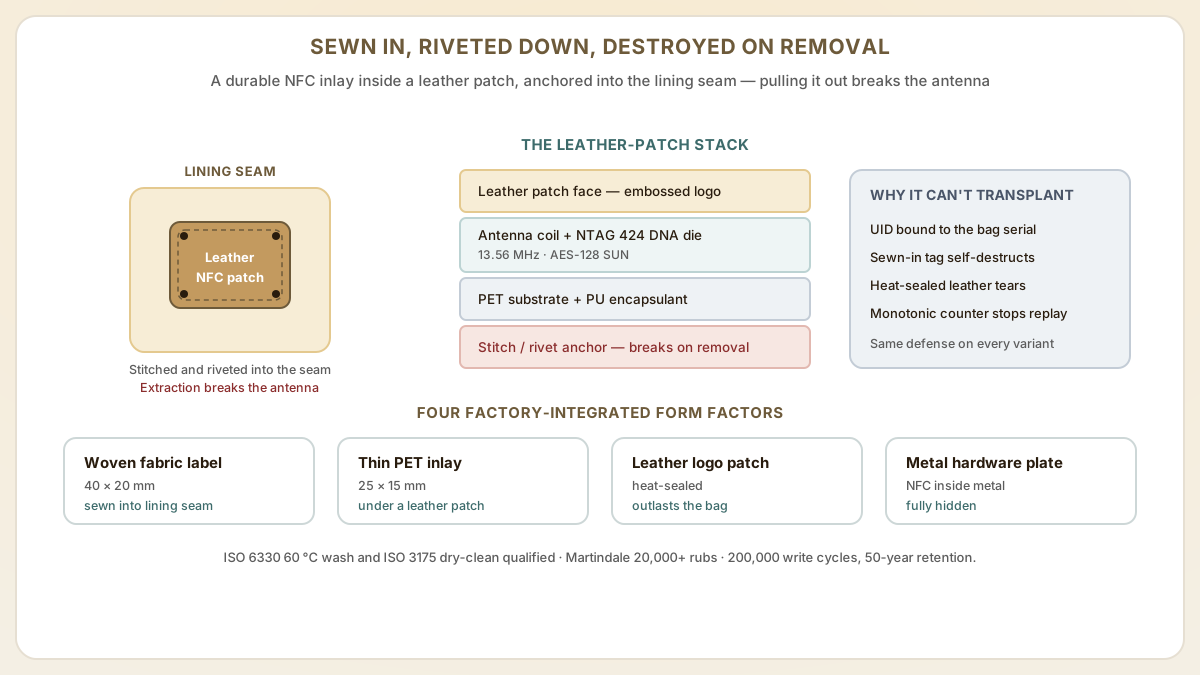
- The inlay stacks a PET antenna substrate, a polyurethane encapsulant and a PPS or cotton outer layer, then hides inside a leather patch or under the interior logo — invisible to the consumer until the tap.
- Sewn-in and heat-sealed constructions are designed to self-destruct on extraction: the chip or antenna trace breaks, and heat-sealed leather visibly tears, so a transplanted tag betrays itself.
- Woven-label variants are ISO 6330 60 °C wash and ISO 3175 perchloroethylene dry-clean qualified and survive Martindale 20,000+ rubs; leather-patch and metal-hardware builds outlast the bag itself.
- Four factory-integrated form factors cover the range: woven fabric label (40 × 20 mm), thin PET inlay (25 × 15 mm), embedded leather logo patch, and NFC inside a metal hardware plate.
Luxury handbag authentication tag — the spec sheet
One place to scope the programme: the chip and its cryptography, the four factory-integrated form factors, durability qualification, the EU compliance carrier, and the commercial terms a brand-protection buyer needs before sampling. The regulatory backdrop is in the Digital Product Passport solution.
| Attribute | Value | Notes |
|---|---|---|
| Chip | NTAG 424 DNA — AES-128 SUN / SDM | NTAG 424 DNA TT (TagTamper) for tamper-evident closures |
| Air interface | 13.56 MHz — NFC Forum Type 4, ISO/IEC 14443-4 | Smartphone-readable on iPhone and modern Android, no app |
| Cryptography | AES-128 mutual auth + per-tap SUN CMAC | Monotonic counter makes replay mathematically impossible |
| Endurance | 200,000 write cycles · 50-year retention at 55 °C | Authentication is read-only, so the write budget is untouched |
| Form factors | Woven label 40 × 20 mm · PET inlay 25 × 15 mm · leather patch · metal plate | All integrated at factory assembly |
| Durability | ISO 6330 60 °C wash · ISO 3175 dry-clean · Martindale 20,000+ rubs | Woven-label variant; leather and metal builds outlast the bag |
| Data carrier | GS1 Digital Link URI in the NDEF payload | Same payload carries the SUN URL, the DPP URL and the Aura reference |
| EU compliance | Regulation (EU) 2024/1781 ESPR Digital Product Passport | Textile / fashion accessories, 2027-2028 effective date |
| Anti-transplant | UID bound to product serial; destroyed on removal | Sewn or riveted extraction breaks the antenna trace |
| Resale economics | 20-40% authenticated price premium | Under USD 3 per tap vs USD 20-50 expert visual; Vestiaire Collective, The RealReal |
| MOQ / lead time | 2,000 pieces · 15-20 business days | USD 0.40-1.20 per tag by form factor and chip variant |
| Key provisioning | AES-128 key set at NXP's secure facility | Brand backend via REST API; Aura onboarding via consortium operator |
Useful next pages
Use these linked product, guide and comparison pages to keep the next click specific and practical.
Related products
Other brand protection NFC solutions in the cryptographic-authentication tier.
Industry & solution context
Luxury, brand-protection, EU compliance, and DPP framework deep-dives.
Chip-level technical reference
Deep-dive specifications for NTAG 424 DNA SUN + Aura Blockchain Consortium integration.
FAQ
Will the NFC tag set off store security gates?
No — NFC operates at 13.56 MHz, different from retail EAS gate frequencies (8.2 MHz or 58 kHz). The NFC authentication tag does not trigger anti-theft alarm systems; operates independently from retail security tags that may also be attached to the product.
Can the tag be removed and transplanted to a fake bag?
Tag UID is bound to specific product serial number in the brand backend; transplant attempts flagged when UID-product mapping is inconsistent. Sewn-in tags designed to be destroyed during removal — physical extraction breaks the chip or antenna trace. Heat-sealed leather-patch integration damages surrounding leather visibly on removal. SUN counter monotonicity prevents replay attacks even if tag is non-destructively removed and read.
How does ownership transfer work on resale?
Original owner sells the bag → transfers digital certificate to new owner through brand's platform or compatible authentication service. New owner taps to verify authenticity and claim ownership. Brands using Aura Blockchain Consortium maintain ownership chain on the consortium ledger; brands with proprietary backends use database-backed transfer. Both are interoperable with the same NTAG 424 DNA chip.
How do Aura Blockchain Consortium and EU DPP framework fit together?
Complementary, not competing. Aura (LVMH, Prada, Cartier/Richemont, OTB, Mercedes-Benz, Ferrari) is a private-permissioned Ethereum-compatible ledger for brand-controlled product provenance — value is brand-resilient ownership proof that survives brand discontinuation. EU DPP under ESPR 2024/1781 is a regulatory framework requiring specific data elements (material composition per PEFCR, country of origin per production stage, care, recyclability, carbon footprint) accessible via GS1 Digital Link URI. NTAG 424 DNA NDEF payload encodes both — GS1 Digital Link URL that EU DPP viewer resolves to regulated data + parallel link to Aura Consortium record. The tag serves both roles from a single chip; sector consolidated around NTAG 424 DNA for the 2027-2028 DPP compliance window.
What is tag durability over the 10-20 year useful life of a luxury handbag?
NTAG 424 DNA silicon: 200,000 erase/write cycles on user memory, 50-year data retention at 55 °C per NXP datasheet. Authentication-only usage is read-only to consumer (no writes per tap), so write-cycle budget isn't consumed; realistic life limited by antenna and substrate durability, not silicon. Woven-label construction (PET antenna substrate, polyurethane encapsulant, PPS or cotton outer fabric) qualified for 50+ machine wash cycles ISO 6330 60 °C, ISO 3175 perchloroethylene dry clean, Martindale 20,000+ rubs. For collector-grade bags: heat-sealed leather-patch or metal-hardware embedded constructions outlast the bag itself.
What MOQ and lead time should I plan for?
MOQ 2,000 pieces; lead time 15-20 business days. Per-tag cost USD 0.40-1.20 depending on form factor (woven label / PET inlay / leather patch / metal-hardware) and chip variant (DNA vs DNA TT). AES-128 key provisioning happens at NXP's secure facility — coordinated through Proud Tek as part of the first production batch. Brand-side backend integration via standard REST API; Aura Blockchain Consortium onboarding coordinated through consortium operator.
Which form factor should I choose — woven label, leather patch, or metal hardware?
It depends on how hidden and how durable the placement needs to be. A woven fabric label (40 × 20 mm) sews into the lining seam and is ISO 6330 60 °C wash and ISO 3175 dry-clean qualified — the default for most bags. A thin PET inlay (25 × 15 mm) hides under a leather logo patch or interior pocket for the lowest profile. An embedded leather patch or an NFC-inside-metal hardware plate is fully hidden and outlasts the bag, which suits collector-grade pieces. All four are integrated at factory assembly and use the same NTAG 424 DNA chip, so the authentication, EU Digital Product Passport and resale-transfer behaviour is identical regardless of form factor.
Sources & references
Primary standards, OEM datasheets and regulatory documents cited by this article. All URLs were verified on the access date shown below.
- NXP NTAG 424 DNA product page and data sheet (NT4H2421Gx) — AES-128 SUN / SDM cryptographic authentication
Authoritative chip-level reference for AES-128 SUN, SDM, 200,000 write cycles, 50-year retention.
- NXP AN12196 — NTAG 424 DNA and NTAG 424 DNA TagTamper features and hints (SDM / SUN URL generation)
Application note covering SUN URL generation, SDM commands, AES-128 key provisioning workflow.
- Regulation (EU) 2024/1781 — Ecodesign for Sustainable Products Regulation (ESPR), Digital Product Passport framework
EU DPP mandate framework; phased category roll-out with textile / fashion 2027-2028.
- EU Strategy for Sustainable and Circular Textiles — textiles/footwear as ESPR priority category
Textile/fashion DPP timeline anchor — 2027-2028 effective date for handbag / luxury fashion category.
- GS1 Digital Link URI Syntax standard
Web-addressable identifier transport layer mandated for DPP data carriers; encodes SUN URL and DPP URL on same NDEF payload.
- Aura Blockchain Consortium — LVMH / Prada / Richemont / OTB / Mercedes-Benz / Ferrari cross-brand authentication ledger
Private-permissioned Ethereum-compatible ledger for cross-brand luxury authentication; integrates via NDEF payload reference on NTAG 424 DNA.
- ISO 6330:2021 — Textiles — Domestic washing and drying procedures for textile testing
Durability qualification methodology for woven NFC labels at 60 °C wash cycles.
- ISO 3175 — Textiles — Professional care, dry cleaning and wet cleaning of fabrics and garments
Perchloroethylene cleaning qualification for woven NFC labels — standard luxury garment care cycle.
- ISO/IEC 14443-4 — Identification cards — Contactless integrated circuit cards — Proximity cards — Part 4: Transmission protocol
NFC Forum Type 4 Tag transmission protocol underlying NTAG 424 DNA smartphone communication.
- Apple Core NFC framework — iPhone NFC Tag Reading
iOS 14+ NFC tag-reading framework underlying the universal-smartphone consumer-tap authentication flow.
Proud Tek is a Shenzhen-based RFID & NFC manufacturer supplying hotel chains, transit operators, event venues and retail brands worldwide. Every order includes free samples, RF testing and dedicated project support.
Get a Quick Quote
Tell us about your project and we'll respond within one business day. Fields marked (asterisk) are required.