
RFID Warehouse Efficiency
RFID Warehouse Labor Savings
Picking Data
Quick answer
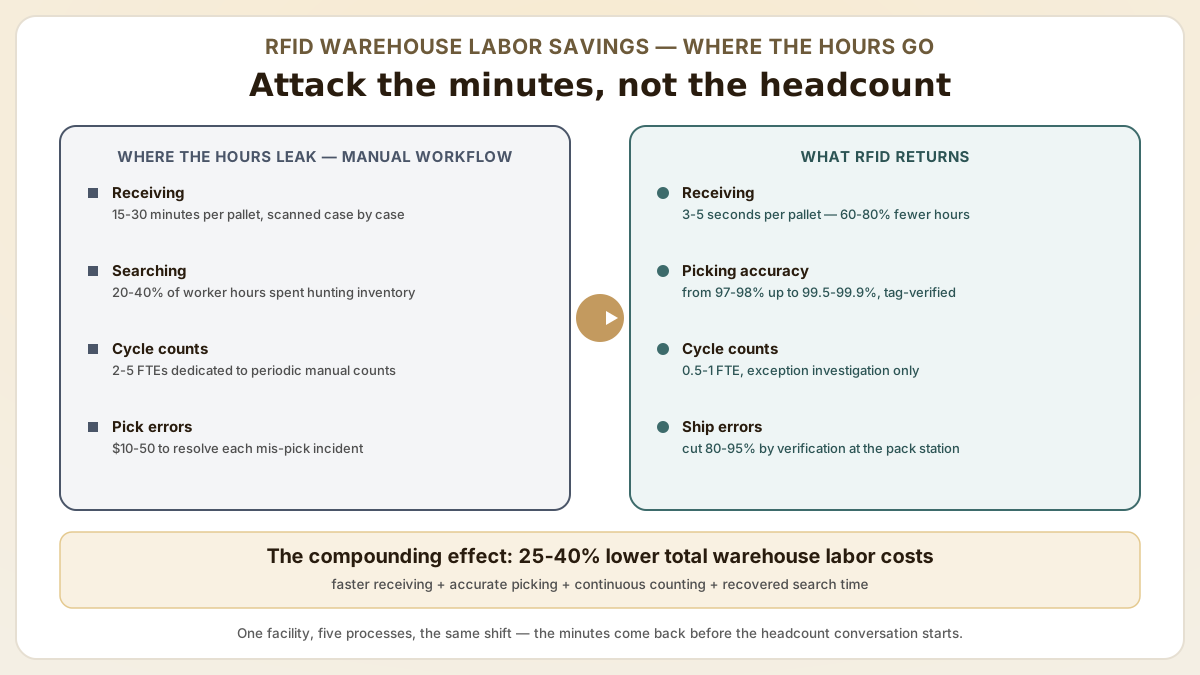
RFID cuts total warehouse labor costs 25-40% — receiving labor drops 60-80% and picking accuracy climbs to 99.5%+. This guide follows the hours process by process, from dock door to yard, with third-party benchmarks, a phased rollout calendar and the pitfalls that quietly erode the projected number.
- Picking accuracy improvement to 99.5%+ — RFID verification at pick and pack stations catches errors before shipment, reducing costly returns, re-ships and customer complaints.
- Receiving time reduction of 60-80%. RFID portal readers scan entire pallets at dock doors in seconds, replacing manual barcode scanning of individual cases that takes 15-30 minutes per pallet.
- 25-40% reduction in overall warehouse labor costs. The combined effect of faster receiving, more accurate picking, reduced cycle count labor and eliminated search time drives significant payroll savings.
At a glance
Use these short answers to decide whether this page matches the project before moving into the detail.
Key takeaway
Picking accuracy improvement to 99.5%+ — RFID verification at pick and pack stations catches errors before shipment, reducing costly returns, re-ships and customer complaints.
Where do the RFID efficiency gains come from, process by process?
Walk a distribution center at shift change and the wasted labor announces itself: someone scanning cases off a trailer one beep at a time, someone else pacing an aisle h...
Next step
Ready to move forward? Start your inquiry to get specific answers for this project.
Improve warehouse efficiency with RFIDWhere do the RFID efficiency gains come from, process by process?
Walk a distribution center at shift change and the wasted labor announces itself: someone scanning cases off a trailer one beep at a time, someone else pacing an aisle hunting a pallet the system swears is here somewhere. None of it shows up as a line item called 'waste' — it is just 'how receiving works' and 'how picking works.' RFID's pitch is unglamorous but specific: attack the minutes, not the headcount. The flow below traces the five processes where those minutes go; the bullets put numbers on each.
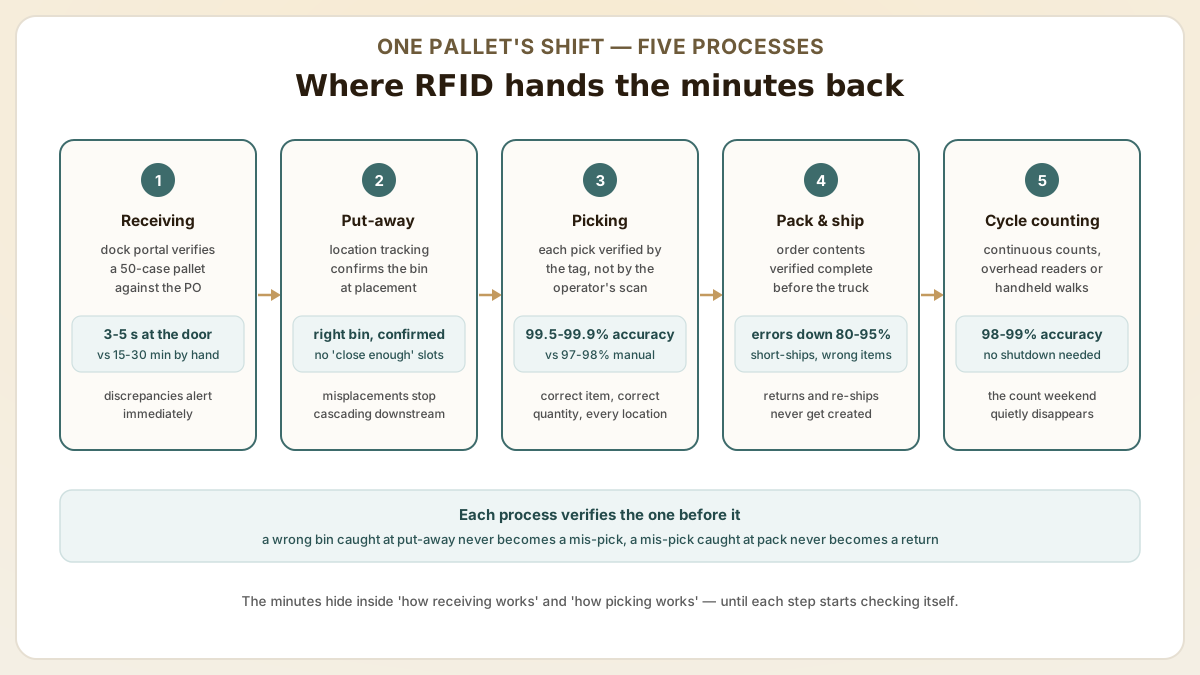
- Receiving: RFID portal readers at dock doors automatically scan and verify incoming shipments against purchase orders. A pallet with 50 cases is verified in 3-5 seconds vs. 15-30 minutes of manual barcode scanning. Discrepancies trigger immediate alerts.
- Put-away: RFID location tracking confirms items land in the correct bin or zone — not the 'close enough' slot they drift into when nobody is verifying — reducing misplacement errors that cascade into picking failures and inventory discrepancies downstream.
- Picking: RFID-guided picking verifies that the correct item and quantity are selected at each pick location. Pick verification accuracy improves from 97-98% (manual/barcode) to 99.5-99.9% (RFID-verified).
- Packing and shipping: RFID verification at pack stations confirms that all items in an order are present and correct before shipping, reducing short-ships, over-ships and wrong-item errors by 80-95%.
- Cycle counting: continuous RFID counting replaces disruptive periodic manual counts. Fixed overhead readers or regular handheld walks maintain 98-99% inventory accuracy without shutting down operations.
How do you analyze labor cost impact?
Nearly all of the payroll impact sits in five ledger lines: receiving hours, picker travel, error rework, cycle-count staffing and search time. None of them is labeled 'waste' in the WMS, which is how they survive every budget review — payroll simply absorbs them. RFID attacks each line separately: dock verification drops from minutes to seconds, directed picking trims travel, and the hours spent hunting inventory — the overhead LED location tags exist to kill — come back to the schedule. The ledger below itemizes all five.
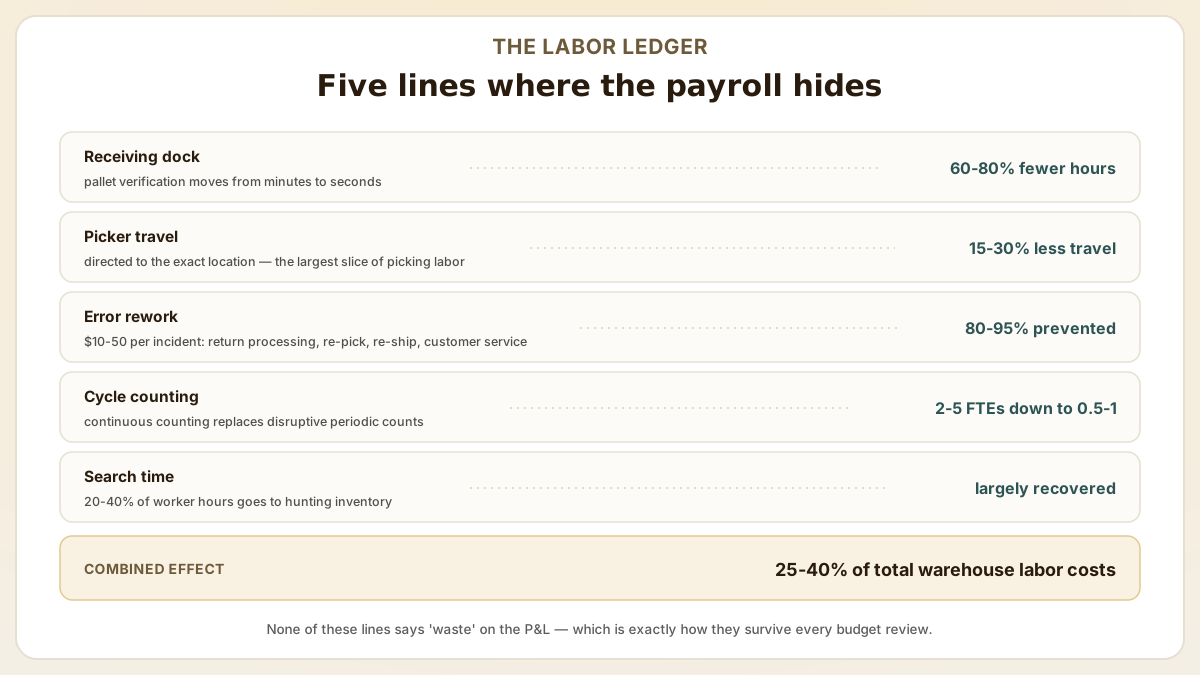
- Receiving dock labor: reducing pallet verification from 15-30 minutes to seconds eliminates the receiving bottleneck. Warehouses report 60-80% reduction in receiving labor hours, freeing dock workers for put-away and other tasks.
- Picking labor productivity: RFID-guided picking with real-time location data reduces travel time (the largest component of picking labor) by 15-30%, as workers are directed to the exact location rather than searching.
- Error correction labor: picking errors cost $10-50 per incident to resolve (return processing, re-pick, re-ship, customer service). RFID verification that prevents 80-95% of these errors eliminates significant rework labor.
- Cycle count labor: traditional warehouses dedicate 2-5 FTEs to cycle counting. RFID automated counting reduces this to 0.5-1 FTE for exception investigation only.
- Inventory search time: warehouse workers spend an average of 20-40% of their time searching for items. RFID real-time location data significantly reduces search time for tagged inventory.
Which warehouse RFID phases deliver fastest labor savings?
Warehouse RFID rollouts that try to do everything at once stall at 6-9 months without ROI. Phasing the deployment by impact unlocks labor savings every quarter — the sequence warehouse RFID programs keep converging on starts at the dock door and ends in the yard, in strict order of payback speed. The calendar below shows what lands when.
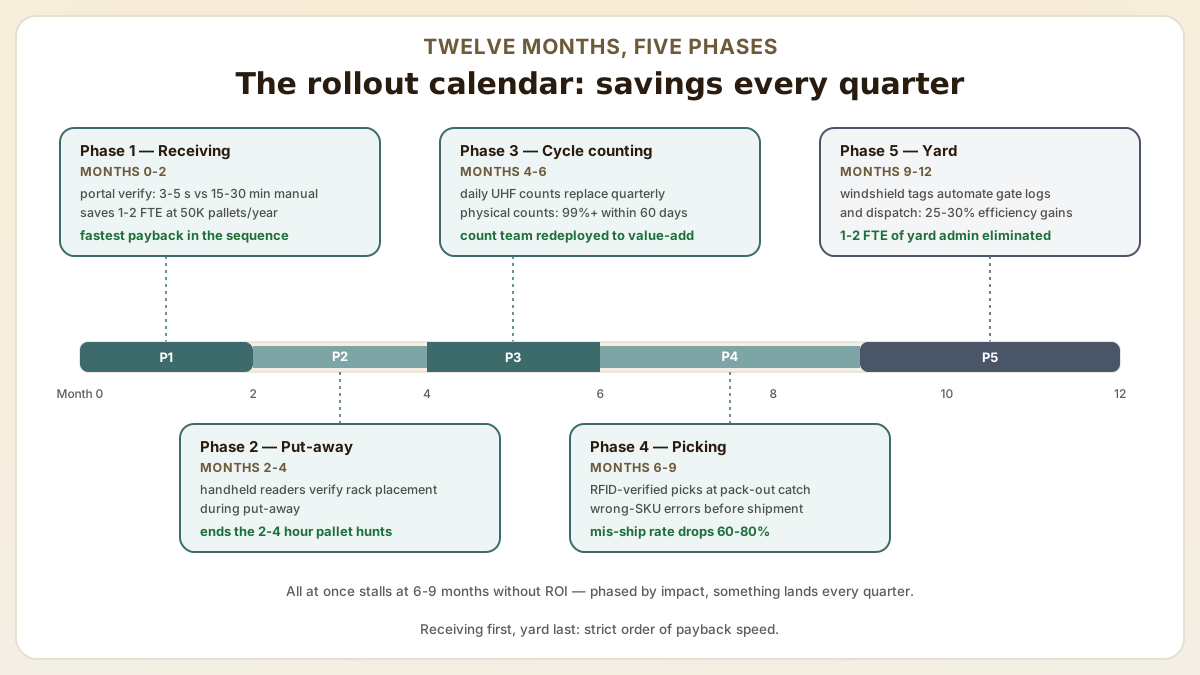
- Phase 1 — receiving (month 0-2): RFID portal at the dock door verifies inbound shipments in 3-5 seconds vs. 15-30 minutes of manual scanning. Saves 1-2 FTE in a 50K-pallet/year facility, fastest payback in the sequence.
- Phase 2 — putaway and bin verification (month 2-4): handheld RFID readers verify pallet placement in racks during putaway. Eliminates mis-slotted pallets that cost 2-4 hours to find later.
- Phase 3 — cycle counting (month 4-6): daily UHF cycle counts replace quarterly physical counts. Inventory accuracy reaches 99%+ within 60 days; physical count team redeployed to value-add work.
- Phase 4 — picking accuracy (month 6-9): RFID-verified picks at pack-out catch wrong-SKU errors before shipment. Mis-ship rate typically drops 60-80%, eliminating return-and-restock labor on the back end.
- Phase 5 — yard management (month 9-12): RFID windshield tags on inbound/outbound trucks automate gate logs and yard-truck dispatching. Highest infrastructure cost but eliminates 1-2 FTE of yard administration. Industry analyses (Jesta IS, Project44) put workforce-efficiency gains in yard operations at 25-30% from RFID + YMS automation.
How do third-party benchmarks quantify RFID warehouse labor savings?
Finance teams will challenge every claim in the labor-savings business case — that is the job, and they are good at it — so anchor each savings line to a citable third-party number rather than a vendor brochure. The benchmarks below come from Auburn University's RFID Lab, GS1 US Project Zipper, CPCON's enterprise RFID guide, and rfidtaghy's 99.9% accuracy framework. The board collects the headline numbers; the bullets carry the mechanisms.
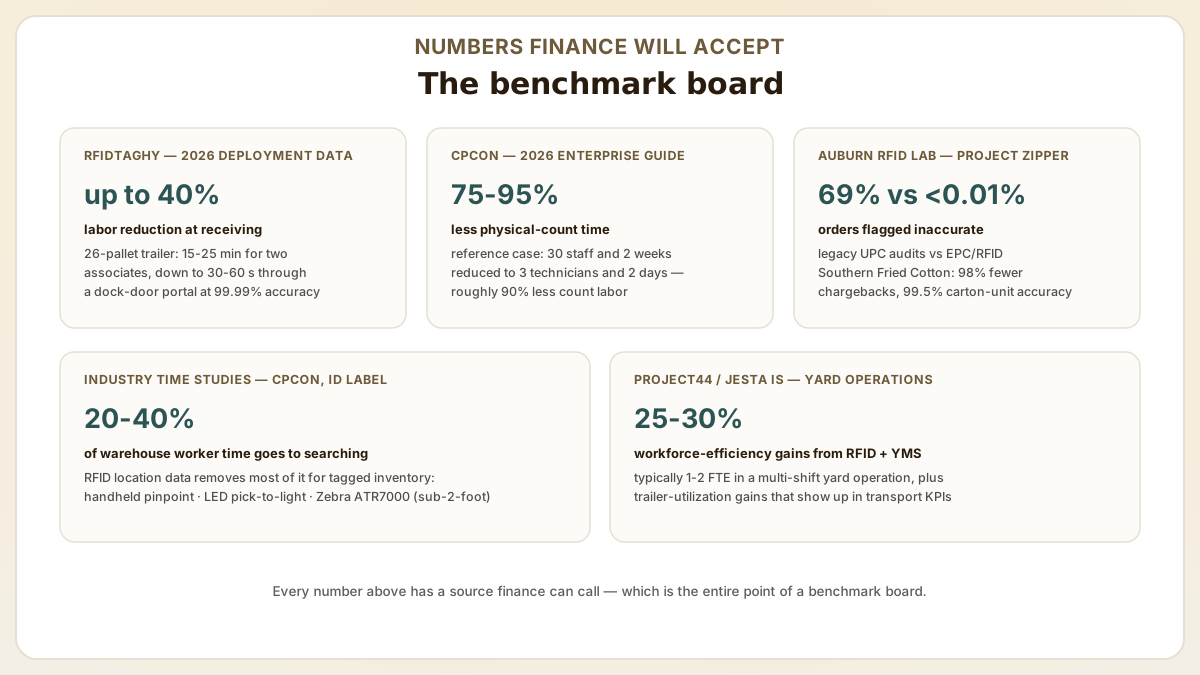
- Receiving labor: rfidtaghy's 2026 deployment data reports up to 40% labor reduction in distribution centers running RFID at receiving. The mechanism is simple — a 26-pallet trailer that took 15-25 minutes for two associates to barcode-verify clears a 4-antenna SLS D-Series or equivalent dock-door portal in 30-60 seconds at 99.99% scan-rate accuracy.
- Cycle-count labor: CPCON's 2026 enterprise guide documents 75-95% reduction in physical-count time. The reference healthcare case — 30 staff and 2 weeks for a wall-to-wall manual count, reduced to 3 technicians and 2 days with RFID — translates to roughly 90% labor reduction on the count itself.
- Picking labor: Auburn Project Zipper measured legacy UPC audits flagging 69% of orders as inaccurate vs. less than 0.01% with EPC/RFID. Even modest pick-error reduction frees the back-end labor that handles returns, re-picks and customer-service inquiries; apparel reference Southern Fried Cotton reported a 98% reduction in chargebacks plus 99.5% carton-unit accuracy.
- Search-and-find labor: warehouse workers spend 20-40% of their time searching for items per industry time studies (CPCON, ID Label warehouse-labels guidance). RFID location data — handheld pinpoint, LED-tag pick-to-light, or ceiling-mounted RTLS like Zebra ATR7000 (sub-2-foot accuracy) — removes most of this overhead for tagged inventory.
- Yard labor: integrating RFID windshield tags with a yard management system reduces dwell time and eliminates manual yard checks. Industry sources (project44, Jesta IS) place workforce-efficiency gains at 25-30% — typically translating to 1-2 FTE in a multi-shift yard operation, plus measurable trailer-utilization improvement that shows up in transportation KPIs.
What pitfalls erode the projected labor savings during rollout?
RFID labor savings are real, but the projected number rarely lands on the first try. The patterns below are the recurring causes of 'we got 60% of the projected savings' from CPCON's failure-mode analysis, IntelliStride's 3PL deployment notes, and rfidtaghy's commissioning playbook. Several also surface in the 3PL deployment we documented end to end — and notice that none of them is the physics failing. The tags read fine; it is the plan that meets the org chart.
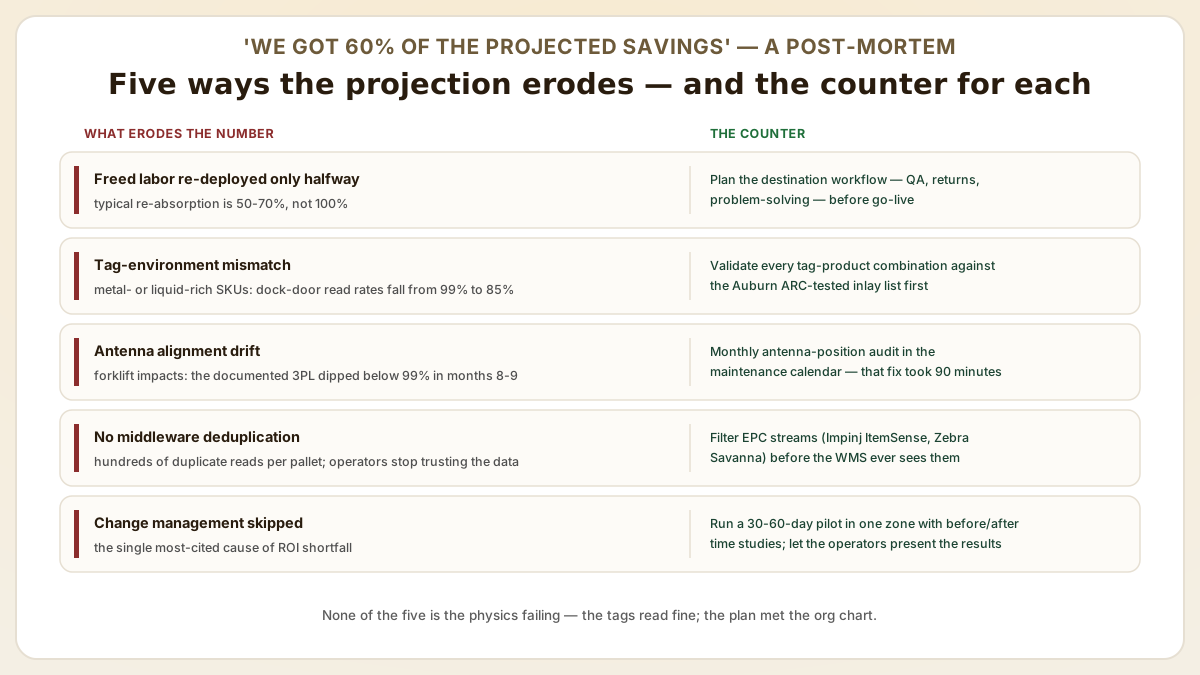
- Re-deploying freed labor only halfway: if you save 80% of cycle-count hours, you cannot also re-deploy 100% of those hours to value-add work — typical re-absorption is 50-70%. Plan the destination workflow (QA, returns, problem-solving) before go-live so the freed FTEs land on a real backlog.
- Tag-environment mismatches: a generic ISO 18000-6C UHF inlay reads poorly on metal-rich or liquid-rich SKUs. Validate every tag-product combination against the Auburn ARC-tested inlay list before bulk-purchasing labels; one missed combination can drop dock-door read rates from 99% to 85% and re-introduce manual fallback.
- Antenna alignment drift: forklift impacts knock dock-door antennas out of alignment. The 3PL we documented saw a brief dip below 99% accuracy in months 8-9 traced to a single antenna misalignment, fixed in 90 minutes. Build a monthly antenna-position audit into the maintenance calendar.
- Skipping middleware deduplication: raw EPC streams from 4-port portals generate hundreds of duplicate reads per pallet. Without proper middleware filtering (Impinj ItemSense, Zebra Savanna, or vendor middleware), the WMS gets noisy data and operators stop trusting the system, reverting to manual scans.
- Under-investing in change management: per CPCON's 2026 guide, field teams resist new technology unless they see the time savings firsthand. Run a 30-60-day pilot in one zone with before/after time studies, and let the operators who used the handheld present internally. Skipping this step is the single most-cited cause of ROI shortfall.
Useful next pages
Use these linked product, guide and comparison pages to keep the next click specific and practical.
Warehouse RFID products
Tags, labels and readers for warehouse automation.
Independent warehouse-labor benchmarks
Authoritative third-party references behind the labor-savings benchmarks in this article.
FAQ
How much can RFID reduce warehouse labor costs?
Warehouses implementing RFID across receiving, picking and shipping typically report 25-40% reduction in total labor costs. The largest savings come from automated receiving verification (60-80% labor reduction at dock doors) and elimination of periodic manual cycle counts (80-90% labor reduction for inventory counting). Picking productivity improvements of 15-30% contribute additional savings.
What picking accuracy does RFID achieve vs. barcode scanning?
Barcode-based picking achieves 97-98% accuracy in well-managed warehouses. RFID-verified picking consistently achieves 99.5-99.9% accuracy because the system automatically verifies each picked item against the order without relying on the operator to scan the correct barcode. This seemingly small improvement from 98% to 99.5% represents a 75% reduction in picking errors.
Do I need to tag every item in the warehouse for RFID to work?
RFID benefits scale with tag coverage, but you do not need to tag everything at once. Many warehouses start by tagging incoming inventory from suppliers who already source-tag (especially retail mandated categories), then expand to tag additional categories based on ROI. Even tagging high-value or high-error categories first can deliver significant accuracy and labor improvements.
What labor-savings benchmark should I expect in the first year vs. steady state?
Year-one labor savings typically capture 50-70% of the projected steady-state number; full savings land in months 12-18 once antenna alignment, middleware filtering and operator workflows have stabilized. Benchmark comparison points: rfidtaghy 2026 dataset reports up to 40% total warehouse labor reduction in mature deployments; CPCON's enterprise guide pegs cycle-count time reduction at 75-95% (close to immediate); receiving and yard labor improvements ramp in over the first 6-12 months as the WMS integration matures and operators trust the auto-verification. Build a conservative year-one model at 60% of the steady-state number, and validate against a 30-60-day pilot with before/after time studies.
How does RFID change the picker-per-square-foot ratio in a typical DC?
RFID changes the picker-per-square-foot ratio through three compounding effects: (1) elimination of search-and-find time, which industry studies place at 20-40% of total picker hours; (2) RFID-verified pick-confirm replacing scan-confirm, saving 5-15 seconds per line; and (3) elimination of post-shift cycle-count crews via perpetual counting. Typical reported outcome: a DC that ran 1 picker per 5,000 ft2 with barcode workflows operates at 1 picker per 7,000-9,000 ft2 with RFID + LED-tag pick-to-light, freeing labor for value-add work like value-added services (VAS), kitting, and exception handling. Combine with ceiling-mounted RTLS like the Zebra ATR7000 (sub-2-foot location accuracy) for the largest gains in dense storage zones.
Proud Tek is a Shenzhen-based RFID & NFC manufacturer supplying hotel chains, transit operators, event venues and retail brands worldwide. Every order includes free samples, RF testing and dedicated project support.
Get a Quick Quote
Tell us about your project and we'll respond within one business day. Fields marked (asterisk) are required.