
Distributor Programs
RFID Tag MOQ Strategy
Negotiating Below MOQ
Quick answer
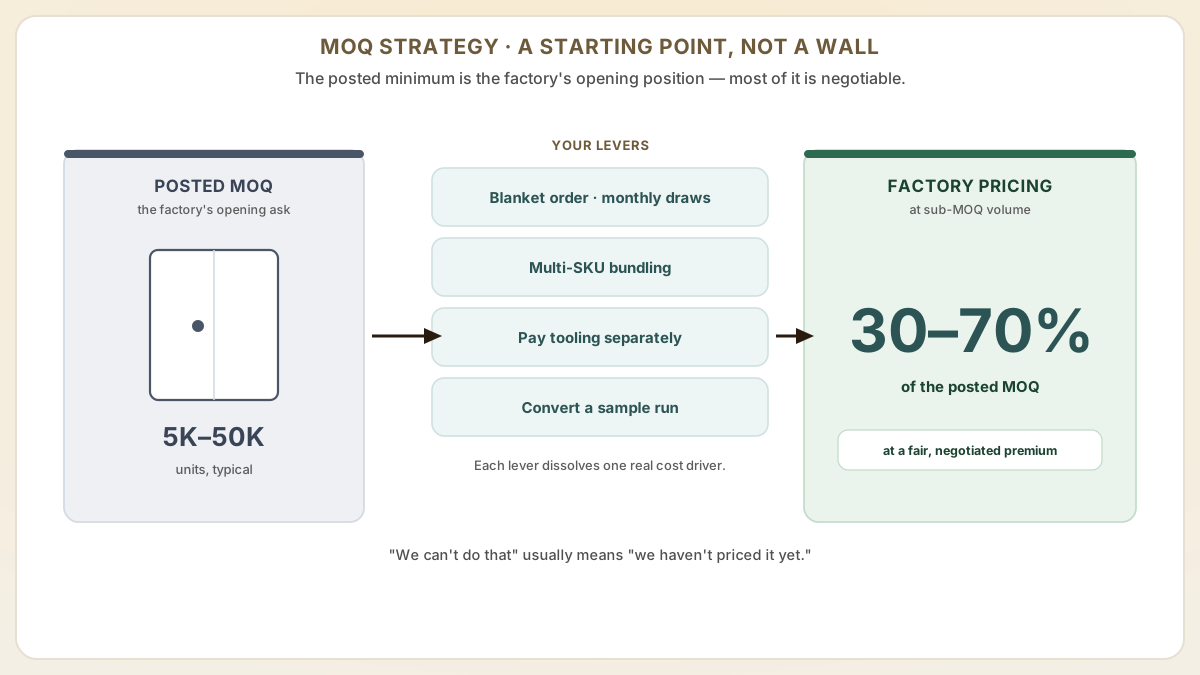
Posted RFID factory MOQ is negotiable — most factories accept below-MOQ orders at 30–70% of the posted number through blanket orders, multi-SKU bundling, paid tooling or sample-run conversion. This guide breaks down the five cost drivers behind MOQ, fair sub-MOQ premium ranges, 2026 MOQ benchmarks by product class, and the sample-run programs that get you to first deployment.
- Posted RFID factory MOQ is rarely a hard floor — most factories accept below-MOQ orders at premium pricing or with creative bundling.
- MOQ exists because of three real cost drivers: chip-lot purchasing, custom-tooling amortization and minimum-machine-run efficiency. Knowing which applies to your SKU reveals which is negotiable.
- Strategic moves: blanket orders, multi-SKU bundling, paid tooling, sample-run conversion — all let distributors access factory pricing at 30-70% of posted MOQ.
At a glance
Use these short answers to decide whether this page matches the project before moving into the detail.
Key takeaway
Posted RFID factory MOQ is rarely a hard floor — most factories accept below-MOQ orders at premium pricing or with creative bundling.
Why does RFID MOQ exist?
Every buyer eventually meets the same line on a quote: a minimum order quantity printed like a locked door. It is almost never locked. Posted MOQ is the order size a fac...
Next step
Ready to move forward? Start your inquiry to get specific answers for this project.
Negotiate sub-MOQ RFID quoteWhy does RFID MOQ exist?
Every buyer eventually meets the same line on a quote: a minimum order quantity printed like a locked door. It is almost never locked. Posted MOQ is the order size a factory would prefer, assembled from real costs you can usually address one at a time — not a hard floor. Understanding which of those costs actually applies to your SKU tells you which constraints are fixed and which are just the factory's opening position; five cost drivers explain most MOQ policies. Each one is mapped below.
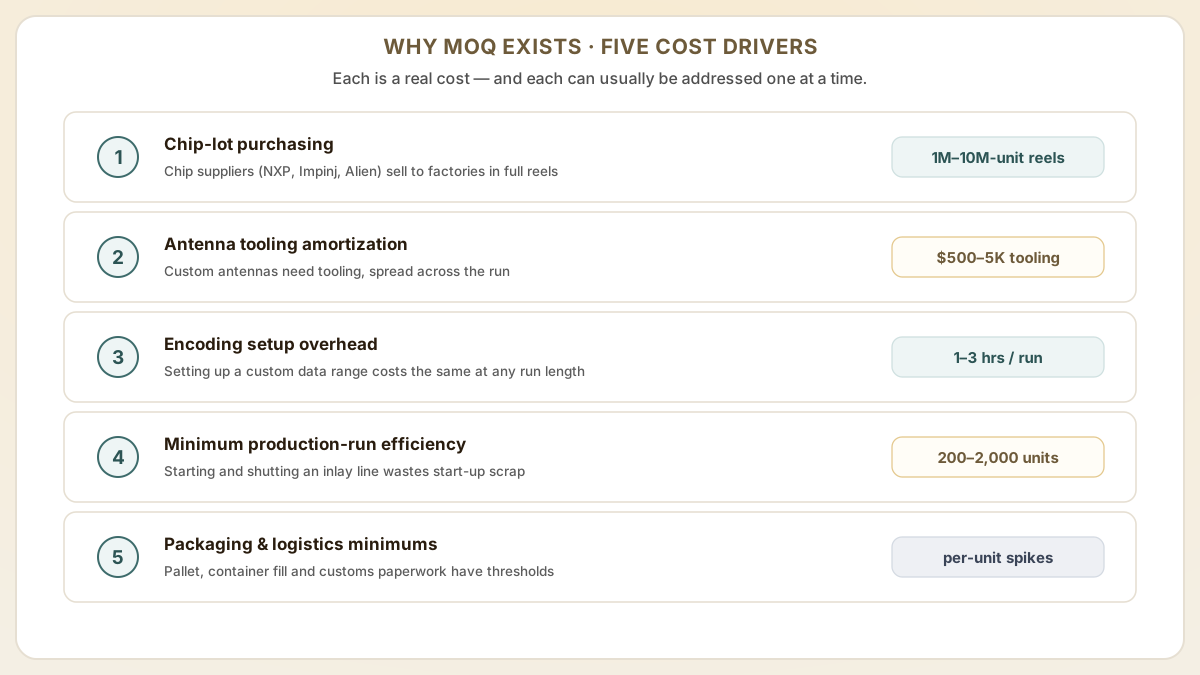
- Chip lot purchasing: chip suppliers (NXP, Impinj, Alien) sell to RFID factories in 1M-10M unit reels. A 5K customer order draws against a much larger reel; factory absorbs the inventory carrying cost.
- Antenna tooling amortization: custom antennas require tooling ($500-5K). At 5K units the per-unit tooling cost is $0.10-1.00; at 100K it is $0.005-0.05. MOQ rises to amortize tooling acceptably.
- Encoding setup overhead: setting up an encoding line for a custom data range takes 1-3 hours regardless of run length. Factory MOQ ensures setup is amortized across enough units.
- Minimum production-run efficiency: starting and shutting down an inlay line wastes 200-2,000 units in start-up scrap. Below 5K-10K, this scrap as percentage of run becomes uneconomic.
- Packaging and logistics minimums: pallet quantities, container fill, customs paperwork all have minimum thresholds below which per-unit shipping cost spikes.
How to negotiate below posted MOQ
Five strategies regularly let distributors order below posted MOQ at premium-but-acceptable pricing. Each addresses one of the underlying cost drivers — and each belongs in your supplier RFP questions. The map below pairs every move with the driver it dissolves.
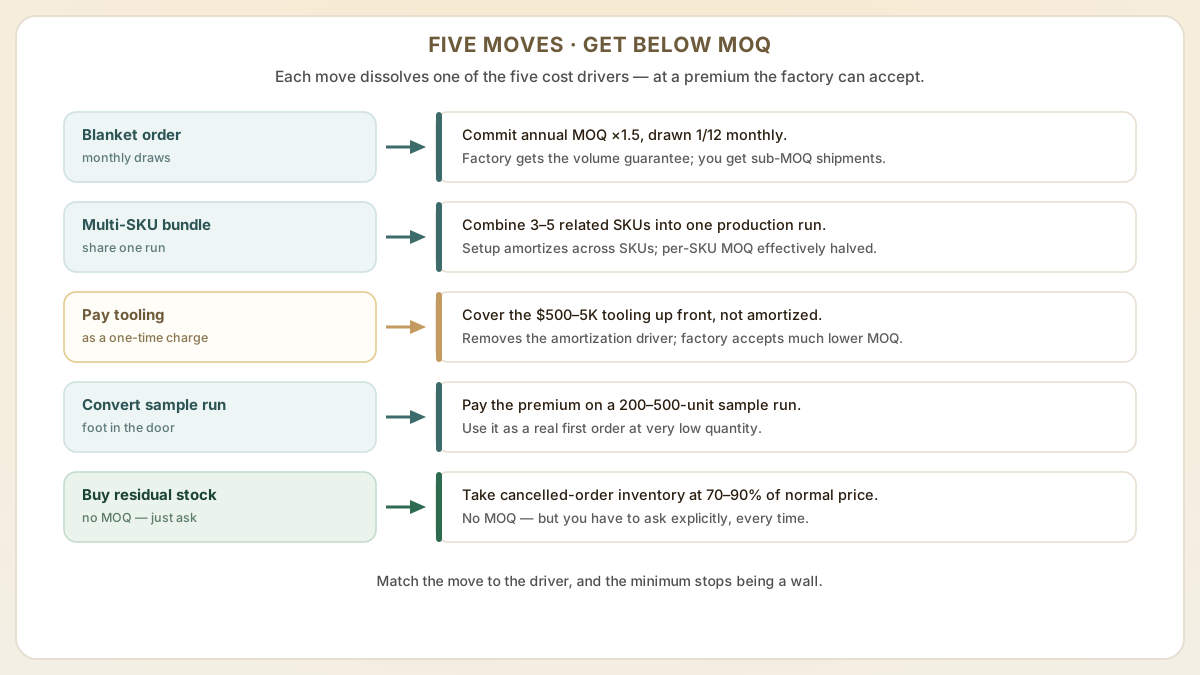
- Blanket order with monthly draws: commit to annual MOQ × 1.5, drawn 1/12 monthly. Factory gets the volume guarantee; you get sub-MOQ shipment quantities.
- Multi-SKU bundling: combine 3-5 related SKUs into one production run. Factory amortizes setup across SKUs; per-SKU MOQ effectively halved.
- Pay tooling separately: cover the $500-5K antenna or encoding tooling as one-time charge. Removes the amortization driver; factory accepts much lower MOQ.
- Convert sample run to first order: factories often run 200-500 sample units. Pay sample-run premium and use as a real first order; gets your foot in the door at very low quantity.
- Buy from factory's existing inventory: factories sometimes hold residual inventory from cancelled orders. Available at 70-90% of normal pricing with no MOQ. Ask explicitly each time.
What MOQ premium is fair for sub-MOQ orders?
Below-MOQ pricing should be a negotiated premium, not a refusal — 'we can't do that' usually means 'we haven't priced it yet.' Knowing the fair premium ranges keeps the conversation about numbers instead of feelings. The ladder below shows what each order size should cost.
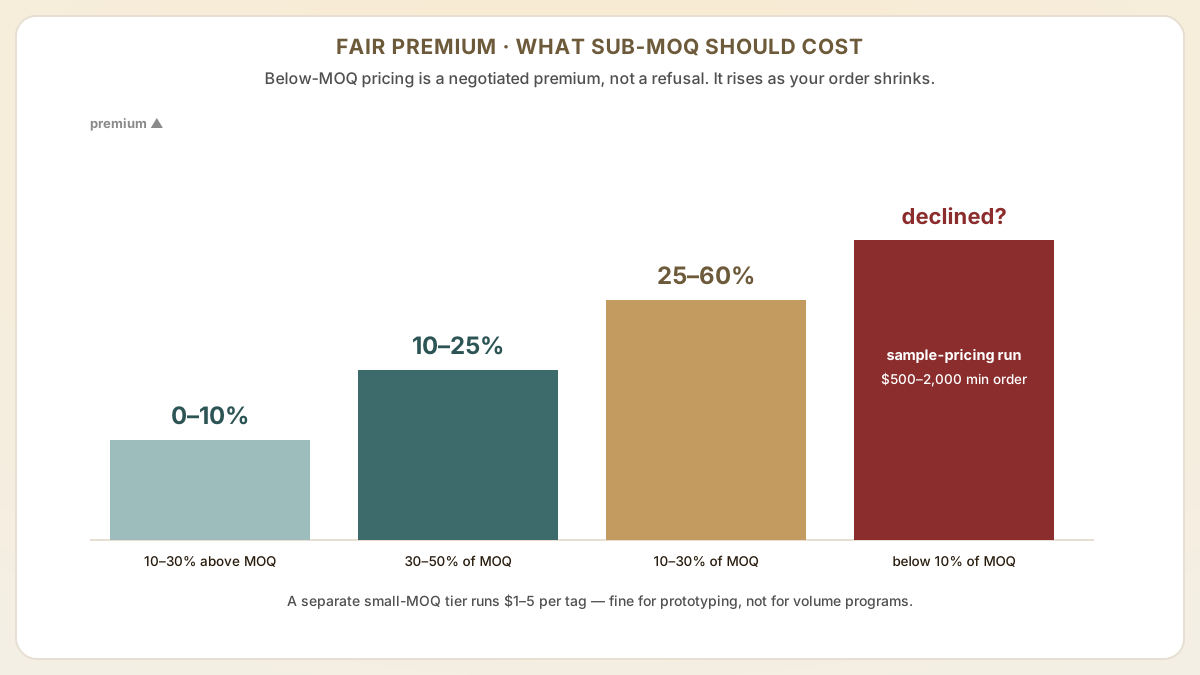
- 10-30% above MOQ: 0-10% premium typical. Factories often accept slight under-volume to maintain customer relationship.
- 30-50% of MOQ: 10-25% premium. Factory absorbs setup and start-up cost; pricing reflects.
- 10-30% of MOQ: 25-60% premium. Significant uneconomic territory; factory may decline or pass through full setup costs.
- Below 10% of MOQ: typically declined or only accepted as sample-pricing run with $500-2,000 minimum order value.
- Per-piece pricing for very-small orders: some distributors stock a 'small-MOQ' pricing tier at $1-5 per tag. Fine for prototyping; not viable for volume programs.
MOQ benchmarks by product class for 2026
Posted MOQ varies enormously by product class because each carries different chip-lot, tooling and run-economics constraints. The five benchmarks below come from current factory-direct quotations across Avery Dennison Smartrac, Identiv, HID, Confidex, Xerafy, Invengo, and 30+ Chinese converters tracked through the past year of distributor RFPs. The chart below plots first-order MOQ for each class.
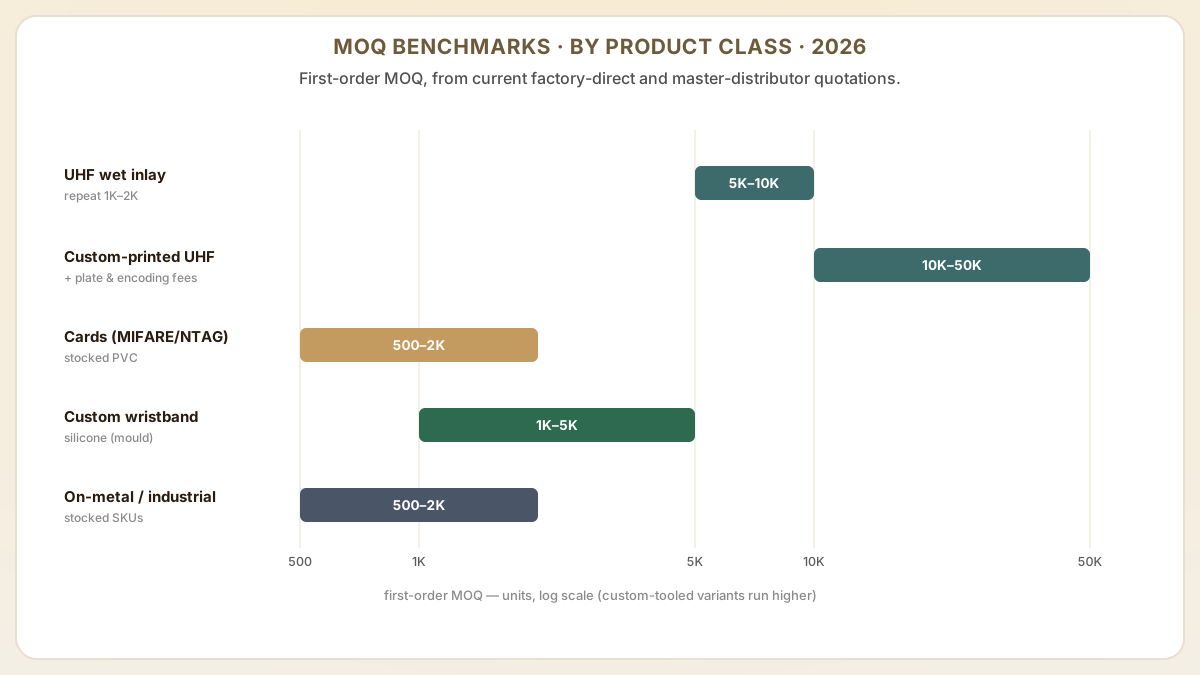
- Standard UHF wet inlay (Avery AD-228m6, Smartrac DogBone, Impinj E51 / E62 antennas) — typical first-order MOQ 5K-10K, repeat MOQ 1K-2K. Some converters go to 1K MOQ on stocked SKUs at 15-25% premium. Tooling and setup are amortised in unit price above 5K.
- Custom-printed UHF label (logo + barcode + variable data) — typical MOQ 10K-50K depending on print complexity. Print plate fee $200-$1,500 (one-time, reusable for repeats) and encoding setup $300-$1,500. Below 10K, distributors typically buy stocked + add an applied label rather than full custom print.
- MIFARE / DESFire / NTAG cards — first-order MOQ 500-2,000 for stocked PVC standard, 5K-10K for custom-printed, 10K-50K for laminated PETG / PC / composite. Card MOQ is lower than tag MOQ because card production is batch (sheet) rather than reel (continuous).
- Custom RFID wristband (silicone, woven fabric, paper Tyvek) — typical first-order MOQ 1K-5K silicone (mould amortisation) or 500-2K for paper / Tyvek (no mould). Mould fee $1.5K-$15K depending on cavity count, amortised over 50K-200K units. Event-RFID specialists hold stock moulds for common designs to drop MOQ.
- On-metal / industrial tag (Confidex Survivor B / Ironside Slim / Steelwave, Xerafy Mercury / Cargo Trak / Container Trak, Omni-ID Power 415 / Exo, HID InLine Tag / IN10000) — typical MOQ 500-2K on stocked SKUs from manufacturer or master distributor. Fully custom-tooled metal tag MOQ 5K-50K with $5K-$30K tooling. Specialist nature keeps MOQ relatively low because units are higher-priced ($1.50-$25 each).
Sample-run programmes and pilot-pricing structures that get you to first deployment
Five sample / pilot structures consistently let distributors evaluate factory quality and run real-world pilots without committing to full MOQ. Knowing the typical economics of each prevents you from leaving leverage on the table. The ladder below runs from free sample to first deployment.
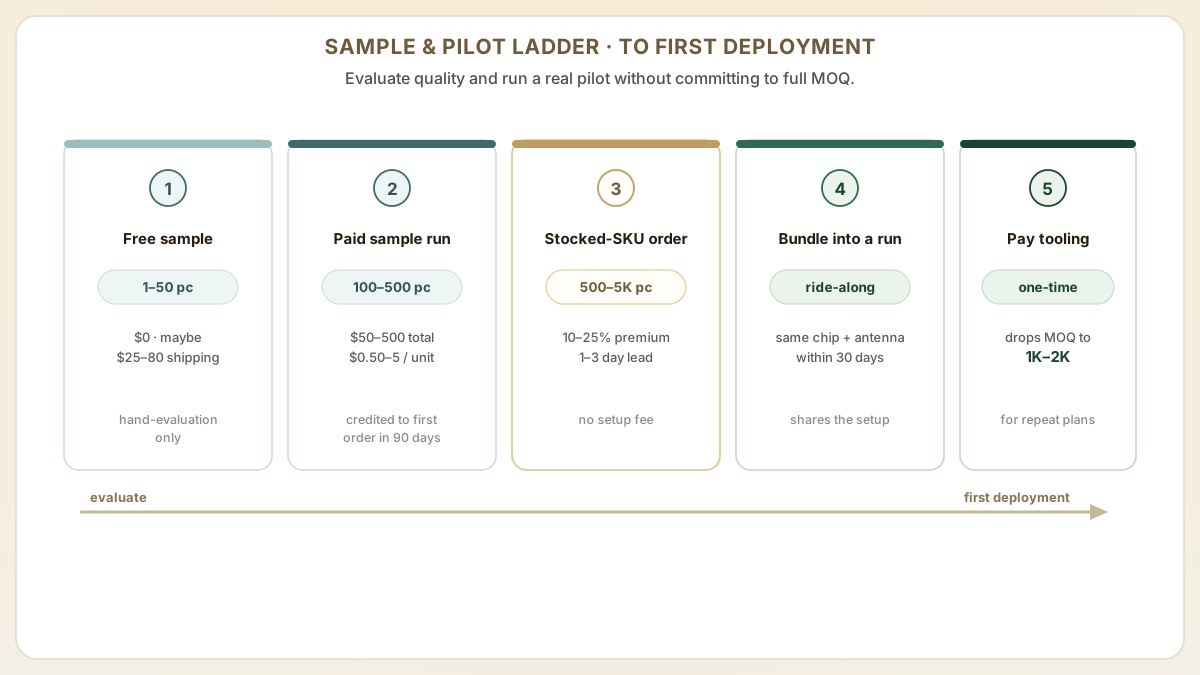
- Free sample (1-50 pieces) — most factories provide free generic samples; some require buyer-paid international shipping ($25-$80 via DHL / FedEx). Useful only for hand-evaluation, not pilot deployment. Always available on stocked SKUs; rarely available on custom designs.
- Paid sample run (100-500 pieces) — $50-$500 total, typically $0.50-$5.00 per unit (5-30x normal volume price). Quote includes shipping. Most factories credit sample-run cost against first production order if it follows within 90 days. Use for pilot deployment and proof-of-concept.
- Stocked-SKU small order (500-5,000 pieces) — factory has finished inventory in standard SKUs (NXP UCODE 9 wet inlay 100x40mm, Impinj M730 75x14mm, MIFARE Classic 1K standard PVC card, etc.). 1-3 day lead time, no setup fee, 10-25% premium versus volume pricing. Most distributors stock these from one or two reliable factories explicitly to serve pilot orders without breaking economics.
- Bundle small custom orders into a larger production run — if factory has another customer running a similar custom (same chip + same antenna) within the next 30 days, ask to ride along. Saves setup cost and slashes MOQ. Requires factory transparency that most are willing to give to repeat customers.
- Pay tooling separately for custom design — the $500-$5K tooling charge is the actual MOQ driver for many custom designs. Pay it as a one-time non-amortised line item and many factories drop MOQ to 1K-2K. Useful when buyer plans repeat orders against the tooling investment over 12-24 months.
Useful next pages
Use these linked product, guide and comparison pages to keep the next click specific and practical.
Low-MOQ RFID label and tag SKUs
Standard RAIN RFID and HF labels with flexible MOQ for pilot and small-batch buyers.
Stocked card and keyfob options
RFID cards and keyfobs available in stocked-blank format below standard MOQ.
Quote a sub-MOQ pilot order
Tell us about your pilot scope — we'll quote the smallest viable run with transparent setup costs.
RFID inlay datasheets and master distributors
Public datasheets for the most common UHF and HF inlay families used in retail-mandate, healthcare, and industrial deployments.
Related reading
More RFID pricing and sourcing guides from the blog.
FAQ
What's a typical RFID tag MOQ for first orders?
5K-10K units for standard SKUs, 50K+ for custom-design orders. Branded white-label programs typically 1K-5K MOQ. Factories with stock-and-customize models support down to 500-unit MOQ for standard-printed variants.
Can I order 100 tags as a sample for evaluation?
Yes — factories run paid sample programs typically $50-500 for 50-200 sample units. Factor sample fee against the first production order if you commit. Useful for prototype validation before committing to real volume.
How does MOQ change for repeat orders?
Repeat orders typically have 30-50% lower MOQ than first orders because tooling and setup are already amortized. Many factories run repeat orders at 1K-2K MOQ for established customers, even if first-order MOQ was 10K.
Should I push for the lowest-possible MOQ or higher volume?
Higher volume captures better unit pricing and locks in supply. Lower MOQ preserves cash and inventory flexibility. Most distributors balance: anchor 50-70% of annual volume to a higher-MOQ blanket; keep 30-50% spot for flexibility.
Why is MOQ for retail-mandate (Walmart / Target / Macy's) RFID tags so much lower in 2026 than five years ago?
Three factors drove MOQ down across RAIN UHF inlay: (1) Avery Dennison Smartrac, SML Group and Checkpoint Systems built dedicated retail-mandate production lines running 24/7 with high yield, lowering per-unit setup amortisation; (2) Impinj M730 / M770 and NXP UCODE 9 chips reached commodity wafer volume with multi-source supply, eliminating chip-allocation MOQ; (3) Walmart and Target compliance audits drove tier-2 / tier-3 supplier demand from 5K-10K piece pilots up through 1M+ rollouts, training factories to support smaller initial orders. Today most ARC-certified retail-mandate inlay can be ordered at 10K-25K MOQ at competitive pricing — a generation ago you needed 100K-250K to be taken seriously.
Should I buy from a converter / aggregator like atlasRFIDstore, RFID4U, GAO RFID, BarcodesInc instead of factory-direct?
For pilot orders below 5K and for stocked-SKU restocks, yes — converters / aggregators add 15-30% margin but provide $50-$500 sample programmes, 1-3 day shipping from US / EU / UK warehouses, technical support in your timezone, and free returns on standard SKUs. For volume above 25K-50K, factory-direct (Shenzhen Xinyetong, Toptag, Jiarfid, ASK / Paragon, etc.) typically wins by 20-40% on landed cost but requires you to own freight, customs, QC and risk. Most distributor programmes split: aggregators for pilot and small-batch, factory-direct for sustained volume. Hybrid approach captures benefits of both.
Sources & references
Primary standards, OEM datasheets and regulatory documents cited by this article. All URLs were verified on the access date shown below.
Proud Tek is a Shenzhen-based RFID & NFC manufacturer supplying hotel chains, transit operators, event venues and retail brands worldwide. Every order includes free samples, RF testing and dedicated project support.
Get a Quick Quote
Tell us about your project and we'll respond within one business day. Fields marked (asterisk) are required.